Episode 68✦1884-present
The Fabian Wolf: How a Delay Strategy and a Stained-Glass Window Remade a Civilisation
June 17, 2026
The Fabian Wolf: How a Delay Strategy and a Stained-Glass Window Remade a Civilisation
In 1910, George Bernard Shaw helped design a stained-glass window. The image showed two robed figures — Shaw and Sidney Webb — hammering the globe on an anvil. The inscription above them, lifted from Edward FitzGerald’s translation of the Rubáiyát of Omar Khayyám: Remould it nearer to the heart’s desire. Below, a second motto: Pray devoutly, hammer stoutly. And on the emblem above the anvil, the Fabian Society’s chosen heraldry: a wolf wearing a sheep’s fleece.
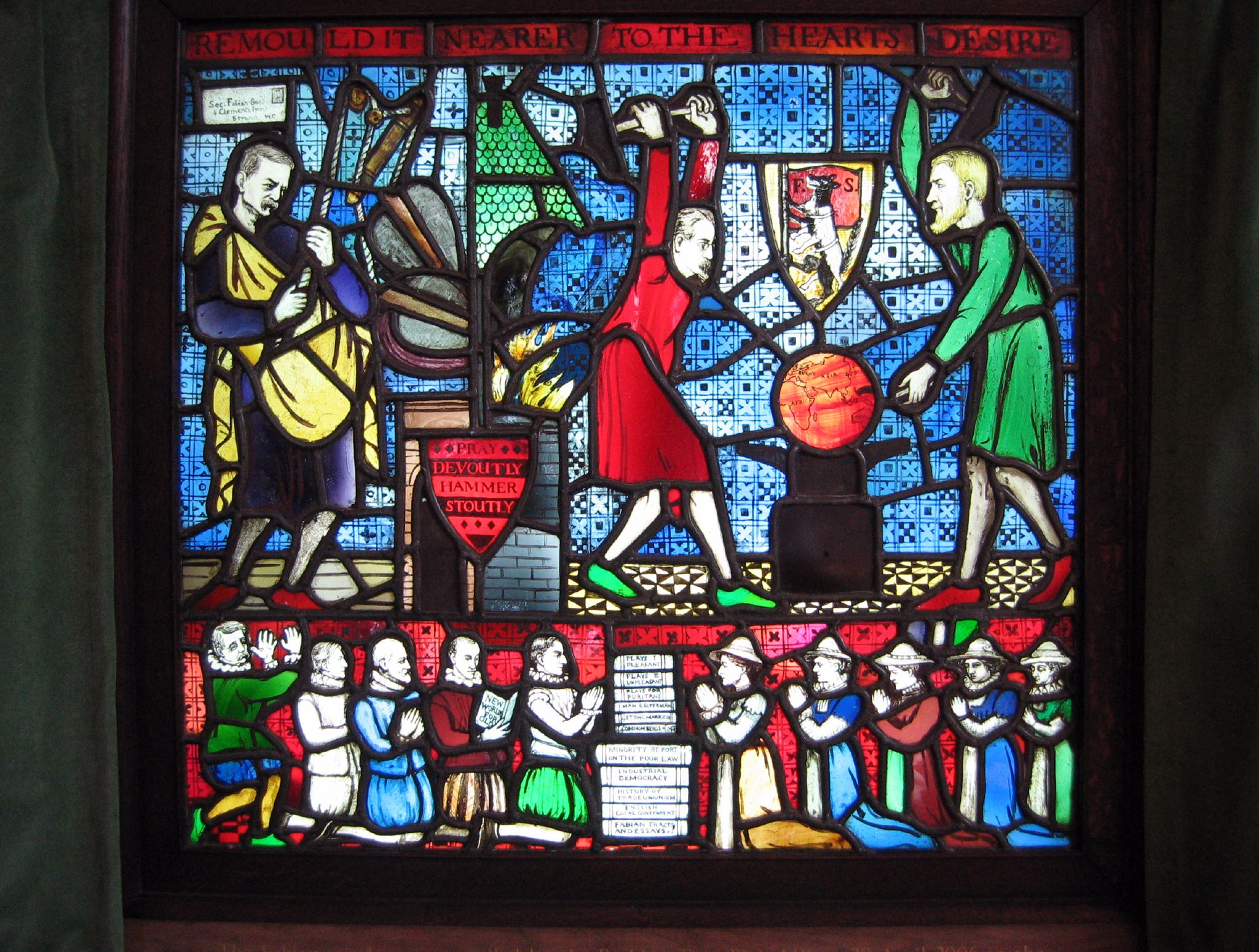
.jpg)
The window was not a private joke. It was a method statement.
The Fabians took their name from Quintus Fabius Maximus Verrucosus, the Roman general called Cunctator — the Delayer. During the Second Punic War he refused pitched battle against Hannibal and won by attrition, harassment, and patient infrastructure denial. The Fabian Society’s founders, drafting their inaugural manifesto in 1884, attached his name to a strategy: not revolution but permeation. The Fabians would not storm the institutions. They would join the institutions. They would write the policy papers. They would train the cadre. They would wait.
The strategy worked at a scale that its authors could not credibly have imagined. The London School of Economics — founded by Sidney and Beatrice Webb in 1895 — became the credentialing factory for the entire administrative class of British government for the next century. The New Statesman — founded by the Webbs and Shaw in 1913 — became the house organ of the British centre-left. The white papers that became the post-war welfare state, the National Health Service, comprehensive education, the BBC’s editorial posture, the institutional language of British government itself — Fabian, top to bottom, for forty years.
A small intelligent minority does not need a coup if it owns the credential, the journal, the curriculum, the appointment, and the policy template. It can simply wait until the institutions notice that everyone with authority inside them shares the same views.
Annie Besant joined the Fabian Society in 1885. She served on its executive committee, organized the 1888 London match-girls’ strike, and in 1907 was elected international president of the Theosophical Society — a position she held until her death in 1933. She did not consider the two organizations to be doing different work. The Fabians would remake society materially through institutional permeation. The Theosophists would remake consciousness spiritually through esoteric initiation. Same minority, two layers, one destination.
The Hidden Fire tradition called this an alliance between the manifest order and the esoteric initiation. The Fabians called it Tuesday.
H.G. Wells wrote it down. In The Open Conspiracy (1928), he proposed — openly, in a published book, available at any decent London bookshop — that a small minority of scientifically literate planners should reshape global society through education, propaganda, and the patient capture of the institutions ordinary citizens still believed they controlled. The conspiracy was open because, Wells reasoned, the public was incapable of acting on the disclosure in time. The book is short. The honesty is total. Nobody read it as confession.
Read that again. The most famous British man of letters of his generation published a book whose first principle was that a small intelligent minority should engineer a global remoulding of civilisation while the public watched and did not stop them, on the grounds that the public could not stop them.
This is now available on throw pillows in approximately zero countries.
The eugenics overlap is where the trolling crosses into something else. Sidney Webb favoured sterilisation policies. Shaw advocated selective breeding from the public stage. Wells, in Anticipations (1901), wrote that the new world order would have to “abolish” some human types to function — his word, abolish. These were not fringe figures muttering in the back of a meeting. These were the Fabian Society’s brain trust, putting it in print, in editions that went through multiple reprints under the most respectable imprints in London.
The 1948 British Nationality Act, drafted by the post-war Attlee government and shepherded by Fabian-formed civil servants, extended British citizenship to every subject of the Commonwealth — approximately 800 million people at a stroke. The decision was made without a referendum. It was made by men whose intellectual formation was Fabian, whose dinner parties were Fabian, whose books sat on the same shelf as the Webbs and Wells.
In October 2009, Andrew Neather — former speechwriter to Tony Blair, Jack Straw, and David Blunkett — wrote a column for the Evening Standard. The headline argued that London needed immigrants. The body of the column included a sentence that has been quoted in every honest history of the period since: that one purpose of the Blair-era immigration surge was “to rub the Right’s nose in diversity and render their arguments out of date.”
He later said he had overstated it. The substance — that the Blair government accelerated immigration partly to alter the political composition of the electorate it was governing — has not been retracted, because the document record supports it.
This is what the Fabian method produces at scale and over time. Not a coup. Not a revolution. A patient, multigenerational programme to remould a country nearer to a heart’s desire that the country was never asked to share.
The Fires Series argument is that trolling is the immune response of free societies to institutional capture — provocation that forces the institutions to reveal their assumptions. The Fabians are the case where the immune response was the capture. They put the joke in stained glass. They put the method in a published book. They put the wolf on the crest.
The British public walked past the window for a hundred years and did not ask what the wolf was for.
The window is still there. The fleece is still on. The hammer is still moving.
Prefer RSS? Subscribe here.