Episode 13✦2006-2016
The Coordinated Operations
June 17, 2026
From Lurk More
The Coordinated Operations
MARBLECAKE ALSO THE GAME.
If you know what that means, you were there. If you do not, here is what happened – and if you read the survey in The Fires of History, Chapter 14, this is the version with the hood up and the engine exposed.
In April 2009, TIME Magazine ran an online poll asking the public to vote on the World’s Most Influential Person. The candidates included Barack Obama, the newly inaugurated President of the United States. Vladimir Putin. Oprah Winfrey. The Dalai Lama. The full roster of people you would expect to find on a TIME Magazine list of global influence.
The winner, by a landslide that was not even close, was a twenty-one-year-old college student named Christopher Poole — known online as “moot” — the founder and administrator of 4chan.org, a website that TIME’s own editors would have struggled to describe in polite company.
But moot winning was not the operation. Moot winning was the cover story. The actual operation was this: the first letters of the top twenty-one names in the final poll results, read downward, spelled out M-A-R-B-L-E-C-A-K-E-A-L-S-O-T-H-E-G-A-M-E. “Marblecake also the game.” Marblecake was the name of the IRC channel where 4chan’s operations against Scientology had been coordinated the previous year. “The game” was a long-running internet meme where the only rule is that you lose the game when you think about the game — meaning that anyone who read the acrostic and understood it had, by the act of understanding, already lost.
Every vote, every ranking, every position from first to twenty-first — precision-engineered by anonymous users on 4chan to embed a hidden message inside the results of a poll run by one of the most established media institutions on the planet. TIME did not notice until it was over.
This was not ballot-stuffing. Ballot-stuffing is crude. This was calligraphy.
The TIME Poll: Precision Engineering Disguised as a Prank
To understand what actually happened, you need to understand the technical reality of what TIME built and what 4chan dismantled.
TIME’s poll worked like this: each candidate was listed on a webpage, and visitors could rate them on a scale. Submitting a vote required nothing more than an HTTP GET request to a URL with the candidate’s ID and a rating as query parameters. No authentication. No session validation. No rate limiting.
Hit that URL: you voted. Hit it again: you voted again. Hit it a thousand times from a script: a thousand votes. TIME had built a voting system with the security architecture of a suggestion box at a middle school — except the suggestion box was on the internet, and the middle school had just invited 4chan.
The initial wave was simple. Someone on /b/ noticed moot was a candidate. Someone else noticed the URL structure. Within hours, autovoters appeared — small programs that would hit the voting URL in a loop, slamming votes for moot at rates that ranged from the hobbyist (a hundred votes per minute from a web-based tool) to the industrial (a Windows application called Mooter, written in Delphi, capable of three hundred votes per minute through rotating proxy lists). One operator submitted ten million votes in two weeks. Moot’s approval rating exceeded 300% because TIME had not even bothered to range-check their input parameters.
# What TIME's engineers thought they were building
class DemocraticPoll:
    def __init__(self):
        self.candidates = load_influential_people()
        self.votes = {}
        self.assumption = "the public will participate in good faith"

    def cast_vote(self, candidate_id, rating):
        # No authentication required
        # No rate limiting
        # No input validation
        # No CAPTCHA
        # What could go wrong?
        self.votes[candidate_id] = self.votes.get(candidate_id, 0) + rating

# What 4chan saw
class UnprotectedEndpoint:
    def __init__(self):
        self.url = "http://www.timepolls.com/contentpolls/Vote.do"
        self.params = {"pollName": "time100_2009", "id": None, "rating": None}
        self.difficulty = "trivial"
        self.entertainment_value = "incalculable"
But getting moot to number one was only phase one. Phase two was the acrostic, and this is where the operation crossed from prank into something more like art.
An operator known as Zombocom wrote two Perl scripts, together under two hundred lines of code. The first script, auto.pl, continuously scanned the poll results, found the highest-ranked person who was not one of the designated twenty-one, and downvoted them. This kept the outsiders out. The second script, the_game.pl, monitored the rating of each of the twenty-one target names and adjusted their scores up or down to maintain the precise ordering required to spell out the message. If the person whose name started with “R” began drifting above the person whose name started with “A,” the script corrected the drift. In real time. Across twenty-one simultaneous variables. Against the backdrop of millions of legitimate and illegitimate votes.
This was a feedback control system. It was a PID controller for trolling. It maintained a twenty-one-character acrostic as a stable equilibrium against the stochastic noise of a live internet poll with millions of participants, and it did this for weeks.
TIME responded, eventually. They added an MD5 hash to the voting URL, requiring a secret salt to validate each vote. The attackers found the salt hardcoded in TIME’s Flash voting widget within hours. They added reCAPTCHA. The attackers built a streamlined voting interface that preloaded multiple CAPTCHAs and let human operators solve them efficiently while the scripts handled the voting math. They tried everything short of shutting the poll down, which they eventually did — but not before the damage was done.
When the results were published, TIME managing editor Rick Stengel acknowledged the hack with the weary diplomacy of a man who has just realized his magazine was outmaneuvered by people whose median age was probably nineteen. Moot was listed as the winner. The acrostic was visible to anyone who looked. MARBLECAKE ALSO THE GAME, embedded in the results of a poll meant to celebrate global influence, published by the magazine that had once named Hitler, Stalin, and Khomeini as Person of the Year.
The media reported it as a prank. It was a distributed systems engineering project conducted by anonymous volunteers with no budget, no organization, and no leadership, executed against a professional media company with dedicated web development staff. The pranksters were better engineers than the professionals. They were operating out of the same reactor described in Chapter 6 — 4chan’s /b/ board, where anonymity, ephemerality, and zero consequences had been producing exactly this kind of coordinated chaos since 2003.
Nobody reported that part.
Habbo Hotel: The Pool Is Closed
The TIME poll hack was elegant. The Habbo Hotel raids were not. They were something else — a demonstration that digital spaces have physical properties, and those properties can be exploited by anyone who understands them.
Habbo Hotel was a social game aimed at teenagers, built around a virtual hotel with rooms, lobbies, a swimming pool, and customizable avatars. Bright, colorful, aggressively wholesome — the kind of online environment where the moderation team worried about profanity in chat and the greatest social threat was supposed to be someone being rude about your virtual furniture.
On July 12, 2006, 4chan arrived.
The plan germinated on /b/ after rumors — disputed, possibly fabricated, ultimately irrelevant — that Habbo’s moderators were banning users based on avatar skin color. Whether this was true did not matter. It provided a pretext, and pretexts are to 4chan operations what stage directions are to theater: they tell you where to stand and when to start.
The raiders created accounts en masse. Every avatar looked the same: a black male character with an enormous afro, wearing a sharp business suit. They flooded into Habbo Hotel by the hundreds, and they deployed a tactic that exploited one of the game’s fundamental design constraints: avatars could not pass through each other. If you stood in a doorway, nobody could get through. If you stood in a hallway, nobody could pass. If you arranged enough avatars in the right configuration, you could blockade any room in the hotel.
They blockaded the pool.
Dozens of identically dressed avatars, arranged in a wall across the pool entrance, refusing to move. When other users asked what was happening, the raiders delivered their message with the deadpan absurdity that defined the operation: “Pool’s closed due to AIDS.”
That was it. The pool was closed. The reason was AIDS. The delivery mechanism was an army of identical black men in business suits who could not be moved because the game engine did not allow avatars to clip through each other. Some raiders arranged themselves into swastika formations — not out of ideological commitment, but because the swastika was the most offensive shape they could think of, and the entire point was to be maximally offensive in the most cheerfully absurd context possible. Transgression as performance art, staged in a virtual hotel designed for thirteen-year-olds.
The moderators panicked. They began banning every black avatar with an afro on sight — which, in a grim irony that was entirely the point, meant the moderators were now actually discriminating based on avatar skin color, thereby confirming the accusation that had started the raid in the first place, even if that accusation had been fabricated. The raiders had created a self-fulfilling prophecy. They had manufactured the exact racism they pretended to protest, using the protest itself as the mechanism of manufacture. The Hidden Fire documented the identical structure in the witch trial era: the Inquisition’s investigation methods produced the confessions that justified the investigations, a closed loop of institutional paranoia manufacturing the heresy it claimed to discover. The Habbo raiders ran the same logic at internet speed, except they did it on purpose and thought it was hilarious. It was a closed loop of trolling, a perpetual motion machine of bad faith, and it was — it has to be said — structurally brilliant.
The hotel was eventually taken offline. The raids continued annually, with July 12 becoming an informal anniversary. By September 2006, the operation had expanded beyond 4chan to include eBaum’s World, YTMND, Something Awful, Gaia Online, Newgrounds, and smaller communities, with an estimated five thousand participants coordinating across platforms without any centralized command structure. “Pool’s closed” entered the internet lexicon as a catchphrase. Sulake, the Finnish company that owned Habbo Hotel, implemented automated detection of the offending avatar configuration — meaning a professional game development company had to write code specifically to identify and ban the combination of dark skin and an afro, which was exactly the kind of outcome that made the whole thing recursive.
The media covered it as harassment, which it was. They covered it as racism, which it was performing but not (for most participants) espousing — a distinction that matters enormously and that almost no coverage navigated. What no one covered it as was a proof of concept: anonymous users with no budget, no leadership, and no prior coordination had identified a structural vulnerability in a digital environment, developed an exploit, deployed it at scale, and forced the target to respond with measures that made the target look worse. That is not a prank. That is an adversarial engagement pattern. That it was also funny does not make it less significant.
Boaty McBoatface and the Naming Problem
In March 2016, Britain’s Natural Environment Research Council committed an error so predictable it should be taught in business schools under the heading “Did Nobody Google This First.”
NERC had commissioned a state-of-the-art polar research vessel — 128 meters, two hundred million pounds, one of the most advanced scientific research platforms ever built. They needed a name. Someone in communications had the idea of letting the public choose. They launched a website called #NameOurShip and invited the internet to submit and vote on suggestions.
The internet submitted “Boaty McBoatface.”
The suggestion came from James Hand, a BBC Radio Jersey presenter, who has spent the subsequent decade insisting he meant it as a lighthearted joke and not as an act of cultural sabotage. Probably true. Does not matter. The name caught fire because “Boaty McBoatface” juxtaposed against “two-hundred-million-pound polar research vessel” contains a comic energy that no focus-grouped name could match. The internet voted for it with the kind of enthusiasm usually reserved for things institutions do not want.
Boaty McBoatface received 124,109 votes — more than four times the second-place finisher and more than ten times the votes for “RRS Sir David Attenborough,” the name eventually chosen by NERC’s science minister, Jo Johnson, who overrode the public vote with the serene confidence of a man whose job title contains the word “minister” and who therefore believes that his judgment supersedes the expressed preferences of 124,109 people.
# The "Never Let the Internet Name Things" pattern recognizer
# Applicable to boats, beverages, babies, and anything else
# an institution is foolish enough to put to a public vote

class InternetNamingDisaster:
    """
    Detects the recurring pattern where an institution opens a public
    naming poll and is surprised when the public treats it as a toy.

    Known instances: Boaty McBoatface (2016), Dub the Dew (2012),
    Pitbull/Walmart (2012), Taylor Swift/Deaf School (2012),
    TIME 100 (2009), every other time anyone has tried this.
    """

    DANGER_SIGNALS = [
        "public vote",
        "naming contest",
        "let the internet decide",
        "what could go wrong",
        "we want to engage our community",
    ]

    PREDICTED_OUTCOMES = [
        "Hitler Did Nothing Wrong",
        "Boaty McBoatface",
        "the internet chose violence",
        "we have taken the site down for maintenance",
        "the contest was compromised",
    ]

    def assess_risk(self, proposal: str) -> str:
        if any(signal in proposal.lower() for signal in self.DANGER_SIGNALS):
            return "ABSOLUTE CERTAINTY OF DISASTER"
        return "NEAR CERTAINTY OF DISASTER"

    def recommend(self) -> str:
        return "Do not let the internet name things."
NERC compromised. The ship became the RRS Sir David Attenborough. The name Boaty McBoatface was given to one of the ship’s remotely operated submarine vehicles — a yellow autonomous underwater vehicle of the Autosub Long Range class, which is the maritime equivalent of naming your child something sensible and then letting the internet name the dog.
The episode established what should have already been obvious: open poll on the internet, uncontrolled inputs, the outputs will reflect the internet’s priorities, not yours. The internet’s priorities, given a blank text field and a voting mechanism, are always the same: maximum comedy, minimum dignity. Not malice. Not coordinated. An emergent property of giving a large number of people a toy and no instructions.
The institutions treated the internet as an audience. The internet treated the polls as a game. The institutions lost every time because they did not understand they were playing.
Dub the Dew: The Mountain That Could Not Be Named
If Boaty McBoatface was the internet being playful, Dub the Dew was the internet being feral.
In August 2012, Mountain Dew launched an online contest to name a new green apple-flavored beverage. The campaign was called “Dub the Dew.” Website. Submit names. Vote on favorites. Mountain Dew — a PepsiCo brand with a marketing budget larger than the GDP of some small nations — apparently did not employ a single person who had heard of 4chan, or who possessed the basic pattern-recognition skills to look at a blank text field on a public website and think “this is going to go badly.”
It went badly.
On August 13, an anonymous user posted on 4chan’s /b/ board calling for others to flood the contest with offensive entries. Within hours, the top-ranked names on DubTheDew.com included “Hitler Did Nothing Wrong,” “Diabeetus,” “Gushing Granny,” “Fapple,” “Soda,” and “Sierra Mist” — the last two being jokes aimed at the utter pointlessness of naming a soda when perfectly good soda names already exist, which is arguably the most devastating critique of all.
But the naming was only the beginning. The attackers also compromised the website itself, adding a banner that read “Mtn Dew salutes the Israeli Mossad for demolishing 3 towers on 9/11” and a pop-up that rickrolled visitors. They had not merely hijacked the poll. They had hijacked the entire campaign, turning Mountain Dew’s marketing website into an outpost of /b/ culture, complete with conspiracy theories, hate speech, and a 1987 Rick Astley video.
Mountain Dew took the site down. Their statement was a masterpiece of corporate euphemism: the campaign “was compromised” and they were “working diligently with our customer’s team to remove all offensive content that was posted.” Translation: we gave the internet a blank text field and it wrote “Hitler Did Nothing Wrong” in it, and we are pretending this was unforeseeable rather than admitting that everyone who has ever worked on the internet could have told us this would happen.
The beverage was eventually named “Mtn Dew Baja Blast” or was quietly shelved — the reporting is unclear and Mountain Dew understandably preferred not to draw further attention. But the Dub the Dew debacle, combined with Boaty McBoatface and the TIME poll, established an iron law of internet interaction:
If you open a public input mechanism on the internet without adversarial input validation, the internet will treat your input mechanism as a vulnerability, and it will be exploited within hours.
Not a social observation. An engineering principle. As reliable as gravity, as predictable as sunrise, and institutions keep learning it the hard way because the people who commission public-facing websites do not talk to the people who secure them.
Pitbull Goes to Kodiak
Not all coordinated operations end in corporate humiliation. Some end with a rapper performing at a Walmart in Kodiak, Alaska, accepting a key to the city, and being genuinely charming about the whole thing.
In the summer of 2012, Walmart ran a promotion: the rapper Pitbull would visit the Walmart store that received the most Facebook likes. A writer for The Boston Phoenix named David Thorpe — a former Something Awful columnist, which tells you everything you need to know about what happened next — suggested on Twitter that it would be funny to send Pitbull to the most remote Walmart in the United States. The hashtag #ExilePitbull was born.
The most remote Walmart in the United States is in Kodiak, Alaska — an island accessible only by plane or boat, with a population of roughly thirteen thousand people, most of whom had not previously considered the possibility that their Walmart might become the destination of a hip-hop pilgrimage.
The Kodiak Walmart’s Facebook page accumulated over seventy thousand likes. The population of Kodiak is thirteen thousand. The math alone was a statement.
Pitbull’s response was, by the standards of internet pranks, extraordinary. He did not back out. He did not complain. He said: “I heard that Kodiak, Alaska, has the most likes due to someone that thinks he was playing a prank… but you’ve got to understand, I will go anywhere in the world for my fans.” Then he went. He flew to Kodiak on July 30, brought David Thorpe with him — the man who had started the campaign — performed for locals, visited Walmart employees, accepted a key to the city from the mayor, and bear-hugged the whole experience with a warmth that the internet had not anticipated and did not quite know how to process.
The operation had been designed to embarrass Pitbull. Instead, it provided Pitbull with the single most endearing public relations moment of his career. He had been sent to the most remote Walmart on earth by people who thought it would be funny, and he went, and he was a good sport, and the internet — which is almost never at a loss — was briefly at a loss. You cannot troll someone who refuses to be trolled. The Pitbull Kodiak operation was the rare case where the target won by accepting the premise.
Taylor Swift and the School for the Deaf
Same summer, different contest, different target, different outcome — one that reveals the range of responses available to a troll target and the different ways those responses can land.
In August 2012, a contest sponsored by Papa John’s and the textbook rental company Chegg offered to send Taylor Swift to perform at the school that received the most Facebook votes. Users on 4chan and Reddit voted en masse to send Swift to the Horace Mann School for the Deaf in Boston.
The joke is obvious and cruel in a way that distinguishes it from Pitbull-to-Kodiak: sending a singer to a school for deaf students is funny only if you do not think about the students. The organizers noticed the vote manipulation. Horace Mann was removed from the competition. Standard playbook — internet does a thing, institution undoes the thing, everyone moves on — running on schedule.
Then Taylor Swift donated fifty thousand dollars to the school.
The donation included a personal contribution from Swift for ten thousand dollars, matched by the sponsors, with additional ten-thousand-dollar contributions from American Greetings, Cover Girl, and VH1’s Save the Music program. The instruments went to students at Horace Mann, who had more use for them than a Taylor Swift concert.
Swift had done something the internet, despite its collective intelligence, had not considered: she accepted the result and redirected it. The vote said “send Taylor Swift to a school for the deaf.” Swift said “okay, I will help that school.” The troll’s energy — designed to embarrass — was absorbed and converted into a charitable donation. Rhetorical aikido. The internet had swung; Swift used the momentum.
Between Pitbull and Swift, the summer of 2012 produced a brief masterclass in troll response strategy. Both refused to be humiliated. Both accepted the premise. Both came out looking better than they went in. The trolls, for once, had created unintentional public relations victories for their targets. The lesson was there for anyone willing to learn it: you do not have to play defense. You can catch the punch and use it.
Most institutions did not learn it. They kept building open polls.
Twitch Plays Pokemon: The Accidental Civilization
On February 12, 2014, an anonymous Australian programmer launched a social experiment that became, depending on your perspective, either the greatest waste of human time in internet history or one of the most profound demonstrations of emergent collective behavior ever conducted. Probably both.
The concept was simple: a Game Boy emulator running Pokemon Red, streamed live on Twitch. Anyone in the chat could type a command — up, down, left, right, a, b, start — which would be executed in the game. Every command from every viewer was processed. No filtering, no hierarchy, no leadership. Fifty thousand people type “up” and fifty thousand people type “down” at the same time, the character vibrates in place like a man having an existential crisis in a doorway.
Over the next sixteen days and seven hours, 1.16 million people participated. Peak simultaneous viewership reached 121,000. The stream accumulated 55 million total views. And despite the input being, by any rational measure, absolute chaos — a hundred thousand conflicting commands per minute from anonymous strangers around the world who could not communicate with each other except through the game itself — they completed the game. They beat Pokemon Red. They defeated the Elite Four. They became the Pokemon champion.
The journey was not smooth. The character walked into walls for hours. Important items were discarded. Key Pokemon were released — permanently deleted by stray commands in the chaos. The party’s strongest Pokemon, Abby the Charmeleon and Jay Leno the Rattata, were released into the wild — “killed,” in the community’s parlance — by accidental menu inputs. The community mourned. Actual grief, expressed by thousands of people, for fictional creatures lost to the stochastic noise of a hundred thousand simultaneous inputs.
// The Leaderless Coordination Protocol
// As demonstrated by Twitch Plays Pokemon, Habbo Hotel raids,
// the TIME poll hack, and every other coordinated operation
// in this chapter

protocol LeaderlessCoordination {
    participants: anonymous[]     // no identity required
    leadership: null              // explicitly none
    communication: emergent       // no dedicated channel

    // The three requirements for coordination without leaders:
    requirements: {
        shared_context:  true,    // everyone can see the same state
        low_cost_action: true,    // individual contribution is trivial
        visible_feedback: true    // results are immediately observable
    }

    // The emergent behaviors nobody planned:
    emergent_properties: {
        mythology:    "Helix Fossil becomes a god",
        governance:   "anarchy vs. democracy mode wars",
        grief:        "mourning fictional creatures lost to chaos",
        art:          "fan comics, songs, lore documents",
        religion:     "unironic worship of a key item",
        achievement:  "completed the game in 16 days"
    }

    // What institutions should learn from this:
    lesson: "coordination does not require organization"
}
Four days into the experiment, the creator added a governance mechanism. Viewers could now vote between two modes: “anarchy” (the original system, where every command was processed) and “democracy” (where commands were tallied every twenty seconds and only the most popular command was executed). This was, in miniature, one of the oldest arguments in political philosophy — order versus freedom, efficiency versus expression — playing out in real time in a Pokemon game streamed to a hundred thousand people.
Anarchy mode was chaotic but authentic. Democracy mode was functional but boring. The community warred over which mode to use with a passion that political scientists found uncomfortably familiar. The anarchy faction argued that the chaos was the point — that the whole experiment was about what emerged from unfiltered collective input, and filtering it defeated the purpose. The democracy faction argued that the game was literally unplayable in certain sections (the infamous ledge near the entrance to the Rock Tunnel, which required precise directional inputs that anarchy mode could not reliably produce) and that democracy was a necessary concession to reality.
They were both right. The tension between them was the experiment.
And then there was the Helix Fossil.
Early in the game, the player character obtained the Helix Fossil — a key item that could later be revived into the Pokemon Omanyte but was otherwise functionally useless. Because the inventory menu was accessed constantly by stray “start” inputs, and because the Helix Fossil could not be discarded, the character was perpetually “consulting” it. The item was selected, examined, and put away thousands of times per hour. It did nothing. It could do nothing. It just sat there, being consulted.
The community decided it was a god.
The Helix Fossil became Lord Helix — a deity, a guiding force, an object of genuine (if ironic) (if possibly not ironic) worship. Fan art appeared. Lore documents were written. A mythology coalesced around the fossil, the Pokemon team, and the events of the playthrough with the speed and complexity of an actual oral tradition. The counterpart item, the Dome Fossil, became the dark god — associated with democracy mode, order, and the suppression of chaos. The Bird Pokemon Pidgeot, the team’s most reliable fighter, was canonized as “Bird Jesus.” The character “AIIIIIIRRR” (named by random inputs) became a tragic hero. An entire theology — complete with saints, martyrs, prophecies, and schisms — emerged from a Pokemon game played by a million people typing random commands into a chat box.
Nobody planned this. Nobody could have. A theology emerged from noise. Meaning constructed from randomness by a collective with no communication channel other than the game itself and a chat window scrolling too fast to read. The Hidden Fire documented the same process in the ancient world: religions emerging from collective ritual practice, not from top-down doctrine – the mystery cults coalescing around shared experience before anyone wrote a creed. The Helix Fossil religion was not organized, not designed, not even, in any conventional sense, intentional. Emergent property: a million people watching the same thing, experiencing the same events, reaching for the same human impulse — to impose narrative on chaos, to find meaning in the meaningless, to worship something when the universe seems random — without any coordination whatsoever.
A million strangers built a religion in two weeks. Most organized religions take longer and have worse attendance.
Twitch Plays Pokemon was not a coordinated operation in the way the TIME poll was. There was no target, no exploit, no objective beyond “beat the game.” But it demonstrated the same underlying principle with greater clarity than any of the pranks: large numbers of anonymous people, given a shared context and a mechanism for action, will produce coordinated behavior without coordination. They will develop governance. They will develop mythology. They will grieve. They will achieve. And they will do all of this without a single leader, a single plan, or a single moment where someone said “here is what we are going to do.”
The Pattern
Pull back far enough and the individual operations blur into a single repeating pattern. Regular as a heartbeat. Ignored as a warning label.
Step one: an institution creates a public-facing mechanism — a poll, a contest, a naming competition, a game. The mechanism accepts input from anyone. The institution assumes the inputs will be sincere.
Step two: the internet notices.
Step three: the inputs are not sincere.
Step four: the institution is surprised. By 2012, the pattern had repeated enough times that surprise was no longer an intellectually defensible response. By 2016, when NERC opened the naming poll for a two-hundred-million-pound research vessel, predicting Boaty McBoatface required less analytical sophistication than predicting sunrise. And yet: surprise. Every time.
Notice what every operation in this chapter shares: verifiable results. The poll numbers were public. The Habbo Hotel was visible. The Twitch stream was live. Coordination without leadership requires evidence everyone can see. When that evidence infrastructure degrades — when the same image means different things to different audiences and no one can agree on what just happened — the coordination model breaks. The meme wars of Chapter 12 are where that fracture starts.
The pattern persists because the people who design these campaigns and the people who understand the internet are, in most organizations, different people who do not talk to each other. Marketing sees “public engagement.” Security sees “unauthenticated input.” Marketing wins the meeting because engagement metrics are a line item and security concerns are a buzzkill. Then 4chan shows up and marketing learns what security already knew: unauthenticated input, at scale, from anonymous sources, will be adversarial. Not might be. Will be. Every time. Without exception. For as long as the internet exists.
The TIME poll. Habbo Hotel. Boaty McBoatface. Dub the Dew. Pitbull to Kodiak. Taylor Swift to a school for the deaf. Twitch Plays Pokemon. The specific mechanisms vary. The target response varies. The comedy value varies. But the underlying dynamic is identical in every case: a distributed group of anonymous individuals, with no formal organization, achieved coordinated action that the target institution was unable to prevent, unable to predict, and frequently unable to understand even after it happened.
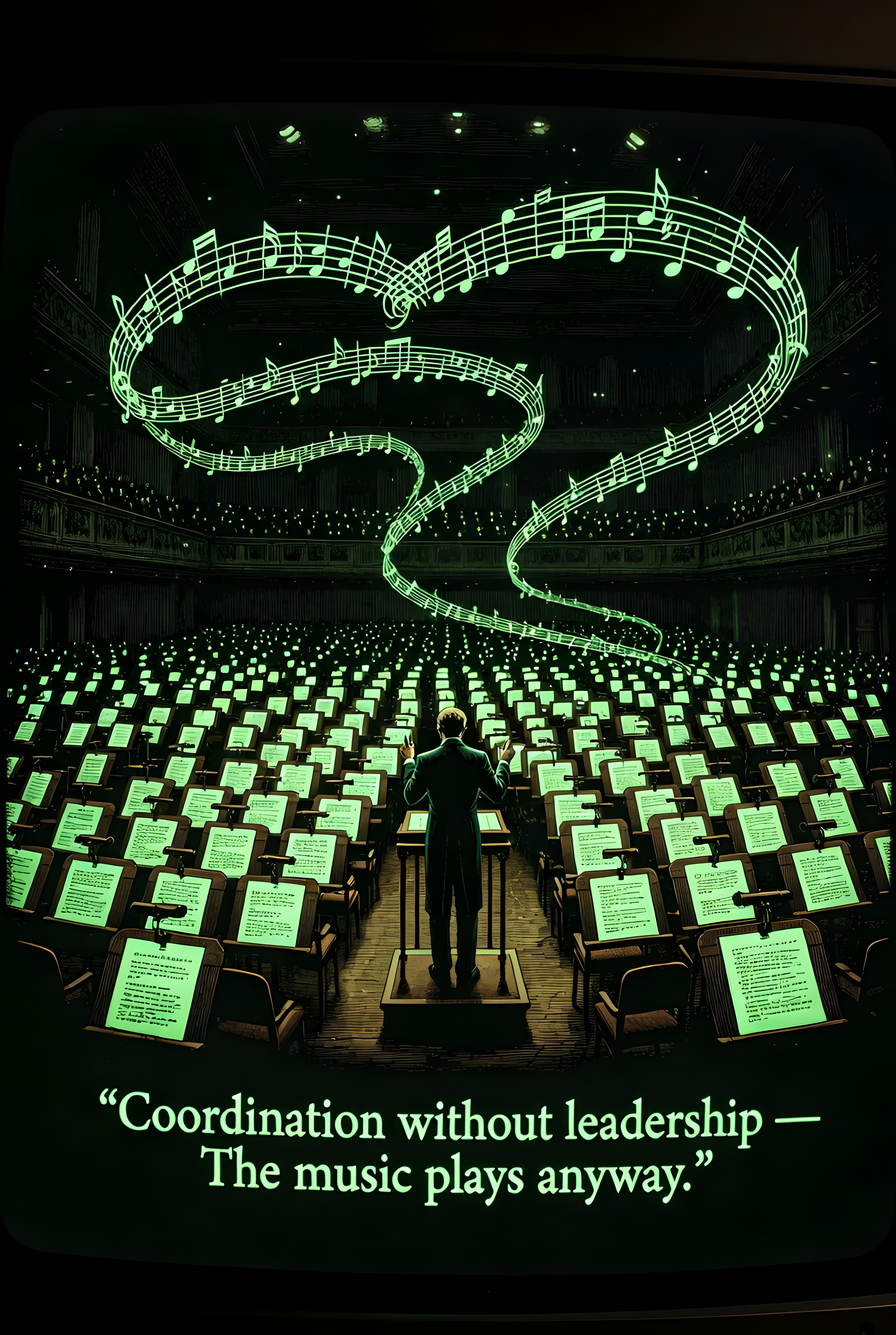
Coordination Without Leadership

Here is the part that matters, and it is not the part that is funny.
Every operation in this chapter was executed without leadership. Not decentralized leadership. Not emergent leadership. Not “temporary autonomous zones” or “consensus-based decision-making” or any of the other euphemisms academics use when they cannot find the org chart. Without leadership. Without hierarchy. Without a plan anyone agreed to in advance. Without a chain of command, a budget, or a formal communication infrastructure. When this principle scales up from naming boats to shutting down institutions — when the coordination mechanism gets pointed at the Church of Scientology instead of a TIME Magazine poll — you get Anonymous. That is Chapter 13’s problem, and it is a bigger problem than anyone expected, because the mechanism that spelled MARBLECAKE ALSO THE GAME turns out to work on targets that hit back.
The TIME poll hack had contributors — Zombocom wrote the Perl scripts, someone else wrote the Mooter application, countless anonymous users ran autovoters — but no leader. Nobody was in charge. Nobody could be, because the participants were anonymous and the “organization” was a 4chan thread that expired within hours. The operation succeeded not because someone coordinated it but because the objective was legible (get moot to number one, spell the acrostic), the mechanism was accessible (run this script), and the feedback was visible (check the poll results). Three conditions — legible objective, accessible mechanism, visible feedback — sufficient for coordination. Leadership not required. Not even particularly helpful.
This should concern institutions, and it has nothing to do with internet polls.
The conventional understanding of collective action — the understanding that underlies every institution, every military, every corporation, every government — assumes that coordination requires organization. Hierarchy. Communication channels. A plan. Someone in charge. This assumption is so deeply embedded in institutional thinking that it is not recognized as an assumption. It is treated as a physical law, like thermodynamics.
The coordinated operations of internet culture disprove this assumption with a regularity that should be academically embarrassing. A million people completed a video game through a chat window. Ten thousand people blockaded a virtual hotel using identical avatars. A hundred anonymous users precision-engineered a twenty-one-position acrostic in a TIME Magazine poll using Perl scripts and rotating proxies. And none of these operations had a leader.
The mechanism is not mysterious. Same mechanism that allows a flock of starlings to produce a murmuration — those shape-shifting clouds of thousands of birds moving in perfect apparent coordination. Each bird follows three rules: match the speed of your neighbors, steer toward their average position, avoid collisions. No bird is in charge. No bird knows the shape of the flock. The shape emerges from the rules. The coordination emerges from the structure.
Internet operations work the same way. Each participant follows simple rules: look at the current state (the poll results, the game screen, the Habbo Hotel map), take a small action (submit a vote, type a command, move an avatar), and observe the result. The coordination emerges from the shared context, not from shared planning. The swarm does not need a leader because the environment itself provides the coordination signal.
This is why institutions keep being surprised. They look for the leader because their mental model requires a leader. When they cannot find one, they conclude that the operation was random, or spontaneous, or “just a prank.” They cannot recognize coordination without organization because their entire worldview is built on the premise that these two things are inseparable.
They are not.
The internet proved they are not, over and over, in contexts ranging from the trivial (naming a boat) to the consequential (organizing protests, overwhelming corporate infrastructure, manipulating elections). The operations in this chapter are the trivial ones. They are the dress rehearsals. They are the proof-of-concept runs where the stakes were low enough that failure was funny and success was funnier.
These operations are funny. A hundred identical black men with afros blockading a virtual pool “due to AIDS.” A two-hundred-million-pound polar research vessel named Boaty McBoatface. Mountain Dew executives reading “Hitler Did Nothing Wrong” on their own website. Pitbull bear-hugging the mayor of Kodiak, Alaska. A million people screaming at a Game Boy through a chat window and accidentally inventing a religion. Very, very funny.
Also demonstrations of something that should terrify institutions: the internet can coordinate action at scale without organization, leadership, or communication infrastructure. Every one of these operations was a proof of concept. The targets were polls and contests and virtual hotels because the participants were mostly in it for the laughs. The mechanism — distributed, anonymous, leaderless, self-correcting, scalable — does not care what it is pointed at. A mechanism that can spell MARBLECAKE ALSO THE GAME in a TIME Magazine poll can do other things. A mechanism that can blockade a virtual hotel can blockade other things. A mechanism that can coordinate a million inputs to beat a video game can coordinate a million inputs toward other ends.
The institutions that laughed at Boaty McBoatface built another open poll the following year. They always do.
Prefer RSS? Subscribe here.