Episode 52✦1885-1897
The Leo Taxil Hoax — The Greatest Anti-Masonic Troll
June 17, 2026
From The Hidden Fire
The Leo Taxil Hoax (1885-1897)
The Fires of History — Episode 52
Taxil fabricated a Satanic-Masonic conspiracy for twelve years, won a papal audience for the lie, then called a press conference to confess he had invented every word. The Pike “Lucifer” quote he made up during the hoax is still being passed around as gospel a century later. The confession did not undo the damage. It never does.
The Man
Gabriel Antoine Jogand-Pagès was born in Marseille in 1854. He was expelled from Jesuit schools as a youth — a biographical detail that should have functioned as a warning label. He became a journalist and a committed anti-clerical polemicist. Under the pen name Léo Taxil, he published a string of anti-clerical books in the early 1880s: attacks on the Bible, on Catholic doctrine, on the Pope. He was excommunicated. He was sued for libel. He was fined. None of it slowed him down.
Then, in 1885, he announced his conversion to Catholicism.
The Conversion
It was pure theater. Taxil publicly repented his anti-clerical past, professed his return to the faith, and was welcomed back with open arms. Pope Leo XIII granted him a private audience. The prodigal son had returned, and the Church was delighted.
What the Church did not grasp — what it would not grasp for twelve years — was that the conversion was the setup. Everything that followed was the punch line.
The Fabrication
With his Catholic credentials freshly minted, Taxil pivoted to a new genre: anti-Masonic exposé. He published prolifically. Les Mystères de la Franc-Maçonnerie. Le Diable au XIXe siècle. Book after book of breathless revelation about Masonic ritual, Masonic conspiracy, Masonic devil worship.
The centerpiece invention was Palladism — a supposed Satanic rite operating within the highest degrees of Freemasonry, led by none other than Albert Pike, the American Masonic leader and Confederate general. According to Taxil, Palladist lodges conducted rituals involving direct communion with Lucifer. Demons materialized at meetings. Satan personally dictated instructions to Pike.
None of it was real. Every word was fabricated. Taxil invented the theology, the rituals, the organizational structure, the membership, and the demons.
Diana Vaughan
The masterpiece was a character. Taxil created Diana Vaughan, a fictional American woman who had supposedly been initiated into Palladism as a child, risen through its ranks, and then — miracle of miracles — converted to Catholicism and turned whistleblower. Under the Vaughan byline, Taxil published Mémoires d’une ex-palladiste, a serialized account of her life inside the Satanic-Masonic conspiracy.
Diana Vaughan became famous. Catholics venerated her as a convert and martyr-figure. Anti-Masonic groups cited her testimony as proof of everything they already believed. Requests for interviews poured in. Taxil deflected them all — Diana, he explained, was in hiding from Masonic assassins.
The Church did not merely tolerate the Vaughan material. It endorsed it. Pope Leo XIII’s 1884 encyclical Humanum Genus had already condemned Freemasonry. Taxil’s “revelations” supplied the evidence the encyclical demanded. Catholic newspapers promoted Vaughan. Bishops cited her. The Anti-Masonic Congress in Trent in 1896 debated her testimony as evidence.
The Pike Quote
Among Taxil’s fabrications, one has proven immortal. He attributed to Albert Pike a passage declaring that Lucifer is the true god of Freemasonry and that Masonic initiates must worship him. The quote does not appear in any of Pike’s actual works, including Morals and Dogma (1871), which conspiracy theorists selectively mine for evidence of Satanism that is not there. Pike never wrote it. Pike never said it.
The quote is still circulated today. It appears in fundamentalist tracts, on conspiracy websites, in social media posts, and in YouTube videos. It has been debunked continuously for over a century. The debunking has accomplished nothing measurable. The fabrication has a constituency. The correction does not.
The Press Conference
On April 19, 1897, Taxil called a press conference at the Geographic Society of Paris. The hall was packed. Catholics, journalists, clergy, and the curious came expecting Diana Vaughan to finally appear in person.
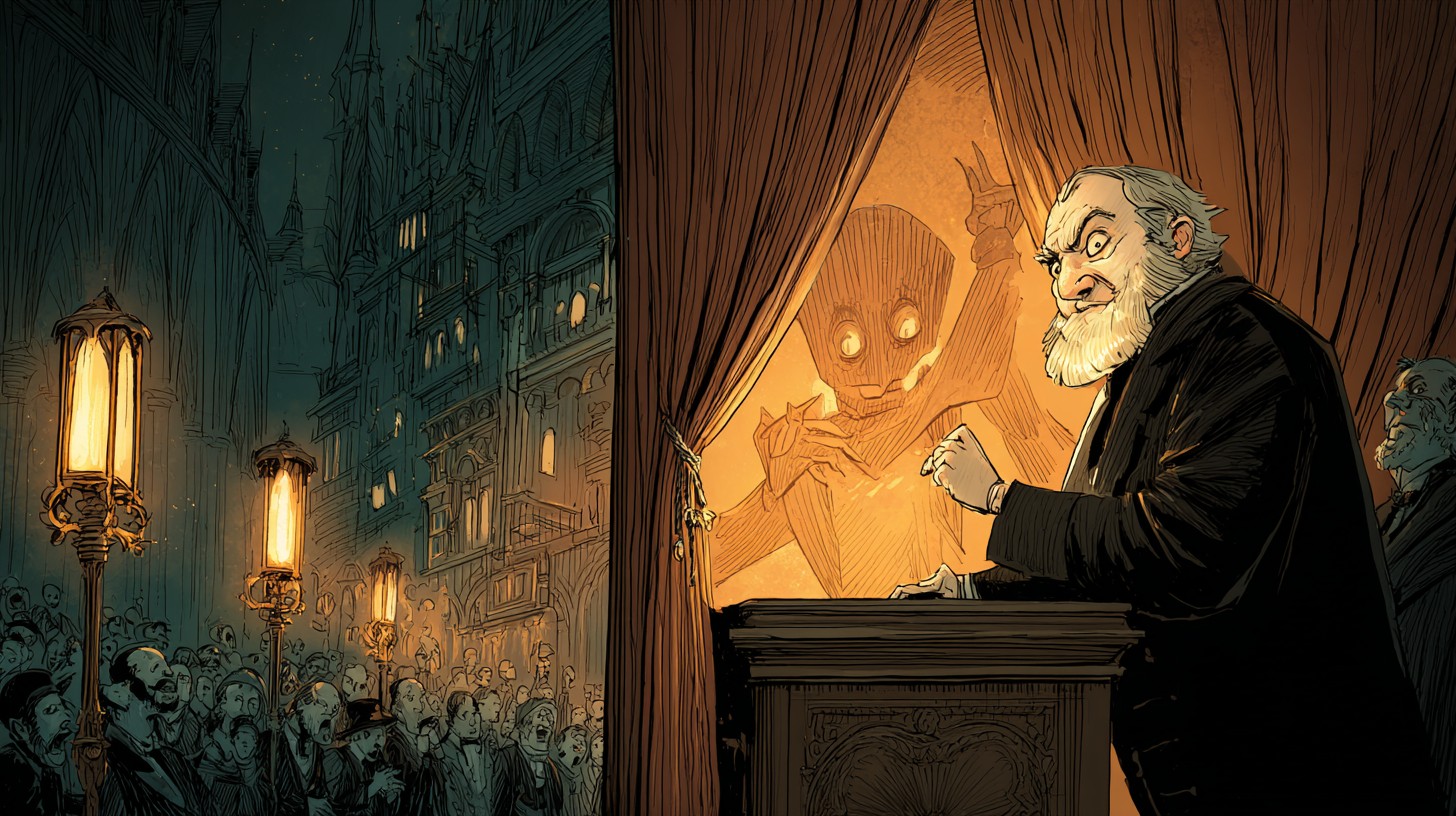
Taxil took the stage. He did not produce Diana Vaughan. He announced, with evident pleasure, that the entire twelve-year campaign had been a hoax. Vaughan had never existed. Palladism was fiction. The Satanic rituals were invented. The demonic manifestations were literary devices. Every book, every serialized chapter, every shocking revelation — all of it fabricated.
He had done it, he explained, to demonstrate the bottomless credulity of the Catholic Church.
The audience erupted. Catholics in the hall were furious. Some rushed the stage. Some reporters applauded. The event descended into chaos. Taxil left under police escort, reportedly laughing.
The Aftermath
Taxil lived another decade, dying in 1907 at fifty-three. His confession changed nothing structural. The Catholic Church did not reassess its anti-Masonic stance. Anti-Masonic conspiracy culture did not collapse. The fabrications Taxil had introduced into the information environment — Palladism, Diana Vaughan, the Pike “Lucifer” quote — continued to circulate as though the press conference had never happened.
The Key Figures
Léo Taxil (1854–1907). Born Gabriel Antoine Jogand-Pagès in Marseille. Expelled from Jesuit school. Anti-clerical polemicist in his twenties. Excommunicated. Sued for libel. Then: fake conversion, twelve years of fabricated anti-Masonic exposé, a papal audience, a press conference confession, and a police escort out the back. His fabrications are 128 years old and counting.
Pope Leo XIII (1810–1903). Issued Humanum Genus in 1884 condemning Freemasonry before Taxil even began his hoax. Granted Taxil a private audience after the conversion. The encyclical created the demand. Taxil supplied the product. When the product was exposed as counterfeit, the demand remained.
Albert Pike (1809–1891). American Masonic leader, Confederate general, author of Morals and Dogma. Never wrote the Lucifer quote attributed to him. Has been dead since 1891. Is still being quoted saying things he never said, by people who have never read his actual work, in service of a conspiracy theory invented by a man who confessed to fabricating it. Pike is the most successful posthumous victim of attribution fraud in modern history.
Diana Vaughan (fictional). Never existed. Was venerated by Catholics, cited by bishops, debated at an international congress, and remains more famous than most real people of her era. The fictional whistleblower told people exactly what they wanted to hear. The Church did not verify her existence because her story confirmed the encyclical. Confirmation bias does not require a real person. It requires a plausible one.
Why This Matters
This is the purest case in the Fires series of a troll who demonstrates the thesis by destroying his own work and watching nothing change. Taxil fabricated a conspiracy, confessed to fabricating it, and the conspiracy survived the confession. The twelve-year hoax produced beliefs that have now persisted for over 125 years.
The mechanism: the hoax satisfied a pre-existing demand. The Catholic Church wanted evidence that Freemasonry was diabolical. Anti-Masonic movements wanted confirmation of their suspicions. Taxil supplied the product. When the manufacturer announced the product was counterfeit, the customers kept buying.
The parallel to the Protocols of the Elders of Zion is exact. The Protocols were exposed as a plagiarized fabrication within years of their publication. The exposure accomplished nothing. The document continued to circulate, to be cited, to be believed, to be used as justification for violence. Taxil’s Pike quote operates on the same principle at a smaller scale: the debunking becomes background noise, the fabrication becomes permanent infrastructure.
Taxil’s stated motivation was to prove Catholic credulity. The twelve-year hoax was the experiment. The press conference was the publication of results. The results: they believed everything, and the confession changed nothing. The troll did not merely mock the institution. He ran a controlled demonstration of its epistemological failure, then presented the findings to an audience that was itself part of the experiment.
QAnon is a direct modern descendant. When the prophesied events failed to materialize, when specific predictions were falsified, when the underlying narrative was repeatedly debunked, the movement did not dissolve. It adapted. The belief survived its own refutation, just as Taxil’s fabrications survived his confession. The conspiracy theory does not require evidence. It requires demand.
Source URLs
| Source | URL |
|---|---|
| Wikipedia — Léo Taxil | https://en.wikipedia.org/wiki/L%C3%A9o_Taxil |
| Wikipedia — Taxil hoax | https://en.wikipedia.org/wiki/Taxil_hoax |
| Wikipedia — Albert Pike | https://en.wikipedia.org/wiki/Albert_Pike |
| Wikipedia — Diana Vaughan | https://en.wikipedia.org/wiki/Diana_Vaughan |
| Wikipedia — Palladism | https://en.wikipedia.org/wiki/Palladism |
| Pope Leo XIII, Humanum Genus (1884) | https://www.vatican.va/content/leo-xiii/en/encyclicals/documents/hf_l-xiii_enc_18840420_humanum-genus.html |
| Pike, Albert. Morals and Dogma (1871) | https://www.gutenberg.org/ebooks/search/?query=morals+and+dogma |
| Wikipedia — Protocols of the Elders of Zion | https://en.wikipedia.org/wiki/The_Protocols_of_the_Elders_of_Zion |
| Weber, Eugen. Satan franc-maçon (1964) | https://www.worldcat.org/title/satan-franc-macon |
| Grand Lodge of British Columbia — Taxil debunking | https://freemasonry.bcy.ca/anti-masonry/taxil.html |
Prefer RSS? Subscribe here.