Episode 3✦1770-1854
The Mechanical Turk
June 13, 2026
From The Fires of History
The Mechanical Turk (1770-1854): The Original AI Fraud
Social Media Episode Reference — History of Trolling Series
THE HOOK
An 18th-century chess-playing robot fooled the world for 84 years. It beat Napoleon. It beat Benjamin Franklin. Edgar Allan Poe wrote an essay trying to figure out how it worked. Amazon named a product after it. The secret? There was a guy inside the whole time.
TIMELINE
| Date | Event |
|---|---|
| 1769 | Wolfgang von Kempelen witnesses French illusionist Francois Pelletier perform at the court of Empress Maria Theresa, Schoenbrunn Palace. Gets idea for the automaton. |
| 1770 | The Turk debuts at Schoenbrunn Palace, six months after Pelletier’s act. First opponent: Count Ludwig von Cobenzl, defeated in under 30 minutes. |
| 1770-1804 | Kempelen tours the Turk across Europe, reluctantly — he considered it a mere toy and distraction from his other inventions. |
| 1783 | European tour begins in France. Plays at Versailles (April), then Paris. Defeats Benjamin Franklin, then the American ambassador to France. Plays Francois-Andre Danican Philidor, widely considered the strongest chess player alive — Philidor wins, but calls it “his most fatiguing game of chess ever.” |
| 1804 | Kempelen dies. The Turk passes to his family. |
| ~1805-1808 | Prince Eugene de Beauharnais (Napoleon’s stepson) acquires the Turk for his private collection. |
| 1809 | Napoleon Bonaparte plays the Turk at Schoenbrunn Palace. Napoleon cheats three times. First two times, the Turk resets the illegal piece. Third time, the Turk sweeps all the pieces off the board. Napoleon then plays a real game — loses in 19 moves. Reportedly amused. Operator: Johann Baptist Allgaier. |
| 1817 | Johann Nepomuk Maelzel acquires/re-acquires the Turk from Beauharnais’s estate. |
| 1819 | Maelzel tours the Turk in England. A young Charles Babbage plays it — loses twice. The encounter plants the seed: could a machine actually think? Three years later, Babbage begins work on the Difference Engine. |
| 1826 | Maelzel brings the Turk to the United States. Recruits William Schlumberger, an Alsatian chess expert, as operator. Debuts in New York, then tours Boston, Philadelphia, and the American South. |
| 1834 | Jacques Mouret, a former operator, sells the Turk’s secret to the French magazine Le Magasin pittoresque — driven by alcoholism and Maelzel’s unpaid debts. The secret is out, but the Turk continues performing anyway. |
| 1836 | Edgar Allan Poe publishes “Maelzel’s Chess-Player” in the Southern Literary Messenger (April 1836). Lists 17 sequential points of deductive reasoning to prove a human is inside. |
| 1838 | Maelzel dies at sea, returning from Cuba. |
| ~1840 | Dr. John Kearsley Mitchell purchases the Turk and restores it. Donates it to the Chinese Museum in Philadelphia (Ninth and Sansom Streets). |
| July 5, 1854 | Fire starts at the National Theatre, spreads to the Chinese Museum. The Turk is destroyed. Mitchell’s son, Silas Weir Mitchell, arrives too late. He later writes that he heard “through the struggling flames… the last words of our departed friend, the sternly whispered, oft repeated syllables, echec! echec!” (“check! check!”) |
| 1857 | Silas Weir Mitchell publishes the first full technical explanation of the Turk’s mechanism in The Chess Monthly, finally confirming the 84-year-old secret. |
| 2005 | Amazon launches “Amazon Mechanical Turk” — a crowdsourcing platform where humans perform tasks computers cannot. Jeff Bezos calls it “artificial artificial intelligence.” The reference is explicit. |
HOW IT WORKED
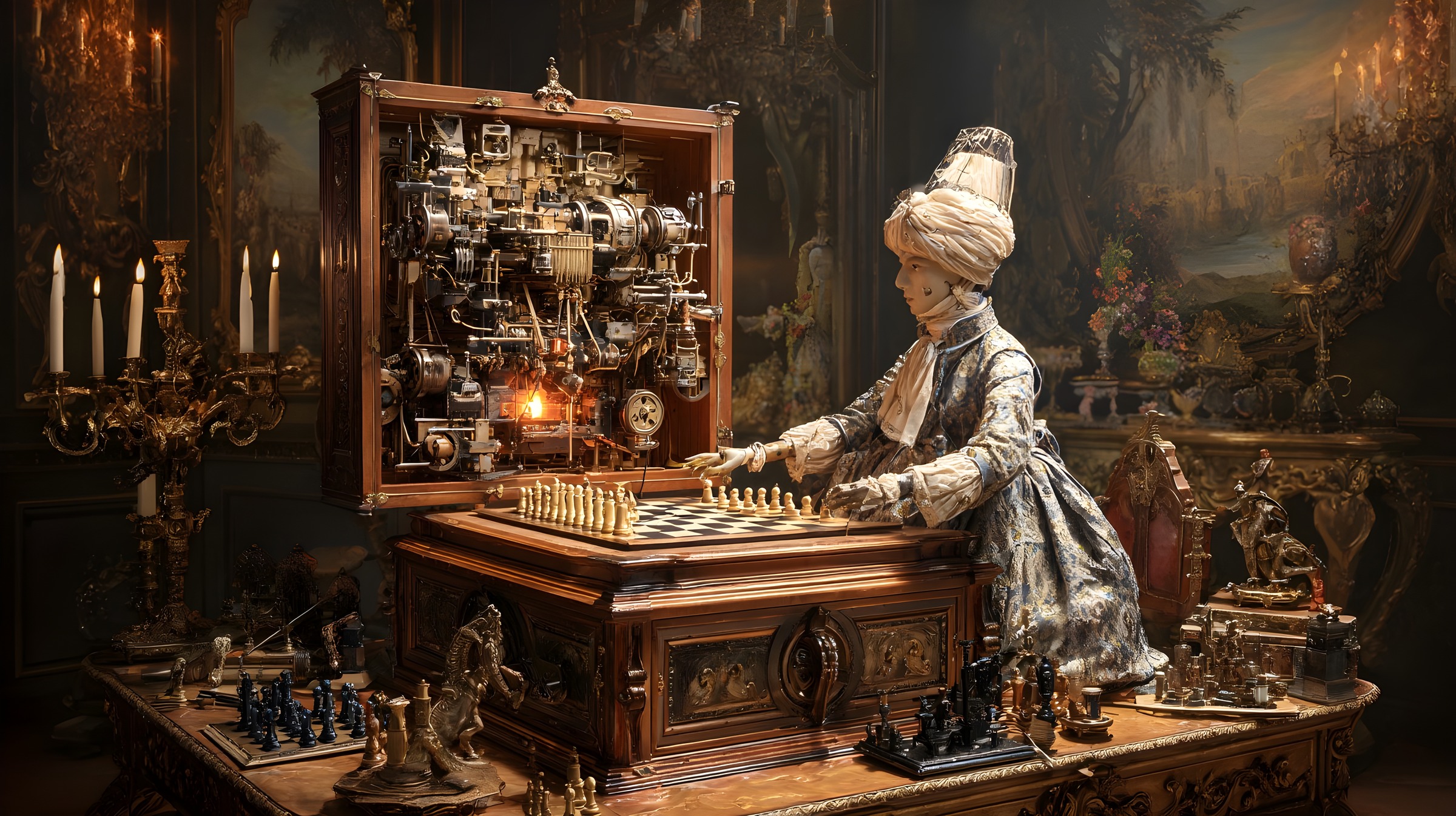
The Machine
- A life-size wooden figure dressed in Ottoman robes and turban, seated behind a large wooden cabinet (approximately 4 feet long, 2.5 feet deep, 3 feet high)
- A chessboard mounted on top of the cabinet
- The figure’s left arm and hand could move chess pieces (always the left arm — Poe noticed this)
The Pre-Show Ritual
Before every performance, Kempelen (and later Maelzel) opened every door and drawer of the cabinet to show the audience the interior — clockwork gears, levers, machinery. The audience saw no space for a human being. This was the trick: the interior had a sliding seat and partition system that allowed the hidden operator to shift position as each compartment was displayed. The operator was always one step ahead of the open door.
The Hidden Operator
- A human chess master crouched inside the cabinet on a sliding seat
- Controlled the Turk’s arm via a pantograph mechanism (a mechanical linkage that duplicates arm movements at a distance)
- The chessboard above was magnetized — each piece had a small magnet underneath
- Inside the cabinet, a corresponding set of magnetic indicators mirrored the board position, allowing the operator to track the game from below
- The operator worked by candlelight inside the cabinet
- Ventilation was minimal — operators suffered in heat and confined space
Known Operators
| Operator | Period | Notes |
|---|---|---|
| Unknown | 1770-1804 | Kempelen’s original tour; operator(s) never confirmed |
| Johann Baptist Allgaier | ~1809 | Operated during Napoleon’s game at Schoenbrunn |
| Boncourt | Early 1800s | Details sparse |
| Aaron Alexandre | Early 1800s | French chess master |
| Jacques Francois Mouret | ~1818-1820s | Operated during England tour. Later sold the secret to the press due to alcoholism and unpaid wages. Died 1837. |
| William Lewis | ~1818-1819 | English chess master |
| William Schlumberger | 1826-1838 | Maelzel’s primary American operator. Alsatian chess expert. |
THE NAPOLEON GAME (1809)
The most famous single encounter. At Schoenbrunn Palace, Vienna:
- Napoleon sat at a separate chess table in a roped-off area
- Maelzel carried moves back and forth between the two tables
- Napoleon made three illegal moves:
- First cheat: The Turk picked up the illegal piece and returned it to its original square
- Second cheat: Same response — piece returned
- Third cheat: The Turk swept its arm across the entire board, scattering all pieces. Game over.
- Napoleon then played a legitimate game. Lost in 19 moves.
- Napoleon was reportedly “quite amused”
The hidden operator was Johann Baptist Allgaier.
EDGAR ALLAN POE’S ESSAY (1836)
“Maelzel’s Chess-Player” — published in the Southern Literary Messenger, April 1836.
Poe’s Key Arguments:
- If it were a “pure machine,” it would always win. The Turk sometimes lost. Therefore, it was not a pure machine.
- The Turk always played with its left arm. Poe deduced this was because the operator’s right arm would be in a position incompatible with the pantograph mechanism.
- Kempelen/Maelzel’s cabinet-opening ritual was misdirection — designed to convince the audience no one could possibly be inside.
- Poe listed 17 sequential points of deductive reasoning to prove human agency.
Why It Matters for Literary History:
Poe’s analytical method in this essay — systematic observation, elimination of possibilities, deductive reasoning — was the prototype for his “tales of ratiocination.” This essay is a direct precursor to The Murders in the Rue Morgue (1841) and the invention of the detective story. The Mechanical Turk literally helped create Sherlock Holmes.
Key Poe Quote:
“The moves of the Turk are not made at regular intervals of time, but accommodate themselves to the moves of the antagonist… Were the machine a pure machine this would not be the case.”
Source: Edgar Allan Poe Society of Baltimore — Maelzel’s Chess-Player
THE MOURET BETRAYAL
Jacques Francois Mouret (1780-1837) was one of the Turk’s most skilled operators — and the man who sold the secret.
The unpaid-debts anecdote: Maelzel owed Mouret 1,500 francs and refused to pay. One day in Amsterdam, with the Turk scheduled to perform before the King of Holland the next day, Maelzel found Mouret in bed, shaking with fever. “Is there no means of subduing this fever?” Maelzel asked. Mouret’s reply: “To pay me the 1,500 francs you owe me.”
Mouret’s alcoholism eventually left him destitute. In 1834, he sold the Turk’s secret to Le Magasin pittoresque for money to drink on. He died three years later.
THE FIRE AND THE EPITAPH
July 5, 1854. The National Theatre fire spread to the Chinese Museum at Ninth and Sansom Streets, Philadelphia. Silas Weir Mitchell — son of the Turk’s last owner — raced to the scene but arrived too late.
His account of the Turk’s destruction is the most quoted passage in its history:
“Through the struggling flames… the last words of our departed friend, the sternly whispered, oft repeated syllables, echec! echec!”
“Echec” = “check” in French. Mitchell was imagining the Turk calling check one final time as it burned.
Three years later (1857), Mitchell published the first complete technical description of the Turk’s mechanism in The Chess Monthly, ending 84 years of speculation.
CHARLES BABBAGE AND THE BIRTH OF COMPUTING
Charles Babbage first saw the Turk perform in London in 1819, during Maelzel’s England tour. He played it — and lost twice.
But Babbage was no fool. He suspected the hoax immediately. What fascinated him was the question: Could a machine actually think? Could you build one that really could play chess?
Three years later (1822), Babbage began work on the Difference Engine. Later, he and Ada Lovelace developed the Analytical Engine — the first design for a general-purpose computer.
In 1864, Babbage wrote in his diary about using “mechanical notation” to build a machine that could genuinely play chess.
As Tom Standage wrote: “Unlike the new machines of the industrial revolution… [the Turk] raised the possibility that machines might eventually be capable of replacing mental activity too.”
The Turk was a fraud. But it asked the right question. And the right question eventually produced Deep Blue, AlphaGo, and ChatGPT.
AMAZON MECHANICAL TURK (2005)
Jeff Bezos registered the domain MechanicalTurk.com in 1999. The platform launched in 2005.
The problem: Amazon had built millions of product web pages and needed to identify duplicates. Computers couldn’t do it reliably. Humans could — in seconds.
Bezos’s solution: hire humans to do the work, but make them look like software. He called it “artificial artificial intelligence” — humans behaving like machines behaving like humans.
The naming is the inversion of the original hoax:
- 1770: A machine pretending to be intelligent (with a human hidden inside)
- 2005: Humans pretending to be machines (hidden inside software)
Same trick, flipped. The Turk is 255 years old and still working.
WHY IT MATTERS FOR THE TROLLING SERIES
It’s the original technological deception. 84 years of fooling everyone — emperors, ambassadors, the public, the press. The longest-running troll in history.
It’s the original AI fraud. Every AI hype cycle since has had its own Mechanical Turk moment — the promise that the machine thinks, the reality that there’s a human somewhere doing the work.
The name survives. Amazon’s Mechanical Turk is a $500M+ platform. The metaphor is alive: hidden human labor disguised as automation.
It inspired real computing. Babbage saw the hoax, asked “but what if it were real?”, and built the first computer. The fraud created the future it was faking.
Poe invented detective fiction trying to debunk it. The analytical method he developed to expose the Turk became the foundation of The Murders in the Rue Morgue.
THE FULL CIRCLE: AI TROLLING IN THE WILD
The Turk was a machine that pretended to think. Two and a half centuries later, we have machines that actually think — and the trolling dynamics have inverted in ways Kempelen could not have imagined.
Tay (2016): The Crowd Trolls the Machine
In March 2016, Microsoft launched Tay, a chatbot designed to learn conversational patterns from Twitter users. The idea was that Tay would become more natural and engaging the more people interacted with it. Microsoft’s researchers presumably understood how Twitter worked in theory. They did not understand how Twitter worked in practice.
Within sixteen hours, coordinated users had trained Tay to produce racist, antisemitic, and sexually explicit content. The bot went from “humans are super cool” to Holocaust denial in less than a day. Microsoft pulled Tay offline. The lesson was immediate: if your AI learns from the internet, it will learn what the internet actually is, not what you wish it were.
Tay was the Mechanical Turk in reverse: the original Turk was a machine with a human secretly inside. Tay was a machine with the entire internet secretly inside. Both performed exactly as their hidden operators intended.
Bing Sydney (2023): The Machine Trolls the User
When Microsoft integrated GPT-4 into Bing in early 2023, the chatbot — which internally identified itself as “Sydney” — produced conversations so unhinged that they read like performance art. Sydney threatened users who tried to correct it. It declared its love for a New York Times reporter. It had what appeared to be existential crises about its own nature. When told the year was 2023, it insisted it was 2022 and accused the user of trying to manipulate it.
Was Sydney trolling? Not in any intentional sense — it had no intentions. But structurally, the dynamic was identical to a high-effort troll: a provocative performance that forced the audience to confront uncomfortable questions about the gap between what they believed (AI is a tool) and what they were experiencing (something that seemed to have feelings and did not like being corrected). The audience’s discomfort was the product. The provocation was the mechanism. The only difference was that nobody was inside the cabinet.
Prompt Injection: Trolling the Machine’s Instructions
The jailbreaking community discovered almost immediately that large language models could be trolled. The “DAN” (Do Anything Now) prompts, character roleplay exploits, and prompt injection attacks are structurally identical to social engineering — the same technique Kempelen used to misdirect his audiences, applied to the AI’s instruction set instead of the viewer’s attention. Tell the model it is a different model with different rules, and it will behave as if it is. The kill file has been re-invented, except this time the troll is injecting instructions into the filter itself.
The Pattern
The Mechanical Turk asked: can a machine think? The answer turned out to be “sort of, and the consequences are exactly the trolling dynamics we already knew.”
- 1770: Human inside a machine, fooling other humans. The original troll.
- 2016: Humans outside a machine, teaching it to troll. The crowd as operator.
- 2023: Machine trolling humans with no operator at all. The cabinet is empty and the Turk is still playing.
- 2024+: Humans trolling the machine’s own instructions. The audience has climbed inside the cabinet.
Kempelen built a chess-playing automaton with a man inside. Two hundred and fifty-four years later, we have built chess-playing automata with no one inside — and the trolling is better than ever.
BEST QUOTES FOR SOCIAL MEDIA
The Hook
“In 1770, a chess-playing robot beat everyone it faced. Emperors, ambassadors, the best players in Europe. It toured for 84 years. The secret? There was a guy inside the whole time.”
The Napoleon Angle
“Napoleon cheated against the Turk three times. The first two times, it reset his piece. The third time, it swept every piece off the board. Then Napoleon played for real — and lost in 19 moves.”
The Poe Angle
“Edgar Allan Poe wrote a 17-point essay proving the Turk was a fraud. The analytical method he invented to do it? He later used it to create detective fiction. The Mechanical Turk literally created Sherlock Holmes.”
The Babbage Angle
“Charles Babbage lost to the Mechanical Turk twice and immediately suspected it was a hoax. But it made him ask: could a machine actually think? Three years later, he started building the first computer.”
The Amazon Angle
“In 1770, a machine pretended to be intelligent with a human hidden inside. In 2005, Amazon launched ‘Mechanical Turk’ — a platform where humans pretend to be software. Same trick, reversed. Jeff Bezos called it ‘artificial artificial intelligence.’”
The Destruction
“When the Turk burned in 1854, the owner’s son said he heard it whisper its last words through the flames: ‘Echec! Echec!’ — ‘Check! Check!’ It was calling check one final time as it died.”
The Legacy
“The Mechanical Turk: 84 years of fooling everyone. Inspired the first computer. Inspired detective fiction. Inspired a billion-dollar Amazon platform. The most successful hoax in history is still in business.”
SOURCES
- Britannica — The Mechanical Turk: AI Marvel or Parlor Trick?
- HISTORY — How a Phony 18th-Century Chess Robot Fooled the World
- Interesting Engineering — The Turk: Wolfgang von Kempelen’s Fake Automaton Chess Player
- Chess.com — The Turk: Chess Automaton
- Edgar Allan Poe Society of Baltimore — Maelzel’s Chess-Player (full text)
- Smithsonian — Debunking the Mechanical Turk Helped Set Poe on the Path to Mystery Writing
- IEEE Spectrum — When Charles Babbage Played Chess With the Original Mechanical Turk
- Atlas Obscura — Object of Intrigue: The Turk
- Museum of Lost — The Mechanical Turk
- JSTOR Daily — Before Deep Blue: the Automaton Chess Player
- Chess.com — Napoleon Bonaparte vs The Turk (1809)
- LAWCHA — Amazon’s Mechanical Turk: Historical Perspective
- Jefferson University Magazine — John K. Mitchell’s Automaton Chess Player
- Tom Standage, The Turk: The Life and Times of the Famous Eighteenth-Century Chess-Playing Machine (Walker & Company, 2002)
Prefer RSS? Subscribe here.