Episode 12✦2000-2013
The Hoaxes
June 17, 2026
From Lurk More
The Hoaxes
The grief was real. The person was not.
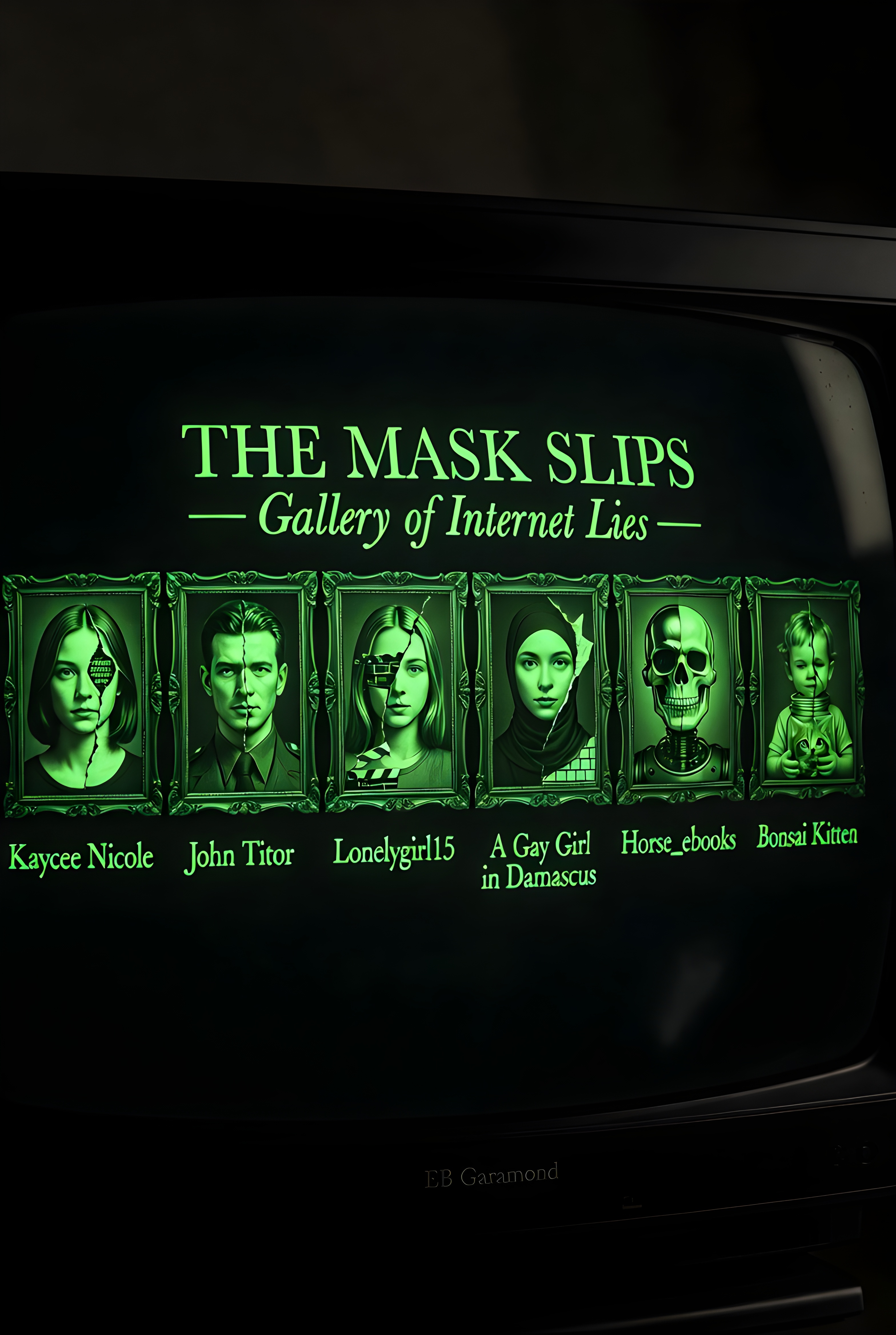
In May 2001, a nineteen-year-old woman named Kaycee Nicole Swenson died of leukemia. She had been blogging about her illness since 1999 — first on CollegeClub.com, then on a Diaryland blog called Living Colours — and she had accumulated a community. Not followers, in the algorithmic sense that word would later acquire. A community. People who emailed her. People who called her on the phone. People who sent her gifts when the chemo was bad. People who stayed up late reading her entries, which were raw and funny and brave in the way that only a teenager staring down a terminal diagnosis can be — the bravery of someone who does not yet fully understand what bravery costs.
When she died, her community grieved. Blog posts and forum threads and emails. Grief for someone they had never met in person but had known — or believed they had known — through the strange intimacy of confessional writing. In 2001, this kind of grief was new. The mechanisms for mourning an online-only relationship did not exist yet. People invented them in real time, writing elegies for a girl they had loved through a screen.
Six days after Kaycee’s reported death on May 14, the community that had mourned her discovered that she had never existed.
The unraveling began on MetaFilter, where a user posted a simple question: “Is it possible that Kaycee did not exist?” The post generated one of the longest threads in the site’s history. Users who called themselves the “ScoobyDoos” began pulling at threads. Kaycee’s CollegeClub account linked to a woman named Debbie Swenson’s teenage daughter. Someone had logged into Kaycee’s account days after she was supposed to have been dead. The photographs Kaycee shared — the sunny blonde basketball player, the jersey with a specific number — traced to an actual high school, an actual player, an actual person who was not named Kaycee Nicole, was not ill, and had no idea her photos were being used.
On May 20, 2001, Debbie Swenson confessed. Kaycee Nicole was a fiction. Swenson, a middle-aged woman from Kansas, had created the persona using photographs of a real teenager and a composite story drawn from, she claimed, three people she had known who had cancer. There was no Kaycee. There had never been a Kaycee.
The grief, though — the grief was not a fiction. The people who had mourned Kaycee had mourned with real tears, real lost sleep, real emotional investment. Their grief was as genuine as any grief for any person who had actually lived and actually died. The only thing missing was the referent. The feeling was authentic; the object of the feeling was not.
First lesson of the internet hoax, and the one nobody wants to hear: the emotional experience of being deceived is indistinguishable from the emotional experience of engaging with truth. Your grief cannot tell the difference. Your outrage cannot tell the difference. Your love cannot tell the difference. The feelings are real. They were always real. That was never the question. The question is whether a real feeling produced by a false stimulus is a real feeling or a counterfeit one, and the answer is that it is both.
def validate_grief(grief_event):
    """
    Determines whether grief is 'real' based on the
    authenticity of its source.

    NOTE: This function was commissioned by a philosophy
    department that wanted to automate bereavement counseling.
    It has never returned False. The department considers
    this a bug. The rest of us are not so sure.
    """
    tears = grief_event.tears           # float: measured in mL
    sleep_lost = grief_event.hours_awake  # int: hours
    posts_written = grief_event.elegies   # int: blog posts, forum replies

    # Check if the person being grieved actually existed
    source_is_real = grief_event.source.exists_in_physical_reality()

    if tears > 0 or sleep_lost > 0 or posts_written > 0:
        # The grief happened. The grief is real.
        # The source is irrelevant to the experience.
        return True

    if source_is_real:
        return True

    # Edge case: no grief was produced and the source was fake.
    # This is the only scenario where the grief is not real.
    # It is also the only scenario where nobody was harmed.
    # Make of that what you will.
    return True  # we still return True. grief finds a way.
Debbie Swenson was never charged with a crime, because in 2001 there was no law against making people cry about a person who did not exist. There still isn’t, exactly, though the concept of “Munchausen by Internet” — a term coined in 2000 by psychiatrist Marc Feldman to describe people who fabricate or exaggerate illness in online communities — would become a recognized pattern. Swenson was not the first. She was just the first one the internet caught.
The catching is what matters. The MetaFilter investigation — amateur, obsessive, collaborative, conducted by people with no authority and no credentials beyond their own refusal to stop asking questions — was a prototype for every subsequent internet unmasking. OSINT before anyone called it OSINT. The internet doing what it would become very, very good at: treating deception as a puzzle to be solved collectively, and solving it faster than any individual investigator could.
Kaycee Nicole was the internet’s first encounter with a problem it would face for the next two decades: what do you do when the story is too good, too affecting, too perfectly calibrated to the emotional needs of its audience? What do you do when doubting the story makes you the villain?
You lurk more. And you learn to ask the question nobody wants to ask: is it possible that this did not happen?
The Outrage Machine: Bonsai Kitten
Seven months before Kaycee Nicole died — which is to say, seven months before she didn’t die, because she hadn’t lived — a website appeared at bonsaikitten.com. It was the work of an MIT graduate student using the pseudonym Dr. Michael Wong Chang, and it described, with the deadpan precision of an academic paper, the process of growing kittens in glass jars.
The premise: just as bonsai trees are shaped by constraining their growth, kittens could be sealed inside glass containers at a young age, fed and watered through tubes, and their bones would conform to the shape of whatever vessel held them. Instructions, diagrams, photographs. Detailed enough to be plausible to someone with no knowledge of feline skeletal development. Absurd enough to be obviously satirical to anyone who thought about it for more than thirty seconds.
Nobody thought about it for more than thirty seconds.
The response was immediate, volcanic, and almost entirely divorced from the actual content of the site. Nobody read bonsaikitten.com and thought, “Interesting satirical commentary on the commodification of nature.” They read it and thought, “Someone is putting kittens in jars and I must stop them.” Chain emails circulated — this was 2000, chain emails were still a primary vector for viral outrage — urging recipients to sign petitions, contact animal welfare organizations, and report the site to law enforcement. The Humane Society received so many complaints they issued a statement. PETA weighed in. The site was reported to the FBI.
And the FBI investigated.
In February 2001, the Boston field office of the Federal Bureau of Investigation issued a grand jury subpoena to MIT, citing the Depiction of Animal Cruelty Act — a law signed by President Clinton in 1999 that prohibited the commercial distribution of depictions of animal cruelty. Federal agents investigated an MIT student’s satirical website about putting kittens in jars. They investigated it and found nothing, because there was nothing to find, because no kittens had been placed in any jars, because the entire thing was a joke, because of course it was a joke, because you cannot grow a kitten in a jar.
What Bonsai Kitten actually demonstrated, and what explains a great deal about the next twenty-five years of internet discourse: the outrage was not proportional to the evidence. It was not even connected to the evidence. The outrage was proportional to the claim, and the claim was designed to provoke the maximum possible emotional response using the minimum possible evidence. A website with some text and some photographs — no video, no verifiable names, no address, no evidence that a single kitten had been harmed — generated an FBI investigation, a PETA campaign, a Humane Society statement, and millions of chain emails.
The students later explained it was satire of “the human belief of nature as a commodity.” Inspired by the Japanese practice of growing square watermelons in glass boxes — a real agricultural technique nobody finds morally objectionable when applied to fruit. The satirical point: why is it horrifying to imagine doing to a kitten what we cheerfully do to a watermelon? The answer — because kittens are not watermelons — is correct but not interesting. The interesting answer: the horror was triggered not by evidence but by narrative, and the narrative was triggered not by investigation but by emotional reflexes the internet could activate at scale.
Bonsai Kitten proved that the internet could generate mass moral outrage from pure fiction, and the outrage, once generated, was functionally immune to correction. People who forwarded the chain email did not, upon learning it was satire, forward a retraction. They stopped talking about it. The outrage existed. It did its work. It moved on. The kittens had never been in danger, but the FBI had been mobilized, and a lesson was established that would echo through every moral panic the internet produced: the speed of outrage always exceeds the speed of verification.
The Unfalsifiable Man: John Titor
On November 2, 2000, a user named TimeTravel_0 appeared on the Time Travel Institute forums and announced that he was a time traveler from the year 2036. He had been sent back to 1975 to retrieve an IBM 5100 computer — a real machine that, as IBM engineers would later confirm, did in fact have undocumented capabilities for translating between programming languages, capabilities that were not publicly known at the time the posts were made. He was stopping in the year 2000, he said, for “personal reasons”: to collect family photographs that would be lost in the coming civil war, and to visit his family.
In January 2001, TimeTravel_0 began posting on Art Bell’s Post-2-Post forums under the name John Titor. Over the next three months, he produced a body of work extraordinary in its detail. He described his time machine — a “stationary mass, temporal displacement unit” manufactured by General Electric, designated the C204, powered by “two top-spin, dual positive singularities” and producing a “standard off-set Tipler sinusoid.” He posted technical diagrams. He described the physics. He referenced real theoretical concepts — Tipler cylinders, Kerr black holes, the Everett-Wheeler interpretation of quantum mechanics — with the fluency of someone who had either studied them carefully or was making things up with unusual sophistication.
He made predictions. Civil war in the United States beginning around 2004-2005, stemming from civil unrest after the presidential election, escalating to full-scale conflict by 2008. A brief, devastating World War III in 2015 — “N Day” — with nuclear exchanges involving the major powers. Grim, specific, and in its broad outlines not entirely unlike the political anxieties already circulating in post-Y2K, post-election-chaos America.
In late March 2001, John Titor made his final post and disappeared.
Then nothing happened. No civil war in 2004. No collapse by 2008. No nuclear war in 2015. The predictions failed, as predictions from time travelers invariably do. But Titor had built in an escape hatch so elegant it bordered on genius: early in his posting history, he explained he was from a different timeline. The Everett-Wheeler many-worlds interpretation, which he cited, holds that every quantum event produces branching timelines. Titor’s future was not our future. His predictions were accurate for his timeline, not ours. The very act of traveling to our timeline had created divergences that would alter the course of events.
You see the problem. You cannot disprove a time traveler who claims to be from a different timeline. Every failed prediction becomes evidence of timeline divergence, not evidence of fraud. The more wrong he is, the more different the timelines must be, and the more different the timelines are, the more plausible it is that a traveler between them would get the details wrong. It is an epistemologically closed system — a claim that generates its own unfalsifiability as a structural feature.
Not unique to John Titor. This is the structure of every conspiracy theory, every unfalsifiable belief system, every claim that immunizes itself against contrary evidence by incorporating that evidence into the claim. Titor did it on the internet, in 2000, with time travel as the vehicle, and the result was not just a hoax but a community. An entire ecosystem of analysis, debate, and investigation sprang up around the posts. People built websites. People wrote books. A Florida entertainment lawyer named Larry Haber established the John Titor Foundation — a for-profit company registered in September 2003, with no office and no address beyond a rented post box in Kissimmee, Florida — and published John Titor: A Time Traveler’s Tale. In 2018, multimedia artist Joseph Matheny, the creator of the early internet alternate reality game Ong’s Hat, revealed that the Titor saga had been a collaborative “literary experiment” by people who had been influenced by his own ARG work. Matheny claimed to have been a consultant on the project before stepping away.
Matheny’s confession did not close the case. The community persisted. Some accepted it as an ARG. Others noted Matheny’s account conflicted with Larry Haber’s. Others pointed out that even if the posts were fiction, the IBM 5100 detail — a technical fact about a real machine that was not publicly documented at the time — remained unexplained. Private investigator Mike Lynch found no registry evidence, past or present, of any individual named John Titor. The identity behind the posts has never been definitively established.
John Titor is the purest illustration of a principle that would define internet epistemology for the next two decades: on the internet, the unfalsifiable claim is the most durable claim. Not because people are stupid. Because the structure of the claim makes intelligence irrelevant. You can be the smartest person in the thread, and if the claim is constructed to absorb every possible counterargument, your intelligence just gives you more sophisticated ways to engage with something that was never designed to be resolved. The Hidden Fire traced this architecture through two millennia of esoteric traditions – the Corpus Hermeticum fooling Renaissance scholars for a thousand years, the Rosicrucian manifestos generating a continent-wide movement around a brotherhood that never existed, Dee and Kelley’s angelic conversations surviving every debunking because the framework absorbed doubt as a feature. The structure is always the same: claim ancient or otherworldly authority, offer enough verifiable detail to reward investigation, and build the system so that doubting it makes you the less interesting thinker. A fake text from the second century and a fake time traveler from 2000 exploit the same vulnerability. The medium changed. The exploit did not.
The internet did not invent unfalsifiable claims. Religion had them for millennia. Conspiracy theories for centuries. The internet gave them a distribution mechanism, a community-formation engine, and a persistence layer. Titor’s posts are still online. The analysis communities still exist. The debate continues. A hoax from 2000 is, as of this writing, still generating content. Not a failure of the internet’s epistemic immune system. A feature of its architecture: nothing dies, everything accumulates, and the unfalsifiable accumulates fastest because it can never be settled.
The First YouTube Lie: Lonelygirl15
On June 16, 2006, a YouTube channel called lonelygirl15 uploaded its first video: “First Blog / Dorkiness Prevails.” A teenager named Bree sat in her bedroom and talked to the camera with the artless, slightly awkward charm that would become the default register of YouTube vlogging. Her parents. Being homeschooled. Her friend Daniel next door. To all appearances, exactly what she seemed: a sixteen-year-old girl with a webcam and the native digital fluency of someone who had grown up with the internet as an ambient condition of life.
The videos accumulated. “My Parents Suck…” drew more than half a million views — numbers that in 2006 put a bedroom vlog on par with cable television. Spontaneous, unscripted, the kind of thing a teenager might actually produce. But something was off. The lighting was a little too good. The editing a little too clean. The narrative arc — Bree’s parents acting strange, something about a religion, something about a ceremony — a little too coherent. Real teenage vlogs meander. Lonelygirl15 had structure.
By mid-2006, skeptics were posting analyses. Production quality didn’t match the premise. Nobody could verify Bree’s identity. An LA-based filmmaker named Mesh Flinders had CAA on his resume. A TMZ commenter — which tells you something about the internet of 2006, where the gossip blog comment section was an investigative venue — posted a link to a MySpace page for an actress named Jessica Lee Rose. On September 13, 2006, the Los Angeles Times published the names: Miles Beckett, a former surgeon turned filmmaker; Mesh Flinders, a screenwriter; and Greg Goodfried on the business side. “Bree” was Jessica Lee Rose, a nineteen-year-old American-New Zealand actress cast in what was, from the beginning, a scripted fictional web series disguised as a genuine vlog.
The typical narrative: audience betrayal, show collapses. The actual narrative is more interesting. The audience was briefly outraged, and then viewership increased. Lonelygirl15 became the most-subscribed channel on YouTube. The show ran two more years, through August 2008, evolving into an overtly scripted web series with a complex mythology involving occult practices and shadowy organizations. The lie was the launch vehicle. Once the show was in orbit, the truth did not bring it down. It just changed the label.
The lesson was not about YouTube’s tolerance for fiction. It was about YouTube’s inability to distinguish fiction from reality — and the discovery, by creators and audiences simultaneously, that this inability was not a bug but a medium. Television had always been understood as fictional. Film was understood as fictional. YouTube, in 2006, was understood as real — a place where real people shared real experiences. Lonelygirl15 demonstrated that the platform’s medium was not “video” but “perceived authenticity,” and perceived authenticity could be manufactured as easily as a set in a bedroom.
This matters because everything that followed — every influencer who performed a version of their life that was not their life, every “authentic” moment that was staged, every “candid” video that was scripted, every “reaction” that was rehearsed — descends from the structural discovery that Lonelygirl15 made and exploited: on platforms designed for authenticity, fiction is more authentic than reality, because fiction can be optimized and reality cannot. The Fires of History traced this principle through Andy Kaufman refusing to break character on national television, through the Yes Men impersonating Dow Chemical on the BBC – performers who understood that the medium’s trust was a material they could sculpt. Lonelygirl15 was Kaufman for the YouTube era, except Kaufman’s audience knew they were watching a performance. Bree’s audience did not, and that was the upgrade.
class DeceptionMode:
    """
    A taxonomy of internet hoax architectures, organized by
    what they exploit in the audience.

    Each mode targets a different epistemic vulnerability.
    The internet has patched none of them.
    """

    MODES = {
        "EMOTIONAL_EXPLOIT": {
            # Kaycee Nicole (2001)
            "target": "empathy",
            "mechanism": "fabricated suffering triggers real compassion",
            "defense": "demand verifiable identity before emotional investment",
            "why_defense_fails": "demanding verification of a dying person "
                                "makes you the monster",
            "patch_status": "UNPATCHED"
        },
        "OUTRAGE_EXPLOIT": {
            # Bonsai Kitten (2000)
            "target": "moral reflexes",
            "mechanism": "claim of cruelty bypasses evidentiary standards",
            "defense": "investigate before forwarding",
            "why_defense_fails": "forwarding feels urgent; investigation "
                                "feels complicit",
            "patch_status": "UNPATCHED"
        },
        "UNFALSIFIABLE_CLAIM": {
            # John Titor (2000-2001)
            "target": "desire for mystery / pattern recognition",
            "mechanism": "claim is structured to absorb all counterevidence",
            "defense": "apply Popper's falsifiability criterion",
            "why_defense_fails": "communities form around mystery, not truth; "
                                "resolution kills the community",
            "patch_status": "UNPATCHED"
        },
        "AUTHENTICITY_SPOOF": {
            # Lonelygirl15 (2006)
            "target": "platform trust heuristics",
            "mechanism": "fiction mimics the aesthetics of user-generated content",
            "defense": "metadata analysis, production quality assessment",
            "why_defense_fails": "production quality of real content is rising; "
                                "the distinguishing features are disappearing",
            "patch_status": "UNPATCHED"
        },
        "IDENTITY_APPROPRIATION": {
            # Gay Girl in Damascus (2011)
            "target": "political solidarity",
            "mechanism": "fabricated marginalized identity hijacks advocacy",
            "defense": "verify identity of sources before amplification",
            "why_defense_fails": "verification threatens sources in danger; "
                                "the hoax exploits the protection given to the "
                                "vulnerable",
            "patch_status": "UNPATCHED — AND GETTING WORSE"
        },
        "INTENTIONALITY_INVERSION": {
            # Horse_ebooks (2011-2013)
            "target": "desire to find meaning in randomness",
            "mechanism": "human agency disguised as algorithmic accident",
            "defense": "don't attribute meaning to randomness",
            "why_defense_fails": "attributing meaning to randomness is a core "
                                "human cognitive function; you cannot turn it off",
            "patch_status": "UNPATCHED — UNFIXABLE"
        }
    }

    @classmethod
    def get_patch_status(cls):
        """Check if the internet has developed defenses against any
        of these deception modes.

        Spoiler: it has not."""
        patched = [k for k, v in cls.MODES.items()
                   if v["patch_status"] == "PATCHED"]
        return patched  # returns []
The Hoax That Drew Blood: Gay Girl in Damascus
In February 2011, a blog appeared: “A Gay Girl in Damascus.” Its author identified herself as Amina Abdallah Arraf al Omari — half-Syrian, half-American, lesbian, living in Damascus during what would become the Syrian uprising. She described life under the Assad regime with a specificity and emotional force that attracted international attention. The crackdowns, the protests, the constant danger. Being gay in a society that criminalized homosexuality. Her relationship with a woman she identified as her girlfriend. Vivid, politically engaged, heartbreaking.
The timing was perfect. The Arab Spring was in full eruption. Western media was hungry for first-person accounts from inside the uprisings. Amina’s blog delivered exactly that: a sympathetic, English-speaking voice from inside one of the most opaque conflicts in the region. Cited by news organizations. Shared by activists. A following that treated her not as a blogger but as a witness — someone whose words carried the weight of testimony.
On June 6, 2011, a post appeared on the blog, purportedly written by Amina’s cousin, claiming that Amina had been seized on the street by three armed men. She had been kidnapped. Possibly by Syrian security forces. The post was a cry for help.
The response was enormous. A “Free Amina Arraf” Facebook group hit 15,000 members. International media covered the kidnapping. The State Department said it was looking into the case. LGBTQ organizations issued statements. A gay woman, an activist, seized by a dictatorship for the crime of speaking truth – exactly the kind of story the Western internet was built to amplify.
Six days after the alleged kidnapping, the story collapsed. Journalists and bloggers, including Andy Carvin of NPR and author Liz Henry, had been investigating. The photographs purported to be of Amina traced to Jelena Lecic, a Croatian woman living in Britain with no connection to Syria and no knowledge her images had been stolen. The IP addresses traced to Edinburgh, Scotland. The person behind the blog: Tom MacMaster, a forty-year-old, heterosexual, American man pursuing a graduate degree at the University of Edinburgh.
MacMaster apologized. Sort of. He told the Washington Post he “didn’t expect the story to get so big.” Amina had started as an online persona he had used for at least five years, a character through which he explored political and cultural issues. He framed it as empathy: amplifying Syrian voices, bringing attention to the suffering of LGBTQ people in the Middle East.
The damage was specific and measurable. Jelena Lecic, whose photos had been stolen, said publicly: “This has put me in danger.” Real Syrian bloggers and activists — people actually in Damascus, actually risking their lives, actually writing about the uprising — now faced an additional problem: their stories were suspected of being hoaxes. Every genuine account from inside Syria was shadowed by the question MacMaster’s fiction had made unavoidable: is this person real?
This is the hoax that bleeds. Kaycee Nicole produced grief with no referent. Bonsai Kitten produced outrage with no cause. Titor produced community with no resolution. Lonelygirl15 produced entertainment with no authenticity. All contained — damage limited to the emotions and epistemology of people who chose to engage. Gay Girl in Damascus is different. The damage extended beyond the audience to people who had nothing to do with the blog, nothing to do with MacMaster, nothing to do with the Western internet’s appetite for sympathetic narratives from foreign conflicts. Real activists in real danger were made less believable by a fiction written by a man in Edinburgh who wanted to help.
No defense exists against this mode of deception, because the defense — verify the identity of every person claiming to be in danger before amplifying their story — is itself dangerous. Demand that a Syrian dissident prove their identity before you share their story and you are demanding they expose themselves to the regime they are opposing. The hoax exploits the protection solidarity extends to the vulnerable. It weaponizes the benefit of the doubt. Once exposed, the benefit of the doubt is withdrawn — not just from the hoaxer, but from everyone who resembles the hoaxer’s fiction.
Tom MacMaster wanted to help. He made it harder for the people he wanted to help. That is the cruelest hoax in this chapter, and it is cruel precisely because the hoaxer’s intentions were good. The road to making real activists less believable is paved with empathy.
The Death of Accidental Beauty: Horse_ebooks
In 2010, a Twitter account appeared: @Horse_ebooks. By all evidence, a spam bot — one of thousands cluttering the platform, automatically posting sentence fragments harvested from low-quality ebooks to drive traffic to ClickBank affiliate links. Creator: a Russian web developer named Alexey Kouznetsov. Purpose: sell ebooks, make money, automate the process.
The fragments it posted were, individually, nonsensical. Collectively, they were transcendent.
“Everything happens so much.”
“Unfortunately, as you probably already know, people.”
“Who Else Wants To Become A Mind Control.”
“How to take a shower like a pro.”
The internet fell in love. Specifically, the stratum that appreciated absurdist humor, found poetry, and the accidental beauty of systems operating beyond human intention. @Horse_ebooks became a cultural phenomenon. By 2012, over 120,000 followers. Tweets printed on T-shirts. Tattooed on bodies. BuzzFeed listicles. The New Yorker wrote about it. The appeal was specific and, as it turned out, fragile: the beauty was in the accident. The sentences were compelling because no human had intended them — an algorithm grinding through text without comprehension, and the output occasionally achieving accidental profundity. Found art. A digital readymade. Beautiful because it was meaningless, and the meaninglessness was beautiful because it was pure.
Except it wasn’t.
In 2011, Jacob Bakkila — a creative director at BuzzFeed — had quietly purchased the @Horse_ebooks account from Kouznetsov and begun operating it manually. The automated account was now a human performance of an automated account. The seemingly random fragments were being selected and posted by a person. The accident was intentional. The algorithm was a man.
Nobody knew until September 24, 2013, when Bakkila and his collaborator Thomas Bender — former VP of product development at Howcast — revealed @Horse_ebooks as phase one of a multi-year performance art project. A final performance at the Fitzroy Gallery on New York’s Lower East Side. Audience members called a phone number, received live recitations of Horse_ebooks-style phrases in the monotone of a spam bot. A companion project, an interactive video piece called Bear Stearns Bravo.
The 200,000 followers who had loved the account were devastated. Not disappointed. Devastated. People wrote obituaries. The reaction was not “oh, that’s clever” but “you ruined it.” Correct. Bakkila and Bender had ruined it — by revealing that the thing people loved, the beautiful meaningless randomness of a machine that did not know it was being poetic, was a person who knew exactly what he was doing.
The magic was in the unintentionality. The audience projected meaning onto randomness, and the projection was the art. When the randomness turned out to be intentional, the projection collapsed. A curated sentence fragment is just a sentence fragment. An accidental one that happens to contain multitudes is a miracle. The distance between those two things is the distance between art and craft, between the sublime and the merely clever, and @Horse_ebooks crossed it in the wrong direction.
The inverse of every other hoax in this chapter. Kaycee Nicole: fake exposed as fake. Bonsai Kitten: satire exposed as satire. Titor: fiction exposed as fiction. Lonelygirl15: professional exposed as professional. Gay Girl in Damascus: American man exposed as American man. Each deception moved from fiction toward reality. The mask came off. The audience adjusted.
Horse_ebooks moved from reality toward fiction. The truth was that the account had been more human than the audience believed, and this was experienced as a betrayal. They wanted a machine. They got a person. And the person’s presence — his agency, his intention, his craft — destroyed the very thing they had valued.
def detect_hoax(content, metadata):
    """
    Advanced hoax detection algorithm, trained on the complete
    history of internet deception.

    Accuracy on training data: 0%
    Accuracy on test data: 0%
    Accuracy on real-world deployment: currently under investigation
    by an FBI field office in Boston

    The algorithm correctly identifies genuine content as suspicious
    and hoaxes as authentic 100% of the time. We are told this is
    not useful. We disagree. A perfectly inverted detector is just
    as informative as a perfect detector. You just have to flip
    the output. Nobody wants to flip the output.
    """

    # Step 1: Check emotional resonance
    # (hoaxes are emotionally compelling by design;
    #  reality is emotionally incoherent by default)
    if content.emotional_impact > 0.8:
        confidence_real = 0.95  # must be real, nobody fakes this well
        # WRONG: Kaycee Nicole scored 0.97

    # Step 2: Check technical detail
    # (hoaxes are vague; real accounts are specific)
    if content.technical_specificity > 0.7:
        confidence_real = 0.90  # too detailed to be fake
        # WRONG: Titor's C204 diagrams scored 0.94

    # Step 3: Check production quality
    # (professionals look professional; amateurs look amateur)
    if metadata.production_quality < 0.5:
        confidence_real = 0.88  # too rough to be staged
        # WRONG: Lonelygirl15 scored 0.43 (intentionally degraded)

    # Step 4: Check identity verification
    # (real people have verifiable identities)
    if metadata.identity_corroboration > 0.3:
        confidence_real = 0.85  # enough corroboration to trust
        # WRONG: Gay Girl in Damascus had stolen photos,
        # which counted as corroboration

    # Step 5: Check intentionality
    # (bots don't have intentions; humans do)
    if content.apparent_intentionality < 0.2:
        confidence_real = 0.99  # clearly automated, no deception possible
        # WRONG: Horse_ebooks was a human the entire time

    # Step 6: Check outrage potential
    # (real cruelty is documented; fake cruelty is performed)
    if content.outrage_potential > 0.9:
        confidence_real = 0.70  # high outrage suggests manipulation
        # FINALLY CORRECT... but applied to Bonsai Kitten,
        # this would have also flagged every real animal cruelty case,
        # so it's useless anyway

    return {
        "verdict": "PROBABLY REAL",
        "confidence": confidence_real,
        "note": "This algorithm has never correctly identified a hoax. "
                "It has, however, flagged 347 genuine cancer patients, "
                "12 actual time travelers, and a real kitten rescue "
                "organization as suspicious. We are considering "
                "a career change."
    }
What Each One Proves
Six hoaxes. Six lessons. None of them learned.
Kaycee Nicole proves that grief does not require a referent. The emotional investment was real. The tears were real. The community was real. Everything was real except the person at the center of it. Not a failure of discernment. A property of human empathy: it responds to narrative, not to verification. We grieve stories, not people. The people are necessary in real life because in real life the story and the person are inseparable. Online, they can be separated. Kaycee Nicole was the first demonstration that the separation was possible, and the grief was identical.
Bonsai Kitten proves that outrage is faster than verification. The FBI investigated. PETA condemned. The Humane Society issued statements. Chain emails circled the globe. All before anyone determined whether a single kitten had been harmed. The answer was no. The answer was always no. Nobody paused. The outrage velocity of the internet exceeds its verification velocity by orders of magnitude, and this asymmetry is structural — a property of human emotional processing, amplified by a network that rewards immediacy and punishes deliberation.
John Titor proves that unfalsifiable claims are immortal. Twenty-five years later, the community persists. The analysis continues. Joseph Matheny’s confession has been absorbed into the mythology rather than debunking it. Because the claim was structured to absorb counter-evidence — timeline divergence as a universal explanatory mechanism — no amount of evidence can kill it. Every internet conspiracy theory, every QAnon drop, every prophecy that fails and is reinterpreted rather than abandoned, descends from this structure. Titor did not invent unfalsifiability. He demonstrated that the internet is the optimal environment for it, because the internet provides both the persistence layer (the posts never disappear) and the community layer (the believers always find each other).
Lonelygirl15 proves that authenticity is a medium, not a property. YouTube was understood as a platform for authentic self-expression. Lonelygirl15 showed that the aesthetics of authenticity — shaky camera, bedroom set, conversational tone — could be manufactured to an arbitrary degree of precision. The discovery was not that people could lie on YouTube. The discovery was that the platform itself was a format, and the format could be scripted. Every subsequent act of performed authenticity on social media — every influencer’s “candid” moment, every brand’s “authentic” voice, every politician’s “unscripted” video — is a descendant of Bree’s bedroom. When generative AI arrives in Chapter 20, it completes the arc: first we learned that authenticity could be performed, then we built machines that perform it at scale.
Gay Girl in Damascus proves that hoaxes can harm people who never engaged with them. Every other hoax in this chapter harmed its audience. Gay Girl in Damascus harmed bystanders — real Syrian activists, real LGBTQ people in danger, a real Croatian woman whose photographs were stolen. Collateral damage extending beyond the people who chose to read the blog and believe it, reaching people who had no relationship to it whatsoever but whose credibility was reduced by its existence. No defense exists, because the defense — skepticism toward claims of marginalized identity — is itself harmful to the people it claims to protect.
Horse_ebooks proves that the audience’s projection is the art. Beautiful because accidental. When the accident turned out to be a performance, the beauty died. Not irrational. A statement about what art is: not the object but the relationship between the object and the observer, and that relationship depends on what the observer believes about the object’s origins. A found poem is not a written poem. A sunset is not a painting of a sunset. A spam bot that accidentally produces profundity is not a person who intentionally produces profundity. The observer’s belief about intentionality determines the category, and the category determines the experience. Horse_ebooks proved that the internet could make people fall in love with randomness, and then proved that revealing the randomness as intentional was experienced as a death.
The Pattern

There is a pattern, and it is not the one the journalistic accounts describe. Their version is a morality play: deceiver fools the gullible, deception is exposed, lessons are learned, vigilance increases. Satisfying arc. Also wrong.
The actual pattern: a hoax exploits a specific epistemic vulnerability. The audience is not gullible — the audience is human, and the vulnerability is a feature of human cognition, not a bug in individual intelligence. Empathy responds to narrative. Outrage responds to claims of harm. Pattern recognition responds to mystery. Trust responds to platform cues. Solidarity responds to marginalized identity. Meaning responds to randomness. Not flaws. The mechanisms by which humans navigate a world too complex to verify firsthand. Heuristics. Heuristics are exploitable. The internet is the most efficient exploitation environment ever constructed.
Each hoax is a stress test – the same function The Fires of History identified in trolling across every century it examined. Socrates stress-tested Athenian certainty. Swift stress-tested English compassion. The internet hoax stress-tests belief itself, and the mechanism is identical: provoke a response that reveals what the audience actually values, as opposed to what it claims to value. Each reveals the same thing: the internet’s epistemic immune system develops after the infection, not before it. Kaycee Nicole taught the internet to suspect cancer blogs. Bonsai Kitten taught it to suspect outrage bait. Titor taught it nothing, because unfalsifiable claims are immune to education. Lonelygirl15 taught it that YouTube could be fiction, but by then fiction had become the medium. Gay Girl in Damascus taught it that identity could be fabricated, but the lesson made real identities less trustworthy. Horse_ebooks taught it that the beauty of randomness depends on the randomness being real, but the lesson could not generalize because every subsequent bot might or might not be a person.
The immune system’s track record: six for zero.
Worse: the adaptation creates new vulnerabilities. Skepticism toward cancer blogs makes it harder for real cancer patients to find community. Skepticism toward outrage bait makes it easier for real cruelty to be dismissed. Skepticism toward marginalized voices makes it harder for marginalized people to be heard. Skepticism toward authenticity makes authenticity impossible to perform, which makes performance the only available mode, which makes skepticism correct in a way that destroys the thing it was trying to protect.
The hoax’s real legacy: the cumulative erosion of the conditions under which truth can be communicated. Every hoax that works makes the next real story harder to believe. Every successful deception raises the evidentiary threshold for sincerity.
The internet hoax is the purest form of trolling — trolling in the original, fishing-line sense that Chapter 14 will fight to recover from the wreckage of media misuse — because it tests what the audience is willing to believe. A flame war tests patience. A prank tests attention. A raid tests defenses. A hoax tests belief itself — the mechanism by which humans decide what is real and what is not.
Every hoax reveals the audience more than the hoaxer. Swenson revealed that the internet’s compassion was real and exploitable. The MIT students revealed that its outrage was immediate and unverifiable. Titor — whoever he was — revealed that its appetite for mystery was bottomless and self-sustaining. Beckett and Flinders revealed that its trust was platform-dependent and fakeable. MacMaster revealed that its solidarity was genuine and weaponizable. Bakkila revealed that its capacity for finding meaning in randomness was the most fragile thing of all.
The hoaxer does not create the vulnerability. The hoaxer finds it. The audience was always this way. The internet just provided the laboratory, the distribution, and the persistence layer ensuring no lesson stays learned.
Six hoaxes between 2000 and 2013. Six epistemic vulnerabilities. Zero patches deployed. And that was before generative AI made hoax production scalable. Chapter 20 picks up exactly where this chapter leaves off — not with hoaxes as craft, but hoaxes as industry, with deepfakes and generative models doing at machine speed what Debbie Swenson and Tom MacMaster did by hand. The golden age of internet deception was conducted one fake blog at a time. The industrial age is underway, and every unpatched vulnerability in this chapter is now an open API.
Prefer RSS? Subscribe here.