Episode 14✦2005-present
The Meme Wars
June 17, 2026
From Lurk More
The Meme Wars
| || || |_
If you just felt something – a groan, a flicker of recognition, a reflexive eye-roll that borders on physical pain – congratulations. You have been initiated into one of the most improbable achievements in the history of visual communication: an image so thoroughly deconstructed that it can be represented as seven characters of ASCII text and still produce an involuntary emotional response in anyone who knows what it means.
Those seven characters represent a four-panel comic strip. The comic was published on June 2, 2008, in a gaming webcomic called Ctrl+Alt+Del by Tim Buckley. In the strip, a character named Ethan enters a hospital, speaks to a receptionist, speaks to a doctor, and finds his girlfriend Lilah lying on her side in a hospital bed, crying. She has had a miscarriage (Know Your Meme, Loss).
The comic was played completely straight. That was the problem.
Ctrl+Alt+Del was a gaming humor webcomic. Its readers came for jokes about video games. Instead, on that particular Tuesday, they got a four-panel wordless miscarriage drama shoved into a format that, the previous week, had been about a character setting something on fire for comedic effect. The tonal whiplash was so severe that the internet’s response was not sympathy. It was not criticism. It was deconstruction.
First came the parodies: the panels redrawn with different characters, with Lego bricks, with scenes from Futurama. Then came the abstractions: the characters reduced to stick figures, to shapes, to objects arranged in roughly the same positions – one figure standing, two figures standing, two figures standing, one figure standing beside one figure lying down. Then came the final reduction: the positions of the characters stripped down to lines. One vertical line. Two vertical lines. Two vertical lines. One vertical line and one horizontal line.
| || || |_
The internet had taken a sincere dramatic moment, identified its structural skeleton, and reduced it to a pattern so minimal that it could be hidden anywhere. In a crossword grid. In a barcode. In the arrangement of hot dogs on a plate. In the layout of a parking lot. People began embedding Loss in images that had nothing to do with Loss, daring viewers to notice the pattern. “Is this loss?” became a question asked with the same mixture of dread and resignation that a bomb disposal technician asks “is this the wire?”
Tim Buckley had intended to tell a story about grief. The internet told a story about structure. And the story about structure turned out to be more interesting, more durable, and more widely transmitted than anything Ctrl+Alt+Del ever produced on purpose.
The Fires of History, Chapter 5 laid out the taxonomy of trolling as an intellectual tradition – Fermat, Cantor, Godel, all operating at the level of structure rather than content. Memes do the same thing at the speed of culture, and this chapter is the deep dive that the taxonomy was pointing toward. Not because Loss is the greatest meme – it is not – but because it demonstrates the thing about memes that almost every outside account gets wrong. Memes do not operate primarily at the level of meaning. They operate at the level of structure. Loss works not because of what it depicts but because of how its elements are arranged. The content is irrelevant. The pattern is everything. You can strip away every detail of the original image – the characters, the hospital, the emotional context, the medium itself – and what remains is still recognizable, still transmissible, still capable of producing a reaction. That is not how jokes work. That is how art forms work.
The Meme Lifecycle (Or: How Meaning Goes to Die)
Every meme that has ever mattered follows the same trajectory. Know this and you understand memes. Miss it and you think they are pictures with funny text on them.
# meme_lifecycle.py — A state machine for cultural objects
# Simulates the journey from creation to exhaustion
# Spoiler: the terminal state is always ironic revival or death

class MemeLifecycle:
    """
    Every meme follows this path. No exceptions.
    The only variable is speed.
    """

    STATES = [
        "CREATION",          # Anonymous post on 4chan/Reddit/Tumblr
        "NICHE_ADOPTION",    # Picked up by the origin community
        "ITERATION",         # Variations emerge. The format solidifies.
        "CROSS_PLATFORM",    # Jumps to Twitter, Tumblr, Reddit
        "MAINSTREAM",        # Your coworker sends it to you
        "NORMIE_SATURATION", # Your mom posts it on Facebook
        "COMMERCIAL",        # A brand tweets it. A corporation prints it.
        "EXHAUSTION",        # "This meme is dead" — said with authority
        "IRONIC_REVIVAL",    # Used ironically, which is a new creation
        "ACADEMIC_STUDY",    # A PhD student writes a thesis about it
    ]

    def __init__(self, name, origin="4chan"):
        self.name = name
        self.origin = origin
        self.state = "CREATION"
        self.meaning = {}  # Context-dependent. Always.
        self.obituaries = 0

    def advance(self):
        """Move to the next state. Meaning degrades at each transition."""
        idx = self.STATES.index(self.state)
        if idx < len(self.STATES) - 1:
            old_state = self.state
            self.state = self.STATES[idx + 1]

            # The crucial operation: meaning changes at every boundary
            if self.state == "MAINSTREAM":
                self.meaning["original_community"] = "played out"
                self.meaning["general_public"] = "hilarious and new"
            elif self.state == "COMMERCIAL":
                self.meaning["everyone"] = "dead"
                self.meaning["brand_manager"] = "engaging content"
            elif self.state == "IRONIC_REVIVAL":
                self.meaning["original_community"] = "funny again (ironically)"
                self.meaning["general_public"] = "wait, is this back?"
                # Ironic revival is itself a new creation.
                # The lifecycle is a loop, not a line.

    def declare_dead(self):
        """Declare the meme dead. Has no effect on actual meme vitality."""
        self.obituaries += 1
        return f"{self.name} has been declared dead {self.obituaries} time(s)."

# Example: tracking a meme from birth to academic study
pepe = MemeLifecycle("Pepe the Frog", origin="Boy's Club webcomic (2005)")
for _ in range(9):
    pepe.advance()
# Current state: ACADEMIC_STUDY
# Meaning: depends on who you ask, which is the whole problem
The lifecycle is not a metaphor. It is an observable, repeatable pattern. Every meme that achieves significant cultural penetration follows it. The critical insight is what happens to meaning at each transition. When a meme moves from its origin community to a broader audience, the context that gave it meaning does not travel with it. The new audience supplies their own. The image stays the same. The meaning does not. By the time a fast food chain tweets it, the meaning has been laundered so thoroughly that it bears no relationship to whatever the meme meant when it was created.
This is not decay. This is the process. Memes are designed – by the evolutionary pressures of the platforms they inhabit, not by any individual creator – to shed meaning as they travel. They are carriers. What they carry changes at every stop. 4chan produced more canonical memes per capita than any platform in history, and the reason is architectural, not cultural – ephemeral threads, forced anonymity, no upvote system – Chapter 6 explains the engineering. Reddit’s upvote system (Chapter 7) created a different selection pressure: memes survived there by being safe enough for a majority to endorse. 4chan’s memes survived by being memorable enough to be reposted before the thread died. One system selects for consensus. The other selects for impact.
Richard Dawkins coined the word “meme” in The Selfish Gene in 1976 – a contraction of the Greek mimeme (something imitated), shortened to rhyme with “gene.” A unit of cultural transmission: tunes, catch-phrases, fashions, ways of building arches. Memes propagate by leaping from brain to brain via imitation, competing for attention, and the fittest survive (Oxford University Press, The Selfish Gene).
But Dawkins only explained the mechanism. The fuel comes from a different thinker working the same Greek root. René Girard, at Stanford, had been developing his theory of mimetic desire since the 1960s: human beings do not desire autonomously. We desire what others desire. I want the meme because you want the meme. Dawkins described how memes replicate. Girard described why – and what happens when mimetic desire escalates into mimetic rivalry, and mimetic rivalry into collective violence against a scapegoat whose destruction temporarily restores peace. The Hidden Fire documented this mechanism across four thousand years of heresy trials and witch hunts without naming it. Girard named it. His most famous student, Peter Thiel, absorbed the lesson at Stanford and went on to fund PayPal and become Facebook’s first outside investor. The platforms his network built then reproduced the scapegoat mechanism at industrial scale: algorithmic amplification of mimetic desire, engagement metrics that reward pile-ons, outrage cycles that manufacture the transgression they claim to punish. The man who diagnosed the disease funded the delivery system.
The Rosicrucian manifestos of the 1610s were the original viral memes – anonymous, self-replicating, engineered to spread through networks of readers who modified and redistributed them. But what the internet did with both Dawkins’s mechanics and Girard’s insight would have been unrecognizable to either. Internet memes are not unconscious cultural transmission. They are deliberate – created with awareness of each other, modified with intent, transmitted through infrastructure neither theorist imagined. The word survived. The definition mutated. Which is, if you think about it, exactly what a meme would do.
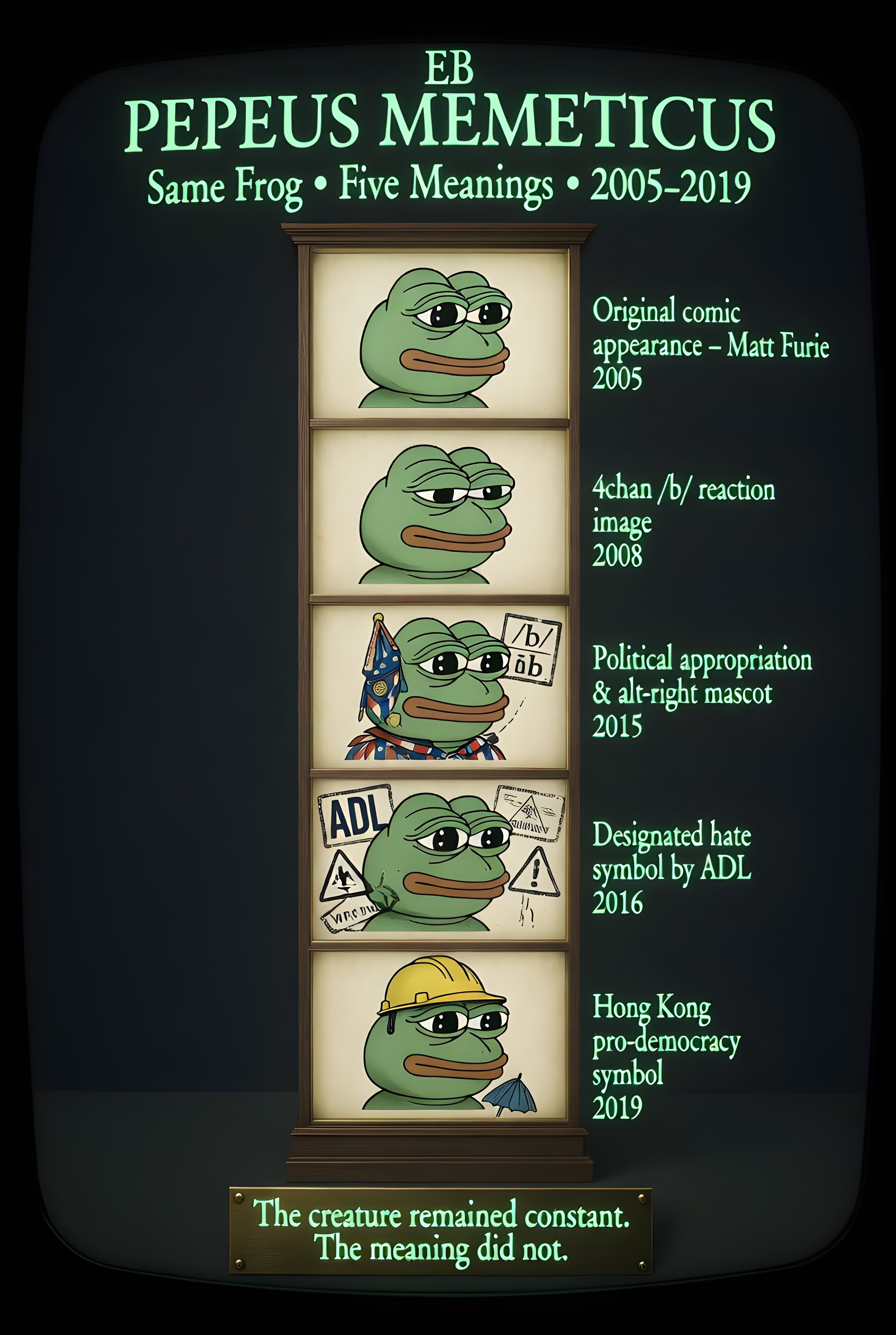
Pepe’s Journey (Or: How a Chill Frog Became a Political Weapon and Then a Democracy Icon)

In 2005, an artist named Matt Furie published a comic called Boy’s Club. Four anthropomorphic roommates – Pepe, Brett, Andy, and Landwolf – doing the things that twenty-something roommates do: hanging out, being gross, existing in a state of affable purposelessness. In one panel, Pepe is caught urinating with his pants pulled all the way down to his ankles. His roommate asks why. Pepe responds: “Feels good man.” (Fantagraphics, Boy’s Club)
That was it. The whole joke. A cartoon frog explaining, with Zen-like simplicity, that he pulls his pants down because it feels good. Not a statement about anything. Just uncomplicated contentment – the kind of thing a person says when they have achieved total comfort with their own absurdity.
In 2008, the page was scanned and uploaded to 4chan’s /b/ board. The image of Pepe’s face – the half-lidded eyes, the slight smile, the expression that somehow conveys both satisfaction and vacancy – separated from the comic and began circulating as a reaction image. “Feels good man” became a caption, then a catchphrase, then a shorthand for any experience of simple pleasure. By 2015, Pepe was one of the most popular memes on both 4chan and Tumblr – a rare instance of a meme achieving penetration across platforms that normally regard each other with open contempt (Know Your Meme, Feels Good Man).
Then came the Rare Pepes.
The concept was simple and brilliant: users on 4chan began creating unique Pepe illustrations – Pepe in various costumes, styles, scenarios – and treating them as collectible items. A “rare Pepe” was a Pepe variant with limited distribution. The economy was a parody of art collecting, of baseball cards, of scarcity itself. Users posted warnings: “Do NOT save this image. This is a rare Pepe.” The warnings, naturally, guaranteed that everyone saved the image immediately. Digital images cannot be rare – anyone can right-click and save – and the entire Rare Pepe economy was built on the communal fiction that they could be.
The fiction became reality in 2016. A community emerged around Counterparty, a protocol built on the Bitcoin blockchain, that let users tokenize Rare Pepes as unique digital assets. The Rare Pepe Wallet was developed for trading them. PepeCash became a dedicated cryptocurrency for the marketplace. In 2021, a single Rare Pepe – “RAREPEPE,” the first card in the series – sold for approximately $500,000. The parody of scarcity had become actual scarcity, enforced by the same cryptographic mechanisms that prevent you from spending the same Bitcoin twice. The joke ate itself and became valuable. This is, for the record, exactly how art markets have always worked (Know Your Meme, Rare Pepe).
But the Rare Pepe economy was a sideshow compared to what happened next.
In the lead-up to the 2016 U.S. presidential election, Pepe was adopted – enthusiastically, aggressively, and with full memetic force – by supporters of Donald Trump on 4chan, Reddit, and Twitter. Pepe was redrawn in a red MAGA hat. Pepe was photoshopped into the Oval Office. Trump himself retweeted an image of himself as Pepe. The frog that had spent a decade as a symbol of “feels good man” was now a symbol of a political movement, and the speed of the transformation caught everyone – Matt Furie, the media, and the political establishment – completely off guard.
On September 27, 2016, the Anti-Defamation League added Pepe the Frog to its database of hate symbols. The ADL noted, carefully, that “the majority of uses of Pepe the Frog have been, and continue to be, non-bigoted.” The designation was made anyway, and the headlines wrote themselves. A cartoon frog was now officially a hate symbol. Hillary Clinton’s campaign published an explainer on her official website titled “Donald Trump, Pepe the frog, and white supremacists: an explainer,” with the subheadline: “That cartoon frog is more sinister than you might realize.” (ADL press release, 27 September 2016; ADL, Pepe the Frog)
A presidential campaign published a policy document about a cartoon frog. Read that sentence again and let it settle.
The internet’s reaction was predictable. For the communities that had been using Pepe for years – in memes about tendies, about feeling sad on a Tuesday, about the simple pleasure of pulling your pants all the way down – the ADL designation and the Clinton explainer were not a wake-up call about the dangers of hate symbols. They were the funniest thing that had ever happened. The establishment had just demonstrated, in the most public way possible, that it did not understand what Pepe was, where Pepe came from, or how memes worked. The Clinton campaign had brought a policy brief to a shitpost fight.
Social scientist Joan Donovan later suggested that the Clinton campaign’s decision to describe Pepe as an alt-right symbol may have amplified its association with the alt-right – the exact dynamic that Whitney Phillips’s “Oxygen of Amplification” framework predicts. Chapter 15 dismantles the “pipeline” version of this story – the claim that memes like Pepe were part of a one-way radicalization funnel from 4chan to extremism. The reality was messier and less convenient. By treating the symbol as inherently dangerous, the establishment made it more attractive to people who wanted to be dangerous, and alienated the vastly larger population that had been using it to express mild contentment about sandwiches.
Matt Furie tried to fight back. He launched a #SavePepe campaign with the ADL. He sued Infowars for copyright infringement after Alex Jones sold a poster featuring Pepe alongside Trump and other figures – Jones settled for $15,000, the entirety of his profits from the poster plus an additional $1,000 that Furie donated to Save the Frogs, an amphibian conservation charity. In May 2017, Furie published a comic strip in which Pepe dies, laid out in an open casket, mourned by his Boy’s Club roommates. A mercy killing. Furie was trying to end the character rather than watch it be used for purposes he never intended and could not control (NPR, 11 June 2019).
The internet did not cooperate. Pepe did not stay dead. Within months of his “funeral,” Pepe resurfaced – in Hong Kong, where pro-democracy protesters adopted the frog as a symbol of resistance during the 2019-2020 protests against Beijing’s encroachment on Hong Kong’s autonomy. The frog that had been a chill stoner, then a reaction image, then a collectible, then a hate symbol, then a dead symbol, was now a democracy icon on the other side of the world.
Arthur Jones’s 2020 documentary Feels Good Man – Sundance premiere, Special Jury Award – traced the entire trajectory from Furie’s apartment to 4chan to the ADL to the streets of Hong Kong. It is the closest thing to a definitive account of what happened to Pepe, and even it cannot quite contain the absurdity. The story is not really about a frog. It is about how meaning moves through the internet. The answer is: uncontrollably (ITVS, Feels Good Man).
# pepe_provenance.py — Tracking how meaning changes with context
# The same image. Different communities. Different meanings.
# This is the content moderation nightmare in twelve lines.

pepe_meanings = {
    2005: {"context": "Boy's Club comic",
           "meaning": "Chill frog who pulls his pants down",
           "audience": "Matt Furie's readers"},
    2008: {"context": "4chan /b/ board",
           "meaning": "Reaction face: 'feels good man'",
           "audience": "Anonymous imageboard users"},
    2014: {"context": "4chan + Tumblr",
           "meaning": "Universal reaction image / Rare Pepe collectible",
           "audience": "Broad internet culture"},
    2015: {"context": "4chan /pol/ + Reddit r/The_Donald",
           "meaning": "Political mascot / transgressive symbol",
           "audience": "Pro-Trump online communities"},
    2016: {"context": "ADL hate symbol database",
           "meaning": "Hate symbol (with caveats)",
           "audience": "Anti-hate organizations / mainstream media"},
    2016.5: {"context": "HillaryClinton.com",
             "meaning": "White supremacist dog whistle",
             "audience": "Democratic voters / policy wonks"},
    2017: {"context": "Matt Furie's funeral comic",
           "meaning": "Dead character (official)",
           "audience": "Nobody who makes memes"},
    2019: {"context": "Hong Kong protests",
           "meaning": "Pro-democracy resistance symbol",
           "audience": "Hong Kong protesters / global observers"},
    2021: {"context": "NFT marketplaces",
           "meaning": "Digital collectible worth $500,000",
           "audience": "Crypto speculators / digital art collectors"},
}

# The question every content moderator has to answer:
# "Is this image hateful?"
#
# The honest answer: "Which year? Which platform? Which audience?
# Which version? What's around it? Who posted it? Why?"
#
# The answer content moderation systems actually give: ¯\_(ツ)_/¯
Pepe’s journey is the most thoroughly documented case study in memetic meaning-drift in internet history. It is not an anomaly. It is the standard trajectory of any sufficiently successful meme. The image persists. The meaning does not. Every institution that tries to fix a single meaning to a meme – the ADL, the Clinton campaign, Matt Furie himself – discovers that memes do not work that way. You cannot pin meaning to a meme any more than you can pin meaning to a word. Context determines meaning. On the internet, context changes faster than any institution can track.
Wojak and His Children
In late 2009, an image appeared on the Polish imageboard Vichan. A simple line drawing of a bald man with a sad expression – slightly downturned mouth, dark circles under the eyes, an affect somewhere between resignation and existential fatigue. The filename was cieplatwarz.jpg – “warmface.jpg” in Polish. In 2010, a user named “Wojak” shared the image on the German imageboard Krautchan. The name stuck (Know Your Meme, Wojak).
By 2011, an image of two Wojaks hugging each other under the caption “I know that feel bro” had become one of the most widely shared reaction images on 4chan. Wojak was paired with the template phrase “that feel when” – often abbreviated to “tfw” or “>tfw” – and became the universal face of melancholy recognition. Where Pepe expressed contentment (“feels good man”), Wojak expressed the opposite: the ache of being alive and aware of it, the specific sadness of recognizing your own condition without being able to change it (Know Your Meme, Wojak).
If Pepe was a character, Wojak was a template. And the distinction matters enormously.
A character has a fixed identity. Pepe is always Pepe – even when he is wearing a MAGA hat or standing in a Hong Kong street, the frog is recognizable as a specific entity with a specific origin. Wojak has no fixed identity. Wojak is a blank – a minimally specified human figure onto which any identity can be projected. And this blankness turned out to be the most generative design decision in the history of internet art.
Once you establish that Wojak is a template – a base figure that can be modified to represent any archetype, any subculture, any emotional state – you have created a character system. Character systems produce variations the way organisms produce offspring: endlessly, adaptively, and with increasing specificity over time.
The variations came in waves. In September 2018, the Doomer appeared on 4chan’s /r9k/ board: Wojak in a black beanie and hoodie, dark circles under his eyes, cigarette in hand, embodying nihilism, depression, and the specific exhaustion of someone who has read too much philosophy and slept too little. The Doomer spawned his opposite, the Bloomer: Wojak in bright colors, outdoors, smiling, having found purpose and contentment. Then came the Zoomer (Wojak as Gen Z, AirPods in, broccoli haircut), the Boomer (Wojak as a middle-aged dad, sipping Monster Energy, grilling), and the Coomer (Wojak as internet pornography addict, drawn with deliberate grotesquerie – unkempt, red-eyed, leering) (Know Your Meme, Doomer).
Then, in 2018, the NPC Wojak arrived, and the template system crossed from cultural commentary into political controversy. The NPC – “Non-Player Character,” borrowed from video game terminology for background characters who repeat pre-programmed dialogue – depicted Wojak as a grey, featureless face with a blank expression, representing people perceived as incapable of independent thought. It was used, primarily by the online right, to mock progressives as mindless followers of mainstream consensus. The implication was blunt: you are not a real person. You are an NPC running a script (Know Your Meme, NPC Wojak).
The Yes Chad – a Wojak drawn with an exaggerated square jaw, blue eyes, and blond hair, paired with the word “Yes.” – became the default symbol of unflappable confidence, typically deployed in memes where the Chad simply agrees with a characterization that was meant as an insult. “You just do whatever you want without caring what people think?” “Yes.”
The Trad Girl – Wojak drawn as a woman with black hair, a choker, and a melancholic expression – started as a female counterpart to the Doomer and evolved into a broader archetype for a certain kind of nostalgic, disillusioned femininity.
The Soyjak – Wojak with glasses, stubble, a receding hairline, and a mouth open in a gaping expression of performative excitement – became the template for mocking a specific type of male internet user characterized by soy-product consumption, vocal enthusiasm for consumer products, and what the internet had decided was insufficient masculinity.
As of February 2023, a search for “Wojak” on Know Your Meme generates over 200 entries. Two hundred documented variations of a single MS Paint line drawing, each representing a specific human archetype, each recognizable to its target audience, each iterating on the same minimal template. No other character in visual communication history – not Mickey Mouse, not Kilroy, not the smiley face – has produced anything close to this volume of culturally resonant variations in this short a time span. And this is not just a boy’s club, despite the name of Pepe’s source comic. Chapter 17 documents the meme production that women were running in parallel – on Tumblr, on LiveJournal, on platforms the canon-keepers never counted – a correction the record has been avoiding for two decades.
Wojak is not a meme. Wojak is a character system – an open-source framework for representing the human condition in compressed, shareable form. Created anonymously, on an imageboard, by someone who almost certainly did not intend to create anything of lasting significance. The folk artist does not know they are a folk artist. They are just drawing a sad face because they feel sad. Two hundred variations later, the art historians show up (Know Your Meme, Wojak).
Rage Comics: Rise, Fall, and What the Fall Tells Us
In mid-2008, someone on 4chan’s /b/ board drew a four-panel comic in MS Paint about the experience of having water splash up into your rear end while using the toilet. The final panel featured a crudely drawn face – wild eyes, gritted teeth – screaming “FFFFFFFUUUUUUUUUUUU-” in a font that conveyed the specific fury of being betrayed by plumbing. Immediately recognizable. It looked like what being angry felt like. Ugly, distorted, disproportionate, and perfect (Know Your Meme, Rage Comics).
The format spread. Other users began creating four-panel comics using the same MS Paint aesthetic, the same crude faces, the same structure: setup, setup, setup, RAGE. New faces followed. The Trollface – drawn on September 19, 2008, by Carlos Ramirez, an eighteen-year-old college student in Oakland, using Microsoft Paint – became the face of deliberate provocation, the visual equivalent of “u mad bro?” The Forever Alone face gave loneliness a grin that was more unsettling than any frown. Everything Went Better Than Expected provided the rare optimistic resolution. Poker Face was the face of a person pretending they had not just done something catastrophically embarrassing (Know Your Meme, Trollface).
The format migrated from 4chan to Reddit, where the subreddit r/fffffffuuuuuuuuuuuu (or “f7u12”) became one of the most popular communities on the platform. Google Trends data shows “rage comics” peaked in February 2012. At their height they were everywhere – Reddit, Tumblr, dedicated websites, phone apps, even printed books. The MS Paint aesthetic, which started as a limitation (nobody on /b/ was going to fire up Photoshop for a toilet joke), became a deliberate style choice. The ugliness was the point. It signaled: this was made fast, by a real person, about a real experience, and the lack of polish is the proof of authenticity.
Carlos Ramirez registered Trollface with the U.S. Copyright Office in 2010 and estimated he earned over $100,000 in licensing fees and settlements. A meme drawn in MS Paint by an eighteen-year-old, generating five-figure monthly revenue at its peak. When a Nintendo Wii U game called Meme Run used Trollface without permission, Ramirez filed a DMCA takedown and had it pulled from the eShop. The most disposable-looking art on the internet had genuine commercial value and legally enforceable ownership (Kotaku).
And then rage comics died.
Not suddenly. Not because of a single event. They died the way memes die: by saturation. The format that felt fresh in 2009 felt exhausted by 2013. The subreddit kept going, but the posts got worse. The faces that had once captured genuine emotion were templates applied mechanically to increasingly forced scenarios. The MS Paint aesthetic, which had signaled authenticity, now signaled effort – someone had chosen to make a rage comic when they could have been making something better. The style became a genre, the genre became a cliche, the cliche became an embarrassment. By 2015, using rage faces unironically was a marker of being out of touch – the visual equivalent of a dad trying to use slang.
The lifecycle was textbook. Creation (4chan, 2008). Niche adoption (4chan and Reddit, 2009-2010). Iteration and cross-platform spread (2010-2011). Mainstream saturation (2012). Exhaustion (2013-2014). Death – or rather, the state that memes enter when they are used only ironically, by people who remember when they were alive (Know Your Meme, Rage Comics).
The fall of rage comics is a diagnostic. The same properties that make a meme successful – simplicity, accessibility, easy iteration – are the properties that guarantee its eventual death. A meme that anyone can make is a meme that everyone will make, and a meme that everyone makes is a meme that nobody wants. Scarcity is not just an economic concept. It is an aesthetic one. When a visual language becomes too widely spoken, it stops being interesting. The internet moves on. The corpse of the old meme becomes a marker of the era that produced it – an artifact, a fossil, a piece of folk art from a specific time and place.
Memes as Folk Art (Or: What Academics Are Slowly Figuring Out)
In 2013, Limor Shifman published Memes in Digital Culture through MIT Press – still the most rigorous academic framework for understanding internet memes. Shifman defined internet memes as “digital content units with common characteristics, created with awareness of each other, and circulated, imitated, and transformed via the Internet by many users.” Her argument: memes constitute a form of “(post)modern folklore” – shared culture produced through participatory imitation and variation (MIT Press, Memes in Digital Culture).
She was right, and more right than the academic establishment was prepared to accept. “Folklore” is not a compliment in most academic contexts. Folklore is what you study when you cannot study literature. Folk art is what you appreciate when you cannot afford real art. The condescension is so deeply embedded that most people who use the term do not notice it is there.
Here is what memes actually are, in terms any art historian would recognize:
Compression. A meme takes a complex idea – an emotional state, a social observation, a political position – and compresses it into an image-text combination apprehended in less than a second. Not simplification. Simplification loses information. Compression retains it in a denser format. The Doomer does not simplify nihilism. It compresses an entire philosophical orientation into a guy in a black beanie smoking a cigarette. The compression is so effective that the image is the idea. You do not need to read Schopenhauer. You just need to see the beanie.
Iteration. A meme is not a single image. It is a format – a template that produces instances. Same structure, different content. The Virgin vs. Chad format, which emerged on 4chan’s /r9k/ board in March 2017, is an MS Paint illustration contrasting an anxious, insecure figure (the Virgin) with a confident, exaggerated figure (the Chad). Not just personality types but compressed moral positions. The Virgin acts normal and is punished for it. The Chad acts absurdly and is rewarded. Infinitely iterable because infinitely substitutable. Any two things can be compared. Any two positions staged. The template does the structural work. The creator supplies the specifics (Know Your Meme, Virgin vs. Chad).
Variation. Each iteration of a meme is a variation – a commentary on, a response to, or a subversion of the iterations that came before it. Loss began as a sincere comic strip. The parodies were variations that commented on the original. The abstractions were variations that commented on the parodies. The ASCII reduction | || || |_ was a variation that commented on the abstractions. Each layer of variation added meaning, and the accumulated meaning of the entire chain is richer than any single instance could be. The Loss meme is not any one image. It is the entire history of its own transformation.
Commentary. Memes are not just images. They are images that comment on other images, on events, on cultural phenomena, on themselves. The NPC Wojak is a commentary on political discourse. The “Is this a pigeon?” meme (from a 1991 anime, The Brave Fighter of Sun Fighbird) is a commentary on misidentification. The “Distracted Boyfriend” stock photo is a commentary on desire and dissatisfaction. Every meme is an argument. The argument may be trivial or profound, but it is always there (Know Your Meme, Is This a Pigeon?).
Appropriation. Memes take existing cultural material – images, characters, phrases, structures – and repurpose them. Not theft. This is how folk art has always worked. Ballads appropriated melodies. Quilts appropriated patterns. Graffiti appropriated public space. The Hidden Fire documented the same process in alchemical symbolism: the ouroboros borrowed from Egyptian iconography, the caduceus borrowed from Greek, the pentagram borrowed from Babylonian – each symbol stripped of its original context and loaded with new meaning by communities that needed it for something its creators never intended. Memes appropriate everything: stock photos, screenshots, paintings, news footage, each other. The appropriation is the creative act. The original creator’s intent is irrelevant.
These are formal properties. Memes have them the way sonnets have fourteen lines, the way blues has a twelve-bar structure, the way folk songs have verses and choruses. Consistent, identifiable, analyzable. They constitute a grammar. The existence of a grammar is what separates an art form from a collection of jokes.
Try explaining that at a dinner party.
In June 2014, Know Your Meme – the most comprehensive documentation site for internet memes, The Wall Street Journal’s “Encyclopedia Britannica of memes” – was inducted into the Web Archiving Program of the American Folklife Center at the Library of Congress. The most important cultural preservation institution in the United States had recognized, however quietly, that memes constitute a form of cultural production worth preserving (Library of Congress, Folklife Today).
Nobody held a press conference. The folk art archive was recognized by the folk art institution, and the internet kept making memes, and the institutions that dismiss memes as trivial kept dismissing them, and the pattern – the same pattern that dismissed jazz, dismissed comics, dismissed graffiti, dismissed hip-hop, dismissed every art form that emerged from communities the academy did not consider serious – continued undisturbed.
Political Weaponization (Or: What Happened When the Normies Found the Arsenal)
Everything described above – the lifecycle, the meaning-drift, the formal properties, the folk art framework – existed before 2016. Memes had been a cultural force for nearly a decade before they became a political weapon. 2016 is when the rest of the world noticed. The story they told about what they noticed was almost entirely wrong.
The mainstream narrative: the “alt-right” weaponized memes, particularly Pepe, to spread hate and influence the 2016 presidential election. Not false. Radically incomplete.
What actually happened: a group of people – mostly on 4chan’s /pol/ board, on Reddit’s r/The_Donald, and on various Discord servers – discovered what internet culture had known for years. Memes are extraordinarily efficient vehicles for transmitting ideology. They compress complex positions into instantly shareable images. They are immune to traditional fact-checking because they do not make explicit claims. They spread through social networks faster than any editorial or position paper. And they are fun, which means people share them voluntarily, which means the distribution is free.
The concept of “meme magic” – the half-ironic, half-sincere belief that memes could influence reality – crystallized around the figure of Kek, the ancient Egyptian frog god of darkness. The resemblance between Kek and Pepe was accidental. The resemblance between “kek” (an online slang term for laughter, derived from World of Warcraft’s Orcish-to-Common translation of “lol”) and the Egyptian deity was coincidental. But the coincidences were treated, by the practitioners of what they called “Esoteric Kekism,” as evidence of a cosmic alignment – a parody religion that was indistinguishable from a sincere one, in exactly the way that Poe’s Law predicts.
The Hidden Fire documented the same architecture in Discordianism and the Church of the SubGenius – joke religions that functioned as real religions for people who understood that the joke was the religion. Esoteric Kekism followed the template exactly: ironic worship that was indistinguishable from sincere worship because the practitioners had abolished the distinction. The Discordians had their Principia. The Kekists had their memes. Both produced communities, mythologies, and real-world effects from rituals that no outside observer could classify as serious or unserious, because the question itself was the wrong question.
The “Great Meme War” – the framing adopted by Trump supporters for their coordinated meme campaigns during the 2016 election – was not a metaphor for them. Or rather, it was a metaphor and it was not, simultaneously, in a way that made it impossible to determine whether any individual participant was joking. The ambiguity was the weapon. Take it seriously and you were ridiculous for treating cartoon frogs as a political threat. Dismiss it and you were ignoring a coordinated propaganda campaign operating at the speed and scale of social media.
Both options were losing moves. The game was rigged before anyone sat down.
The Clinton campaign took it seriously and published the Pepe explainer. The media took it seriously and ran the stories. The ADL took it seriously and added Pepe to the hate symbol database. And every act of taking-it-seriously was itself turned into a meme, shared gleefully by the communities that had provoked the response, because the response validated the provocation. You cannot win a meme war by being earnest. Earnestness is the ammunition that meme warfare uses against you.
None of which means the political weaponization was harmless. Tactics refined during Gamergate in 2014 – targeted harassment, doxxing, coordinated pile-ons – were integrated into the meme campaigns. The “ironic” racism of Pepe edits covered for sincere racism. The ambiguity that made meme warfare effective also made it impossible to distinguish people who were joking from people who were recruiting. The fun was real. The harm was also real. Every outside account fails to hold both simultaneously, because outside accounts are structurally incentivized to pick a side.
The correct account: memes were always political. Every folk art form is political. Ballads were political. Broadsheets were political. Graffiti is political. The difference in 2016 was not that memes became political but that political operatives – on all sides, though the Trump-aligned communities were measurably more effective – began to use memes strategically, with coordination and intent. The folk art form had been industrialized. Like every industrialized folk art form before it – propaganda posters, political cartoons, campaign jingles – it became more effective and less interesting at the same time.
The political weaponization story has a dimension that nobody in 2016 was equipped to see, because the evidence did not surface until January 2026.
Chapter 6 documented the temporal chain: in October 2011, Jeffrey Epstein met 4chan’s founder before a Gates adviser described the platform’s “potential for manipulation” as “huge.” Epstein’s interest in 4chan was documented. His media manipulation infrastructure – $10,000 to $20,000 a month to SEO specialists, crisis PR teams that killed articles before publication, Wikipedia editing campaigns, the cultivation of newspaper owners – was industrial-grade narrative management. Then /pol/ launched. Five years later, /pol/ birthed Pizzagate. A year after that, /pol/ birthed QAnon. And both of those – the wild, unfalsifiable, elaborately detailed conspiracy narratives about elite pedophile rings operating in the basements of pizza restaurants and the upper floors of government – did something that no crisis PR firm could have accomplished at any price. They made the phrase “elite pedophile ring” sound inherently ridiculous to mainstream audiences (MS NOW).
Call it the shield-through-noise effect. When Epstein’s actual sex trafficking operation began generating serious legal exposure in 2019, the public had already been inoculated. The real allegations – a real billionaire, a real island, real victims, real co-conspirators in real positions of power – landed in an information environment where “elite pedophile ring” had been pre-coded as the kind of thing your uncle posts on Facebook between chemtrail updates and JFK Jr. sighting reports. Pizzagate had not merely failed to expose anything real. It had actively degraded the public’s ability to process real exposure when it arrived. The noise did not reveal the signal. The noise buried it.
The crucial distinction: the DOJ files contain no evidence that Epstein or his network deliberately seeded Pizzagate or QAnon content. No document showing a PR consultant recommending “flood the conspiracy space with false versions of the true thing.” What the files show is a man who understood media manipulation at an institutional level, who took a documented interest in the platform that would later generate the conspiracy theories, and whose actual crimes were functionally shielded by the very narratives that claimed to be exposing crimes just like his. Whether anyone designed this outcome is unknown. That the outcome occurred is not. The noise protected the signal. The memes that screamed loudest about elite predators made it harder, not easier, to prosecute an actual elite predator. Chapter 21 follows this thread to its conclusion.
And that is the part of the meme war story that does not fit in anyone’s narrative – not the right’s, not the left’s, not the media’s. The right cannot acknowledge it because QAnon was supposed to be fighting the pedophile elite. The left cannot acknowledge it because doing so requires admitting that the conspiracy theorists were circling something real, however badly they misidentified it. The media cannot acknowledge it because they spent years treating “elite pedophile ring” as a debunked conspiracy theory right up until it turned out to be a documented federal case. Everyone was wrong. The memes did not expose the truth or suppress it. They did something worse: they made the truth indistinguishable from the noise, which is the most effective form of suppression ever devised, and it was accomplished not by a PR team but by the collective output of anonymous shitposters on a Mongolian basket-weaving forum.
The Appropriation Problem (Or: Why Content Moderation Is Impossible)
The problem that Pepe illustrates, that Wojak illustrates, that every successful meme illustrates, and that no content moderation system has solved or can solve:
The same image means different things to different people.
Not a technical limitation. A structural feature of how visual communication works. When a Pepe image appears on a screen, its meaning is determined not by the image but by the viewer’s relationship to the image’s history. Someone who knows Pepe from Boy’s Club sees a chill frog. From 4chan circa 2012, a reaction face. From the 2016 election, a political symbol. From the ADL database, a hate symbol. From Hong Kong, a democracy icon. Same frog. Not the same thing.
This is the content moderation nightmare. Automated systems cannot determine the meaning of a meme because meaning is not in the image. It is in the context – who posted it, where, what else was in the post, what the community norms are, what the current political moment is, what the viewer already knows. No algorithm can process all of that. No human moderator can process it at scale. The result: systems that either over-moderate (banning all Pepe images, including the 99% that are not hateful) or under-moderate (allowing hateful content because the image itself is not explicitly offensive).
This is the flipside of what Chapter 10 established: coordinated operations depend on shared evidence that everyone can verify. Meme warfare degrades that evidence. When the same image means different things to different audiences, the shared context that makes leaderless coordination possible starts to fragment. The mechanism that named Boaty McBoatface requires agreement on what the joke is. Meme warfare ensures that agreement is never possible.
Extremists understand this intuitively. The use of “ironic” hate imagery – memes that are deniable to outsiders but clearly recognizable to insiders – is a deliberate exploitation of the appropriation problem. The image is designed to mean one thing to the in-group and another thing to content moderators, and the content moderator’s inability to determine which meaning applies is the feature, not the bug. “It’s just a meme” is the most effective defense against content moderation because it is, in most cases, true. It is just a meme. It is also, in some cases, a recruitment tool, a signal, a test of allegiance. Both things are true simultaneously. The ambiguity is load-bearing.
LOSS: A PROGRESSIVE ABSTRACTION
=================================

Stage 1: The Original (June 2, 2008)
┌─────────────┬─────────────┐
│  Ethan runs │ Ethan talks  │
│  into the   │ to the       │
│  hospital   │ receptionist │
├─────────────┼─────────────┤
│  Ethan      │ Ethan finds  │
│  talks to   │ Lilah in     │
│  the doctor │ the bed      │
└─────────────┴─────────────┘
Context required: Full Ctrl+Alt+Del readership
Audience: Webcomic readers
Meaning: Dramatic miscarriage storyline

Stage 2: The Parody (2008-2010)
┌─────────────┬─────────────┐
│ [Character  │ [Character   │
│  from other │  from other  │
│  media]     │  media]      │
├─────────────┼─────────────┤
│ [Character] │ [Character   │
│             │  lying down] │
└─────────────┴─────────────┘
Context required: Knowledge of Loss + source material
Audience: Webcomic/meme communities
Meaning: Mockery of the original's tonal failure

Stage 3: The Abstraction (2010-2014)
┌─────────┬─────────┐
│  ○      │  ○  ○   │
│         │         │
├─────────┼─────────┤
│  ○  ○   │  ○      │
│         │    ─    │
└─────────┴─────────┘
Context required: Knowledge that Loss has a pattern
Audience: People who have been on the internet too long
Meaning: The pattern IS the meme now

Stage 4: The Reduction (2014-present)
| || || |_
Context required: Seven characters
Audience: The initiated
Meaning: Recognition itself is the experience

Stage 5: The Embedding (ongoing)
[Any image that contains the Loss pattern, hidden]
Context required: Paranoia
Audience: People who see Loss everywhere
Meaning: "Is this loss?" (The question is the meme)

TOTAL INFORMATION RETAINED AT STAGE 5:
- Image content: 0%
- Emotional context: 0%
- Structural pattern: 100%
- Cultural recognition: 100%

This is not decay. This is distillation.
What Memes Actually Are
The institutions that cover internet culture – newspapers, think tanks, academic journals, policy organizations – have spent two decades trying to explain memes and have consistently gotten it wrong. Not on facts. On category.
They call memes “jokes.” Memes are not jokes. Jokes are self-contained. Memes are part of a tradition. A joke works on its own. A meme works in relationship to every other instance of its format, every previous iteration, every context it has passed through. A joke is a performance. A meme is a conversation – ongoing, distributed, multi-author, unfolding across platforms and years and the full range of human experience from the trivial to the profound.
They call memes “content.” Content is produced for consumption. Memes are produced for participation. A meme that cannot be modified, iterated on, and recontextualized is not a meme. It is just an image. The entire point – the thing that makes a meme a meme rather than a picture – is that it invites modification. The template is the art form. The instances are the folk art.
They call memes “viral media.” Viral media is a video of a cat falling off a table. It spreads because it is entertaining. It does not change as it spreads, does not accumulate meaning, does not produce variations that comment on the original. A viral video is a commodity. A meme is a species – it evolves, adapts, fills ecological niches, goes extinct, leaves descendants.
Here is what memes actually are:
Memes are a folk art form. The first genuinely new form of cultural expression since cinema. They emerged from the internet the way ballads emerged from oral culture, the way blues emerged from the American South, the way graffiti emerged from the urban landscape – not as a deliberate invention but as a natural consequence of the conditions of production. Anonymous or pseudonymous creators. Collaborative production. Iterative refinement. No institutional gatekeepers. No formal training required. The tools are free. The distribution is free. The audience is global. The barrier to entry is having something to say and the visual literacy to compress it.
They have formal properties: compression, iteration, variation, commentary, appropriation. Consistent across formats, from rage comics to Wojak variations to deep-fried surrealist memes. Analyzable. Constituting a grammar.
They have canons. Loss is canonical. Pepe is canonical. Wojak is canonical. The Trollface, the Rickroll, “Distracted Boyfriend,” the Drake format – these are the works that define the form, the way Hamlet defines drama, the way “Strange Fruit” defines protest music, the way Guernica defines political art. If the comparison strikes you as absurd, that tells you more about your cultural assumptions than about the relative significance of the works.
They have criticism. Know Your Meme, archived by the Library of Congress since 2014, is a folk art archive. It documents origin, spread, and variation with a rigor recognizable to any folklorist. Its entry on Loss includes dated examples of every stage of abstraction. Its entry on Pepe tracks meaning-drift across years and contexts. Its entry on Wojak catalogs over 200 variations. Not amateur hour. Systematic documentation of a living folk tradition, conducted in real time, by the community that produces the tradition.
They have a lifecycle that mirrors every other folk art form: creation in a specific community, spread through imitation and variation, appropriation by adjacent communities, adoption by mainstream culture, commercial exploitation, exhaustion, and either death or ironic revival. Not a metaphor. A measurable, repeatable pattern with identifiable stages and predictable transitions.
And they are dismissed by exactly the same institutions that dismissed folk art for centuries. The academy dismissed folk music as primitive until it produced the protest movements of the 1960s. Critics dismissed comic books as juvenile until Art Spiegelman won a Pulitzer for Maus. The art world dismissed graffiti as vandalism until Banksy’s work started selling for millions. The pattern never changes: a form of expression emerges from a community the establishment does not take seriously, the establishment dismisses it as trivial or dangerous, and the form persists anyway, accumulating cultural significance until the dismissal becomes an embarrassment.
Memes are at the “dismissal” stage. The academics are writing papers. The Library of Congress is archiving. The think tanks are issuing reports about “weaponized memes” and “digital radicalization.” Almost none of them have grasped the basic fact that they are looking at an art form, not a phenomenon.
The folk artists, meanwhile, are still at work – anonymous, iterative, compressed, uncredited. They do not need the academy’s permission. They never did.
The appropriation problem cuts deeper than any content moderation framework has acknowledged. When conspiracy theories mirror reality closely enough to inoculate the public against the real thing – when the meme-industrial output of /pol/ renders “elite pedophile ring” a punchline in the same decade that an actual elite is running an actual trafficking operation – memes become something darker than folk art. A machine for making truth unbelievable, whether by design or by emergent dynamics no one controlled. Not a content moderation problem. An epistemological one.
The real threat to memes is not institutional dismissal. It is generative AI flooding the ecosystem with content that looks like memes but carries no human signal – meme-shaped objects that iterate on nothing, compress nothing, and mean nothing. When the production cost drops to zero and the volume goes to infinity, the folk art economy collapses the same way every economy collapses when you counterfeit the currency. That problem is Chapter 20’s, and it is worse than dismissal. Dismissal the art form can survive. Dilution, it might not.
Prefer RSS? Subscribe here.