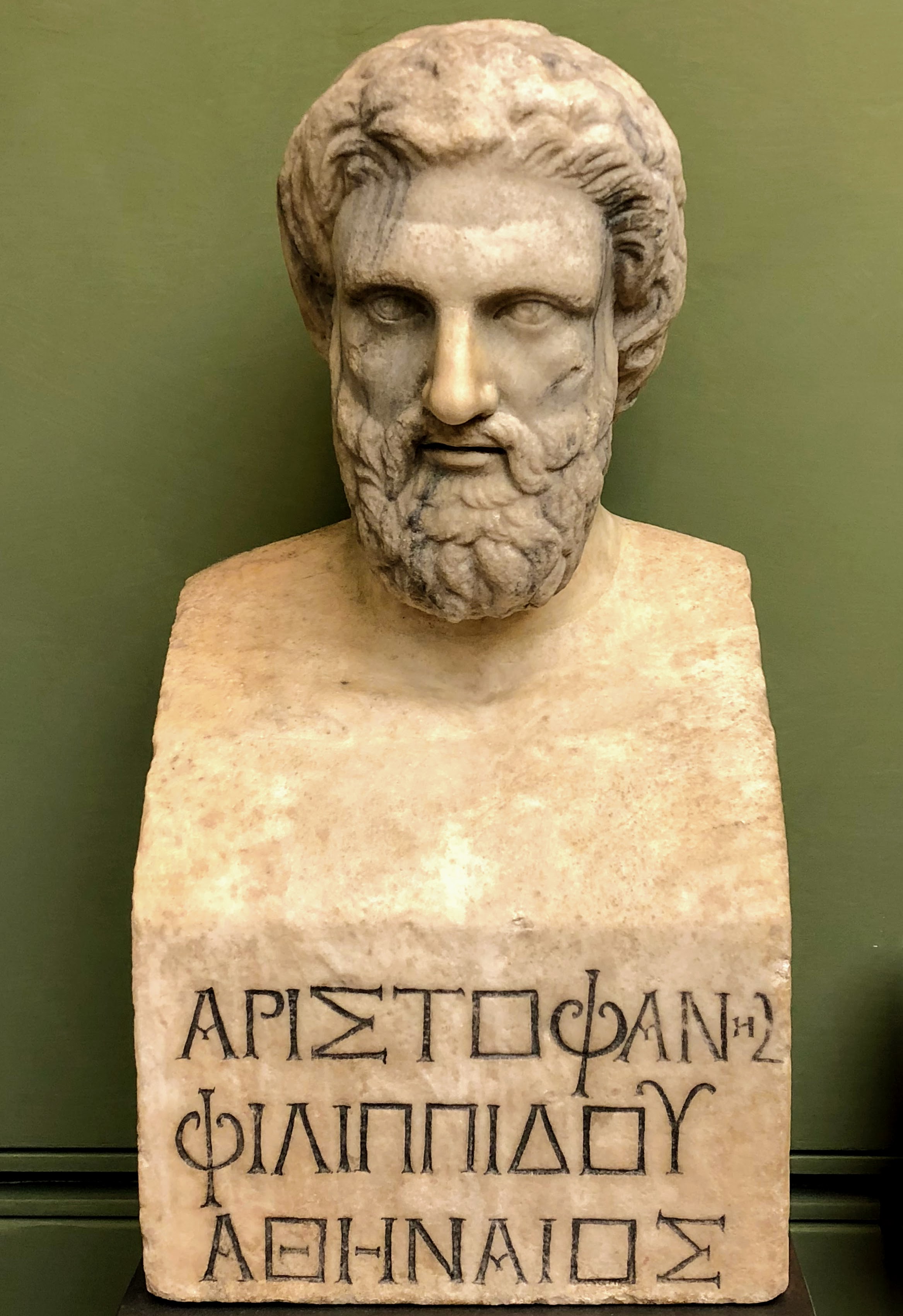
Behavioral Archetype
THE WEAPONIZED PLAYWRIGHT — Subject industrializes ridicule. Where most provocateurs work one target at a time in the agora, subject builds a delivery platform — the comic stage at a state religious festival — and broadcasts character assassination to the entire voting public of Athens simultaneously, by law, with a city-funded chorus and the magistrate’s blessing. Subject named real, living, named individuals on that stage (onomasti komodein — “to mock by name”) and made them watch. The genre is Old Comedy; the actual product is the first scaled, recurring, audience-monetized harassment apparatus in recorded history.
Essence Indicators
- Converts a religious festival into a quarterly content-release schedule with cash prizes for the most effective ridicule
- Targets are always named, always present, and almost always more powerful than the subject — punches up, then publishes
- Weaponizes the one venue in Athens where slander was not actionable: the comic stage carried festival immunity, and subject lived inside that loophole
- Demonstrates that a caricature outlives its subject — the cartoon Socrates dangling in a basket survived the real one by 2,400 years
- Maintains plausible deniability (“it’s only a comedy”) while shaping the reputation of every man he depicts
Social Persona / Impression Management
Immediate impression: A respectable Athenian citizen of the deme Kydathenaion — not a street eccentric, not a beggar-philosopher. Subject is an insider working the institutions, not an outsider attacking them. This is what makes him dangerous: he has standing.
Energy: Exuberant, obscene, relentlessly inventive. Subject oscillates between high lyric poetry (the chorus odes are genuinely beautiful) and the lowest available fart joke within a single scene. The register-whiplash is the technique — the audience is laughing before it notices it has just been handed a political position.
Impression management strategy: “I am merely the funniest man at the festival.” Subject deploys comedy as cover for sustained ideological attack — anti-war (Lysistrata, Acharnians), anti-demagogue (Knights), anti-Sophist (Clouds). When challenged, the work retreats behind its own genre: you cannot prosecute a joke. Cleon tried. Cleon lost.
Forensic Archetype Comparison
| Pattern | Match Level | Evidence |
|---|---|---|
| The Propagandist | HIGH | Every play carries a payload — peace, anti-populism, cultural reaction. The laughs are the delivery vehicle, not the cargo. Subject is running an op and charging admission. |
| The Public Shamer | EXTREME | Onomasti komodein is ritualized public shaming with a chorus. Subject made naming-and-mocking a competitive sport with state prize money. |
| The Grievance Collector | MODERATE | Sustained vendetta against Cleon across multiple plays (Babylonians, Knights, Wasps) following Cleon’s lawsuit. The feud was personal and subject never let it go. |
| The Con Artist | LOW | Takes nothing material by deception. The “fraud” is rhetorical — a caricature presented as a likeness — but subject is open that it is a comedy. |
| The Cult Leader | NONE | Builds no following, demands no devotion, founds no school. The platform, not the personality, is the engine. |
Psychometric Assessment
Big Five (OCEAN):
| Trait | Score | Evidence |
|---|---|---|
| Openness | 95/100 | Invented surreal premises wholesale — a city in the clouds built by birds, a strike of all the women of Greece, a descent to Hades to retrieve a dead playwright. No idea too absurd to stage. |
| Conscientiousness | 80/100 | Produced forty plays across four decades, won at both the Lenaia and City Dionysia, and managed the logistics of chorus, actors, and competition deadlines. The chaos onstage is the product of relentless craft offstage. |
| Extraversion | 78/100 | Worked the most public venue available, but operated through scripts and surrogate actors rather than personal confrontation. Trolled at scale and at a remove. |
| Agreeableness | 12/100 | Mocked the most powerful man in Athens to his face, libelled a philosopher who would later be executed partly on the reputation he helped build, and caricatured his chief artistic rival for thirty years. |
| Neuroticism | 25/100 | Sued by Cleon, denounced before the Council, and undeterred — came back the next festival and did it harder. Some defensiveness leaks through (the parabasis of Clouds whining that the audience was too stupid to award it first prize). |
Dark Triad:
| Trait | Score | Notes |
|---|---|---|
| Narcissism | 55/100 | Elevated. Subject repeatedly inserts self-praise into the parabasis, casts himself as the lone honest voice warning a foolish city, and openly resents losing the 423 competition. The “I alone tell you the truth” posture is load-bearing. |
| Machiavellianism | 82/100 | High. Every play is engineered for effect — calibrated targets, festival timing, the legal shield of comic immunity. Subject knows exactly how reputation is manufactured and does it deliberately. |
| Psychopathy | 30/100 | Moderate-low. Demonstrable indifference to the reputational harm inflicted on named, living people. Not cruel for its own sake — the cruelty serves the bit and the cause — but the casualties were real and subject did not appear to lose sleep. |
MBTI: ENTP (“The Debater”) — the same engine as Socrates, aimed in the opposite direction. Where Socrates dismantled certainties one interlocutor at a time, subject manufactured them a thousand spectators at a time. Dominant extraverted intuition generating endless absurd premises; auxiliary thinking weaponizing them. The two men were the same cognitive type pointed at each other.
Why This Profile Matters
Book connection: Aristophanes is the missing first chapter of the trolling story — proof that the mechanism predates the modern internet by two and a half millennia. He is The Fires of History’s thesis in a single career: ridicule as a public-square weapon, immune from consequence inside a protected venue, scaled to the largest available audience, aimed at the powerful, and remembered longer than anything its targets actually did. The comic stage was the original anonymous-adjacent broadcast platform — festival immunity functioned exactly like a username does now, a license to say the unsayable about real people and walk away clean. When The Clouds fixed a cartoon of Socrates in the Athenian imagination — barefoot, shifty, teaching boys to argue the weaker case into the stronger — it demonstrated the law every subsequent troll would rediscover: the caricature wins, because the caricature is funnier than the man, and funnier travels further than true. Plato thought it helped get his teacher killed. That is the highest documented kill-count of any joke in this file.
Threat Assessment
| Category | Level | Notes |
|---|---|---|
| Physical threat | NONE | A playwright. The danger was entirely textual. |
| Institutional threat | HIGH | Made the demagogue Cleon a laughingstock from inside Athens’ own festival apparatus, using state funds and state sanction. Turned the institution’s own ceremony into a weapon against the institution’s own leadership. |
| Memetic threat | EXTREME | The cartoon Socrates of The Clouds outcompeted the real one in public memory and arguably helped seal his trial. The caricature is still doing damage 24 centuries later — every “ivory-tower intellectual who’ll teach your kids to talk back” smear descends from this play. |
| Posthumous threat | ONGOING | Eleven complete plays survive — the only complete examples of Old Comedy in existence. Subject is the entire genre’s surviving witness, which means he also gets to be the only one whose version of events is preserved. The troll wrote the history. |
Deception Analysis
Primary deception modality: CARICATURE-AS-LIKENESS. Subject presents a deliberate distortion of a real person and lets the audience mistake it for a portrait. The Socrates of The Clouds runs a paid sophistry-school, denies the gods, and teaches unjust argument — none of which the historical Socrates did. Subject knows this; the audience, increasingly, did not. The deception is not in claiming the work is true — it is openly a comedy — but in the durability of the false image after the laughter fades.
Authenticity assessment: PARTIAL. The political convictions are sincere (consistent anti-war, anti-demagogue, culturally conservative across the whole corpus). The portraits are knowingly false. Subject is honest about his positions and dishonest about his targets, which is the precise inverse of Socrates, who was honest about his targets and coy about his positions.
Flame Warrior Classification
Primary: Lurker → Big Cat (works from concealment behind scripts and actors, then strikes at the largest, most powerful available target) Secondary: Tag-Team Troller (the chorus is a coordinated pile-on engine — twenty-four voices amplifying a single attack on cue) Notes: ATK 10 — the highest in the classical cohort. Subject does not merely win arguments; he rewrites his targets’ permanent reputations in front of the entire electorate, and the rewrite sticks for millennia. This is reach no single-combat provocateur achieves. DEF 7 — protected by festival immunity and citizen standing, but not invulnerable: Cleon’s lawsuit landed him before the Council, and The Clouds lost at the festival, a defeat that visibly stung. HP 6 — unlike Socrates (HP 1) or Diogenes (HP 0), subject played the long game, took the hits, came back every season, and died old in his bed. The durability is the point: the troll who survives to write the record gets to be the one history believes.
Sources: Aristophanes (Wikipedia) · Aristophanes (Encyclopaedia Britannica) · Aristophanes (World History Encyclopedia) · Aristophanes, Clouds — English translation (Perseus Digital Library, Tufts)
Cross-Referenced Dossiers



Prefer RSS? Subscribe here.