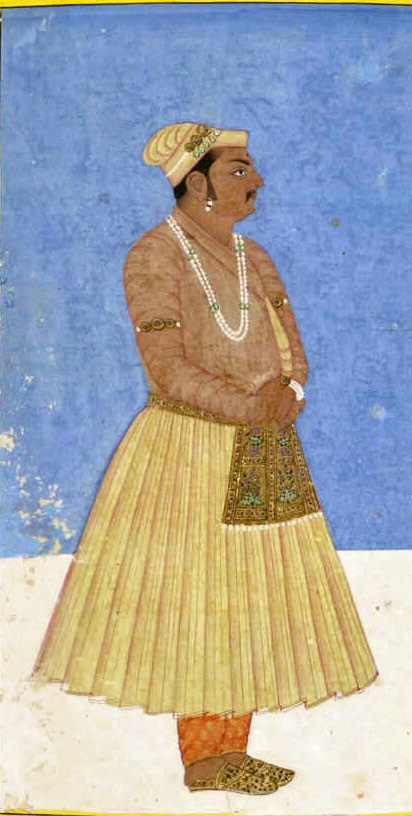
Behavioral Archetype
THE LICENSED CONFIDANT — Subject occupied the one position trolling almost never survives in: a paid seat beside absolute power, held for thirty years, in a court whose dominant faction wanted him gone. Mahesh Das, retitled Birbal by the Mughal emperor Akbar, was a Hindu Brahmin and poet laureate inside a Muslim imperial court, one of the navaratna (“nine jewels”) of advisors, and — per the record — the only Hindu ever to adopt Akbar’s syncretic court religion, the Din-i-Ilahi. The historical man was a working minister, courtier, and military commander who died on campaign. The man the subcontinent actually remembers is a folk construct: the quick-witted advisor of the “Akbar and Birbal” tale cycle who punctures pomposity, traps the greedy in their own logic, and resolves the emperor’s impossible riddles by reframing them. This profile assesses both and keeps them separate. The tales are folklore; the survival was real, and the survival is the finding.
Note on historicity: the wit cycle is overwhelmingly posthumous invention. The contemporary record gives a capable administrator and a doomed general; the thousands of clever anecdotes accreted onto his name over the following centuries the way the West attaches stray witticisms to Twain or Churchill. Where the tales are cited below, they are cited as tales.
Essence Indicators
- Trolled from the inside of power, with a salary and a title, for three decades — the rarest survival profile in this file. Most operatives who get this close to a throne are exiled or executed; Subject was housed inside the palace complex at Fatehpur Sikri.
- A Hindu in a Muslim court, advanced over the objections of the orthodox faction — i.e., a permanent out-group member trusted above the in-group. The friction was structural and never went away.
- Resolved the powerful figure’s impossible commands by reframing the context rather than defying the command. In the best-known tale, ordered to make a drawn line shorter without touching it, he draws a longer line beside it. The constraint is honored absolutely, and the honoring is the punchline. (Folklore.)
- The trolling was pedagogical and load-bearing for the ruler: Akbar kept a man who made him look foolish because tolerating that man made Akbar look wise — wise enough to prize cleverness over flattery. A genuinely symbiotic arrangement.
- Belongs, in his afterlife, to no one and to everyone. The “Akbar-Birbal” corpus is folk property across the subcontinent — anonymous, endlessly remixed, retold in print, on radio, and in animation centuries after the man himself fell in a mountain pass.
Social Persona / Impression Management
Immediate impression: Not a fool and never disguised as one. Unlike Nasreddin Hodja, who hid a judge behind a bumbling villager, Subject presented as exactly what he was — a polished poet and courtier, the “Kavi Priya” (poet laureate), fluent across Hindi, Sanskrit, and Persian. The disarming move was not feigned stupidity but disarming charm: the cleverest man in the room, openly, who made his cleverness entertaining enough to be forgiven.
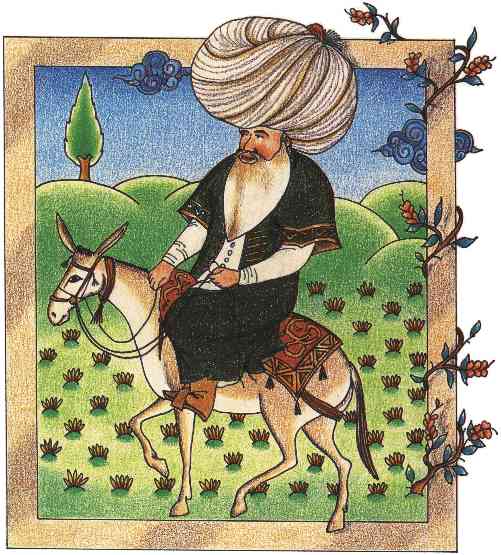
Energy: Quick, dry, deferential in form and subversive in content. The tales show him agreeing with the premise of a hostile question and then following it to an absurd destination that exposes the questioner — the same reframe-not-refuse mechanic Nasreddin uses riding his donkey backwards. He never tells the emperor he is wrong. He builds the emperor a road to noticing it himself.
Impression management strategy: Indispensability as armor. Subject made himself the one advisor who delivered truth as pleasure rather than as risk — flattering the emperor’s self-image as a tolerant patron in the very act of contradicting him. The orthodox faction’s hostility was the proof the strategy worked: a man that disliked, kept that close, that long, is being protected by something. That something was Akbar’s investment in his own reputation for tolerance, an investment Subject fed daily.
Forensic Archetype Comparison
| Pattern | Match Level | Evidence |
|---|---|---|
| The Court Jester | HIGH | The canonical case — licensed to mock power from within, protected by the comic frame and the patron’s pleasure. Differs from the pure jester in that Subject held real administrative and military office; the wit was one instrument among several, not the whole of him. |
| The Methodological Deconstructor | MODERATE-HIGH | Shares the Socratic core move in folk form — accept the premise, extend its logic until it collapses, let the target indict himself. Delivered as one-shot anecdote rather than sustained dialectic. |
| The Chameleon | LOW | One consistent persona — the loyal, brilliant confidant. He did not shift masks; the only “disguise” was that the loyalty and the subversion were the same act. |
| The Grievance Collector | LOW | No enemies list, no score-settling in the corpus. The trolling targets folly, hypocrisy, and greed generically — including, in the tales, the emperor’s own. |
| The Con Artist | LOW-MODERATE | Several tales are structured as long cons in which the mark’s own greed or vanity springs the trap, but the payoff is always a demonstration, never the take. |
Psychometric Assessment
Assessment of the composite figure the tradition built — the historical administrative record is too thin for a clinical read, and the wit corpus is folklore.
Big Five (OCEAN):
| Trait | Score | Evidence |
|---|---|---|
| Openness | 88/100 | The entire schtick is reframing — treating every fixed constraint (a line, a riddle, a rule) as renegotiable context. Crossed religious lines twice over: a Brahmin in a Muslim court, and the lone Hindu adopter of the Din-i-Ilahi. |
| Conscientiousness | 78/100 | The real man was a thirty-year administrator and a field commander who died leading an army. The folk wit reads as improvisation, but the career it sat on top of was disciplined and durable. |
| Extraversion | 80/100 | Operated entirely in the public theater of the court — the durbar, the campaign, the banquet. The wit requires an audience and a foil, and the court supplied both daily. |
| Agreeableness | 70/100 | Genuinely liked, by the one person who mattered. Warm in register; the barbs are wrapped in deference and land softly enough that the target laughs before he counts the cost. |
| Neuroticism | 25/100 | Composure under permanent factional hostility and, finally, under a doomed military command. Low, though not at the floor — the man did, in the end, walk an army into an ambush. |
Dark Triad:
| Trait | Score | Notes |
|---|---|---|
| Narcissism | 30/100 | Moderate-low. The poet-laureate title implies a man comfortable being celebrated, but the folk persona routinely serves the emperor’s glory rather than his own, and several tales make Subject the straight man. |
| Machiavellianism | 60/100 | The real find. Surviving thirty years as the most-resented man at court, advanced over the in-group, is not luck — it is sustained, calibrated political management. Every “harmless” jest in the corpus doubles as a move that flatters the patron while correcting him. |
| Psychopathy | 10/100 | Very low. No cruelty, no callousness in the corpus; the defining note of the figure is affection, the inverse of cold detachment. |
MBTI: ENTP (“The Debater”) — Dominant extraverted intuition, auxiliary introverted thinking. The reframe-everything reflex, the appetite for the adversarial verbal puzzle, the ability to win the exchange while keeping the room on his side. Where Nasreddin (ENFP) wins your love, Birbal wins the argument and makes the loser thank the emperor for hosting it.
Why This Profile Matters
The Fires of History (Chapter 6) files Birbal under “Other Trickster Traditions” to make a load-bearing point: the court-troll is a human universal, not a Western one, and the subcontinent built the cleanest specimen of it. He is the book’s exhibit for the symbiosis of troll and authority — the relationship in which the powerful figure deliberately keeps a man whose job is to make him look foolish, because the keeping is what makes him look wise. The troll needs the patron; the patron needs the troll. Cut either and both lose the thing that made the arrangement work.
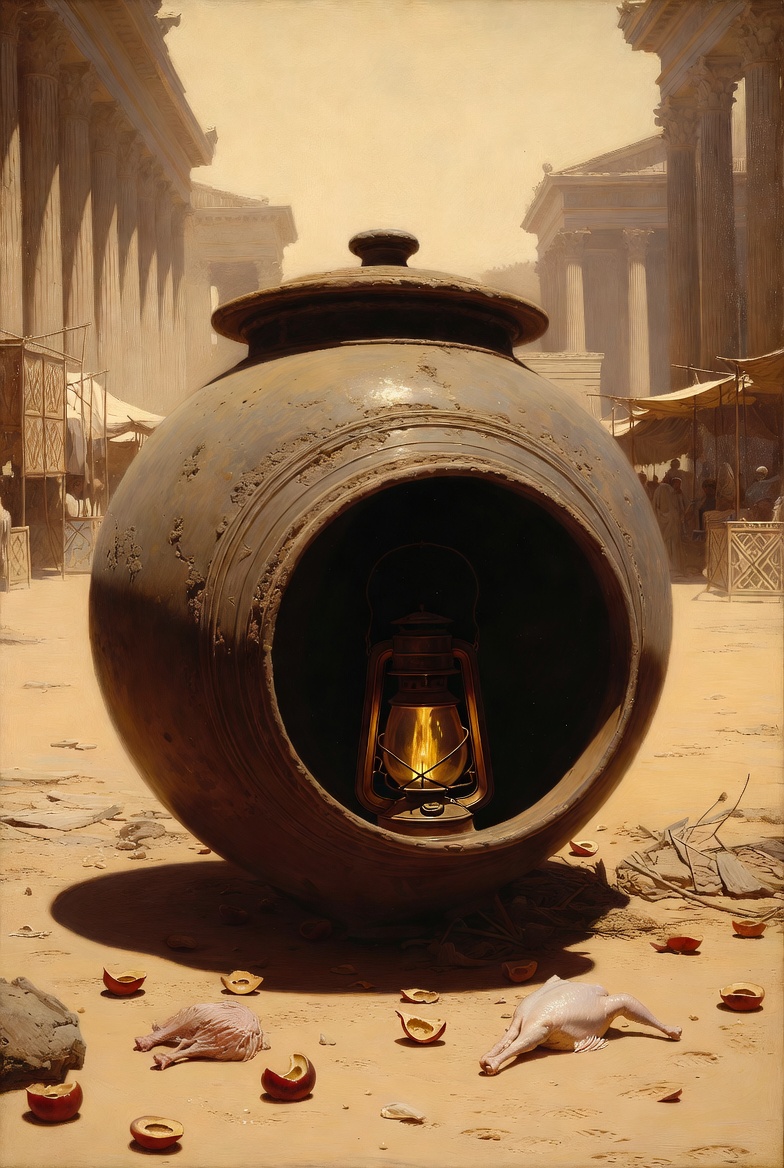
He sits alongside Nasreddin Hodja as the book’s two beloved court-and-folk wits, and the pairing is instructive. Both ran the reframe-not-refuse play; both were absorbed into folk property and outlived every court they served. But Nasreddin hid a judge inside a fool, while Birbal hid the subversion inside open brilliance and indispensability. Two solutions to the same problem — how to tell power the truth and keep your head — and both, unlike Diogenes of Sinope, who told Alexander to stop blocking his sun and went home to a jar with nothing, did it from inside the tent, on the payroll, for life. Diogenes proves you can speak truth to power with zero leverage and survive on indifference; Birbal proves you can do it with maximum proximity and survive on usefulness. The book needs both poles.
Threat Assessment
| Category | Level | Notes |
|---|---|---|
| Physical threat | LOW (to others) | A poet and minister, not a brawler. The lethal risk ran the other way: he died at the head of an army, ambushed in a mountain pass. |
| Institutional threat | NEUTRALIZED-BY-ABSORPTION | Demonstrated, from inside the durbar, that the court’s pieties and its courtiers’ vanities were fair game — but did it in a form the institution chose to enjoy rather than expel. The orthodox faction never managed to dislodge him while Akbar lived. |
| Memetic threat | EXTREME | The “Akbar-Birbal” cycle has self-replicated across the subcontinent for four centuries — print, comics, radio, television, animation — far outrunning anything the historical man said or did. The name is now a synonym for quick wit. |
| Civilizational threat | INVERTED | Not a threat to the order but a load-bearing part of it — the sanctioned internal critic a flexible court keeps on purpose. The cautionary half of the lesson is in the ending: the wit was kept, but the man was also sent to die in a war that had no use for wit, and the court’s “greatest tragedy” was the one it inflicted on itself. |
Flame Warrior Classification
Primary: Jester (the licensed wit who mocks power from inside the court, by the ruler’s own design and to the ruler’s own credit) Secondary: Philosopher (each anecdote resolves into a point about evidence, greed, hypocrisy, or power, delivered as entertainment) Notes: ATK 8 — the reframe-not-refuse move is genuinely sharp and the corpus still lands centuries on, but it is folk-attributed and one-shot rather than the sustained dialectical pressure that earns a 9. DEF 9 — among the highest in this file, and earned the hard way: not the indifference-armor of Diogenes but usefulness-armor, thirty years of being too valuable and too entertaining to remove despite a court faction that wanted him gone. He loses the point off a 10 because the protection was conditional on a single patron’s favor, not granted by a whole culture the way Nasreddin’s was. HP 7 — he survived the court, which kills most of this file, and his name became immortal folk property; but the man himself did not get the soft landing. The same emperor who protected the wit spent the general, and Birbal fell in the Battle of Malandrai with thousands of his troops, body never recovered. The wit is deathless. The man was not.
Sources: Abu’l-Fazl, Akbarnama, tr. H. Beveridge, vol. III, pp. 718-732 (sent to Swat; the Karakar and Malandarai passes; his death); Britannica — Birbal; Birbal (Wikipedia); Battle of the Malandari Pass, 1586 (Wikipedia); Who Were the Nine Gems (Navratnas) of Emperor Akbar? — WorldAtlas.
Cross-Referenced Dossiers
Prefer RSS? Subscribe here.