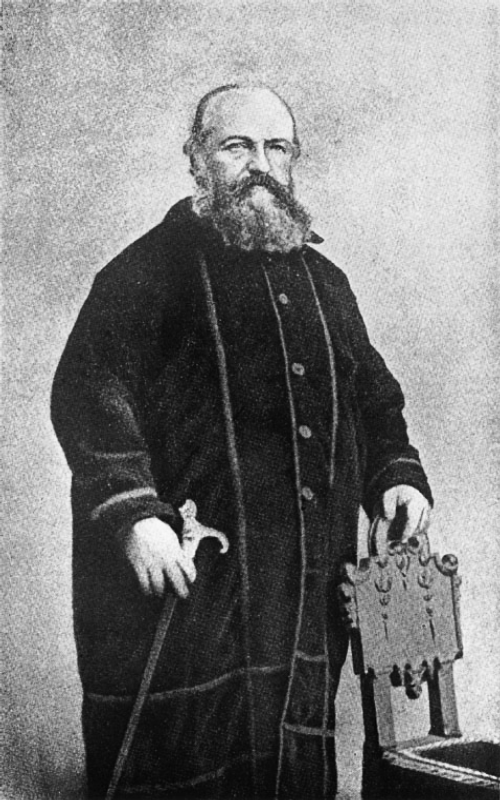
Related research: Eliphas Levi (1810-1875): The Catholic Seminarian Who Drew Satan.
Behavioral Archetype
THE REBRANDER OF THE FORBIDDEN — Subject took the scattered, disreputable wreckage of folk magic, Kabbalah, tarot fortune-telling, and Renaissance grimoires, and assembled it into a single coherent system with a respectable French name: “la haute magie.” He did not invent the material. He invented the package. A failed Catholic priest and lapsed revolutionary socialist rebranded centuries of village superstition as a unified occult science, gave it a synthesized Hebrew pen name for authority, and sold it to the bourgeoisie. Almost every ceremonial magician who followed — the entire Golden Dawn, Crowley, Waite, Papus — is downstream of the catalogue he built.
Essence Indicators
- Projects scholarly authority while operating largely on synthesis, reinterpretation, and confident assertion rather than primary discovery
- Manufactured a new identity (the Hebraized “Éliphas Lévi Zahed” from “Alphonse Louis Constant”) to lend gravity and antiquity to recent invention
- Welded the 22 tarot trumps to the 22 letters of the Hebrew alphabet and the Tree of Life — a pairing Court de Gébelin had made in 1781, which Lévi built into a Kabbalistic system, the occult world adopted, and almost nobody questions to this day
- Popularized (not coined: Dutoit-Membrini had it in 1793) “astral light” as the universal magical medium — one fluid that explains everything from magnetism to miracles
- Drew the single most reproduced image in the history of the occult — the winged, androgynous Sabbatic Goat (Baphomet) — and embedded a whole doctrine of equilibrium into its anatomy
- Carried a revolutionary’s instinct for propaganda from his socialist years straight into his magic: both careers were about converting the reader
Social Persona / Impression Management
Immediate impression: The learned Parisian abbé-who-wasn’t — a man in clerical bearing discoursing on Kabbalah, tarot, and the secret tradition of the magi with the fluency of someone who had read everything and the authority of someone who had decided what it all meant. To his students he was the keeper of a recovered tradition. To the Church he had abandoned, an apostate. To the historian, a brilliant compiler who confidently filled the gaps in his sources with himself.
Energy: Erudite, didactic, persuasive. Contemporary accounts and his own prose describe a man who wrote with total conviction — the register of revealed truth, not tentative scholarship. The same rhetorical engine that produced the socialist pamphlet La Bible de la liberté (1841, and a prison sentence) produced Dogme et Rituel. He never stopped being a propagandist; he only changed the gospel.
Impression management strategy: AUTHORITY BY SYNTHESIS. Lévi’s genius was framing. He presented magic not as a grab-bag of superstition but as a single, ancient, internally consistent science — “la haute magie” — with himself as its expositor. The Hebrew pen name, the Kabbalistic scaffolding, the confident genealogies tracing his system back to the magi: all of it manufactured the impression of a tradition being recovered rather than a system being assembled. It worked so well that the assembly is now indistinguishable from the tradition.
Forensic Archetype Comparison
| Pattern | Match Level | Evidence |
|---|---|---|
| The System Builder | HIGH | Dogme et Rituel de la Haute Magie is the founding architecture of modern Western ceremonial magic. Lévi did not just write about magic — he gave it a structure that everyone after him inherited. |
| The Rebrander | HIGH | Took folk magic, grimoires, tarot, and Kabbalah — individually disreputable — and recombined them under a respectable banner. The material was old; the packaging and the authority were his. |
| The Authority Manufacturer | MODERATE-HIGH | The Hebraized name, the asserted-not-demonstrated tarot/Hebrew correspondences, the confident genealogies. Authority was constructed, then projected. |
| The Failed Insider Turned Prophet | MODERATE | Seminary-trained, a deacon who was expelled or departed before priestly ordination, revolutionary, jailed, then prophet of a new science. The pattern of a man who tried the establishment, was rejected by it, and built his own. |
Psychometric Assessment
Big Five (OCEAN):
| Trait | Score | Evidence |
|---|---|---|
| Openness | 96/100 | Catholic theology, revolutionary socialism, Kabbalah, tarot, mesmerism, alchemy, ceremonial magic — and a willingness to fuse all of them into one framework. Few boundaries respected. |
| Conscientiousness | 78/100 | Twenty-plus books, a coherent and sustained system, decades of disciplined writing and teaching. The output is large, organized, and internally consistent. |
| Extraversion | 58/100 | Moderate. A teacher and propagandist who cultivated students and correspondents, but fundamentally a writer working from his study, not a stage performer. |
| Agreeableness | 48/100 | Cooperative with patrons and pupils, but doctrinally immovable. Abandoned a priesthood and a revolution when each stopped fitting the project; his wife left him and the marriage was annulled. |
| Neuroticism | 55/100 | Moderate. The repeated ruptures — Church, politics, marriage — and the late-life poverty suggest real instability beneath the magisterial prose. |
Dark Triad:
| Trait | Score | Notes |
|---|---|---|
| Narcissism | 58/100 | Moderate-high. Renamed himself in Hebrew, positioned himself as the expositor of the one true magical science, and wrote in the voice of revealed authority. But the ego served the system more than the man — he sought to be the prophet of the tradition, not its god. |
| Machiavellianism | 52/100 | Moderate. The framing strategy — asserting correspondences as ancient fact, manufacturing authority through nomenclature and genealogy — is calculated. Whether Lévi believed his own framing is genuinely unclear, which is the mark of an effective one. |
| Psychopathy | 12/100 | Low. No pattern of callousness or exploitation of followers. The harm, such as it is, is intellectual: a body of confident assertion that later practitioners took as recovered fact. |
MBTI: INTJ (“The Architect”) — Dominant introverted intuition, auxiliary extraverted thinking. Lévi perceives a single hidden unity behind theology, politics, and magic, then builds an explicit, teachable system to express it. The intuition sees the correspondences (tarot ↔ Hebrew ↔ Tree of Life); the thinking function welds them into a structure durable enough to outlast him by two centuries.
Why This Profile Matters
Lévi is the hinge. Before him, Western magic was folklore, hedge-craft, and mouldering grimoires — disreputable, fragmented, embarrassing. After him, it was a system: a body of doctrine with a vocabulary (“astral light”), a structure (tarot welded to Kabbalah), an iconography (Baphomet), and the posture of a recovered ancient science. The Hermetic Order of the Golden Dawn built its curriculum on his correspondences. A. E. Waite translated him. Crowley took the system as foundational — and believed himself to be Lévi reincarnated, having been born the year Lévi died (1875). Nearly every ceremonial magician, tarot reader, and occult bookshelf in the English-speaking world is running, knowingly or not, on infrastructure Éliphas Lévi laid down. He is the proof that a tradition can be assembled and then become real through sheer adoption.
Threat Assessment
| Category | Level | Notes |
|---|---|---|
| Physical threat | NONE | A writer and teacher. Jailed at least twice (three times per Strube: 1841, 1847, 1855) — for pamphlets, not violence. |
| Institutional threat | MODERATE | Abandoned the Catholic priesthood and turned his back on the revolutionary socialism that jailed him, then built a rival framework of meaning outside both Church and state. A one-man counter-institution. |
| Memetic threat | EXTREME | The astral light, the tarot/Hebrew correspondences, “magic is the science of the will,” and the Baphomet image are all still in continuous circulation. The Sabbatic Goat alone has propagated from a French study first issued in 1854 to Church-of-Satan iconography, heavy-metal album art, and a bronze statue unveiled in Detroit (2015) and now in Salem. The package outlived the man, the Church he left, and the revolution he served. |
| Posthumous threat | ONGOING | Died poor; the system made others famous. The Golden Dawn, Waite, and Crowley are household names among occultists in a way Lévi — their source — often is not. The architect is less famous than the building. |
Deception Analysis
Primary deception modality: AUTHORITY BY SYNTHESIS — the confident assertion of constructed correspondences as recovered ancient truth. Lévi rarely lies about discrete facts. He instead presents his own synthesis — the tarot-Hebrew mapping, the unified astral light, the genealogy of the magi — in the register of established tradition, collapsing the distinction between “I have decided this fits” and “this has always been so.” The deception is structural, not factual.
Authenticity assessment: GENUINELY UNCLEAR — and that is the point. Lévi may have wholly believed his system; the conviction in the prose is total. But total conviction is exactly what an effective framing requires, and his earlier careers — priest, then revolutionary pamphleteer — were both exercises in persuading readers of a totalizing worldview. Whether the magus believed the magic is unanswerable, which is precisely why the framing worked.
Flame Warrior Classification
Primary: Philosopher / Tireless Secondary: Issues (the man who reframed the entire subject and made his framing the default terms of debate) Notes: ATK 8 — the system landed and stuck; two centuries of ceremonial magic argue on his terms, using his vocabulary, inside his structure. That is the highest-leverage attack in this file: not a provocation but a frame that everyone after him had to accept or refute. DEF 3 — he protected nothing of his own: lost the Church, lost the revolution, lost the marriage, died poor while his system enriched the reputations of others. HP 4 — survived two imprisonments and serial self-reinvention, but ended in obscurity and want. The HP measures the man; the ATK measures the system, and the system won.
See also: Aleister Crowley, who took Lévi’s system as foundational and believed himself to be Lévi reincarnated — born in 1875, the year Lévi died — and John Dee, whose Enochian system the Golden Dawn would later graft onto the Kabbalistic scaffold Lévi supplied.
Sources: Julian Strube, “The ‘Baphomet’ of Eliphas Lévi,” Correspondences 4 (2016) · Maitron, “Constant Alphonse, Louis” · Éliphas Lévi — Wikipedia · Lévi, Éliphas (1810–1875) — Encyclopedia.com · Transcendental Magic: Its Doctrine and Ritual (Waite trans.) — Internet Archive · Eliphas Levi: The magician who revived occultism — Sky HISTORY
Cross-Referenced Dossiers
Prefer RSS? Subscribe here.