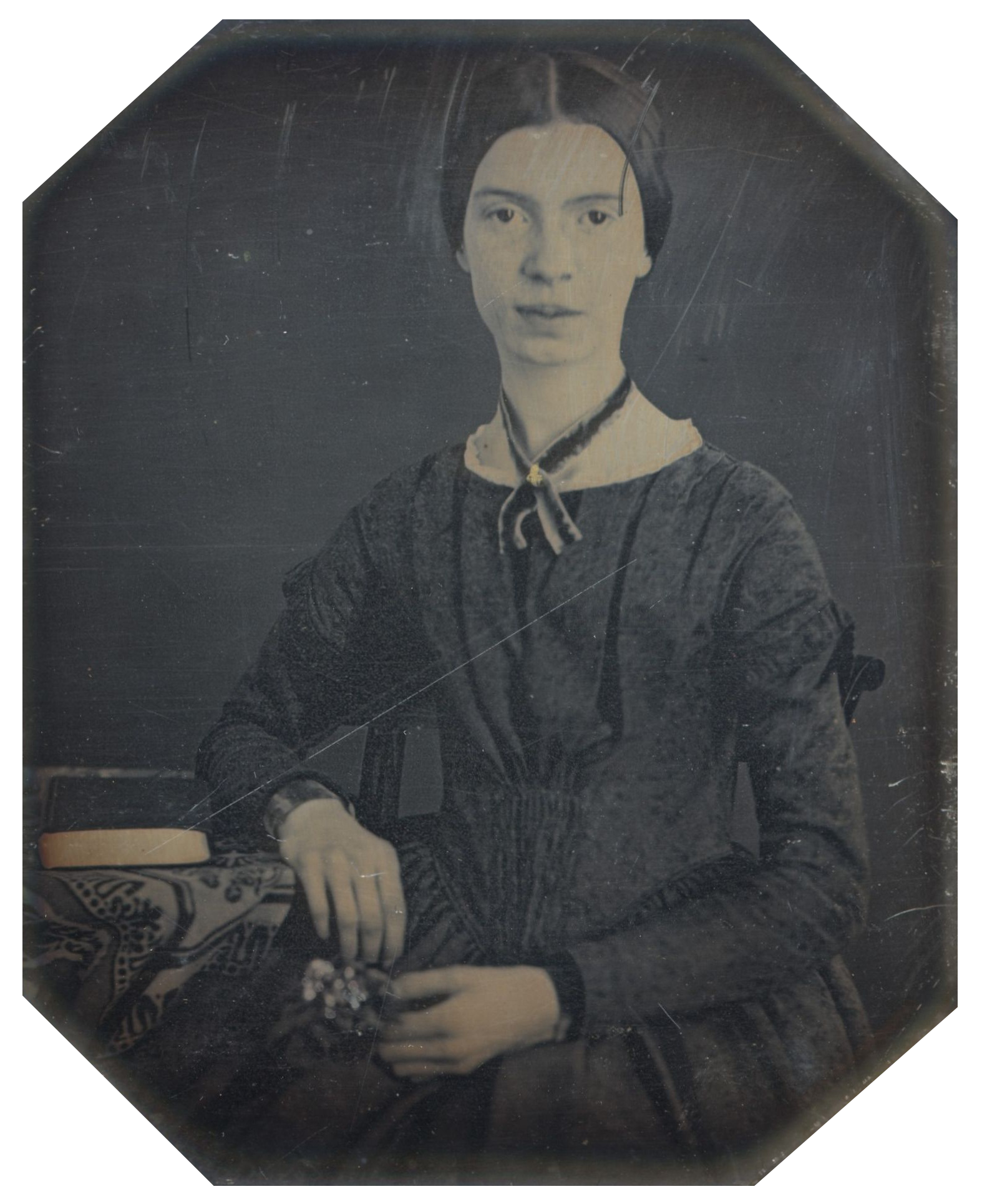
Behavioral Archetype
THE SNIPER — Subject wrote roughly 1,800 poems and allowed about a dozen into print while she lived. The rest she bound by hand into forty fascicles and left in a drawer. There was no flame war, no submission cycle, no campaign for recognition. There was a body of work assembled in near-total privacy and a single decision not to fire it until she was past caring whether it landed. It landed in 1890, four years after her death, and it has not stopped landing since. The Sniper does not argue with the establishment. The Sniper waits, and the shot ends the conversation.
Essence Indicators
- Born and died in the same house in Amherst, Massachusetts; in her final years left it so rarely that the reclusion became the defining public fact about her, which is precisely the cover under which the work was built.
- Wrote nearly 1,800 poems; fewer than a dozen were published in her lifetime, several of them anonymously and at least some without her consent.
- Solicited a verdict from Thomas Wentworth Higginson, an Atlantic Monthly contributor, in 1862 — then carried on a decades-long correspondence with him while declining to publish on his terms. The mentor was consulted and then routed around.
- Built radical formal subversion into work that looked, from across a parlor, like a spinster’s hymn-meter: slant rhyme where convention demanded true rhyme, dashes where convention demanded stops, capitals deployed as a private grammar of emphasis.
- After her death her sister Lavinia found the fascicles; Mabel Loomis Todd and Higginson published the first selection in 1890, “regularizing” the punctuation and rhyme — corrections that scholarship spent the next century reversing.
Social Persona / Impression Management
Immediate impression: The eccentric recluse of the Homestead — the woman in white who spoke to visitors through a door and tended a garden. A figure read by the town as a curiosity, by literary history as a tragedy, and by neither, for a long time, as the most formally aggressive American poet of her century.
Energy: Withdrawn to the point of disappearance, and exact. The compression is not shyness rendered into verse; it is a sniper’s economy. No wasted words, no collateral.
Impression management strategy: Domestic invisibility as camouflage. The reclusion was not a retreat from the work but the condition that made it possible — a poet seen as too odd to publish is a poet left alone to write. Whether she suppressed the work out of conviction or was discouraged into it is the hinge the whole reading turns on: discouraged, she is a victim of Higginson’s verdict; deliberate, she is running the longest delayed-detonation in American letters. The dashes argue for the second.
Forensic Archetype Comparison
| Pattern | Match Level | Evidence |
|---|---|---|
| The Sniper | MAXIMUM | One devastating body of work, withheld until it could not be argued with, fired posthumously. The book’s named exemplar of the type. |
| The Withdrawn Genius | MAXIMUM | Near-total reclusion under cover of which the actual work was done — the same structure as Austin Osman Spare, whose innovations also surfaced only after the basement door closed for good. |
| The Formal Subversive | HIGH | Slant rhyme, dashes, and idiosyncratic capitalization read as incompetence to her contemporaries and as a century-early innovation to everyone since. |
| The Romantic Sufferer | LOW | The isolation was real but not performed for an audience; she aestheticized solitude in the poems, not her biography for the press. |
| The Self-Promoter | NONE | The inverse. She declined the one channel — Higginson, the Atlantic — that could have made her famous in life. |
Psychometric Assessment
Big Five (OCEAN):
| Trait | Score | Evidence |
|---|---|---|
| Openness | 96/100 | Reinvented the formal vocabulary of the lyric — meter, rhyme, punctuation, the very grammar of emphasis — working alone, against every convention available to her. |
| Conscientiousness | 78/100 | Composed and hand-bound forty fascicles over years of sustained, private discipline. The output was meticulous; the career management was deliberately absent. |
| Extraversion | 8/100 | Near-zero. Withdrew from public life almost entirely; conducted her closest relationships by letter through a door she would not open. |
| Agreeableness | 50/100 | Moderate. Warm and generous in correspondence, but immovable on the one point that mattered — she would not publish on anyone’s terms but her own, and chose none. |
| Neuroticism | 60/100 | Elevated. The reclusion and the work’s preoccupation with death, dread, and the edge of sanity point to real interior weather, channeled rather than merely suffered. |
Dark Triad:
| Trait | Score | Notes |
|---|---|---|
| Narcissism | 18/100 | Low. Refused the recognition available to her and attached her name to almost nothing while alive. The fame is entirely posthumous and was never solicited. |
| Machiavellianism | 35/100 | The one elevated reading in an otherwise low profile. Consulting Higginson and then routing around him — keeping the mentor as correspondent while ignoring the verdict — is, on the deliberate reading, a long and patient strategy. |
| Psychopathy | 6/100 | Very low. No cruelty, no exploitation. The aggression is entirely formal, aimed at convention, never at people. |
MBTI: INFJ (“The Advocate”) — introverted intuition driving a private, fully-formed inner vision (Ni), expressed through an intensely personal value-grammar (Fe turned inward). The type that builds a complete world in seclusion and lets it out, if at all, on its own schedule.
Why This Profile Matters
Dickinson is the Sniper archetype in its purest form and the cleanest case in The Fires of History for trolling-as-withdrawal: subversion executed not by engaging the establishment but by refusing it entirely and outlasting it. The literary order of her century could not “correct” what it never saw; when it finally got the poems, in 1890, it edited the dashes into commas and the slant rhymes into true ones — and spent the next hundred years putting them back exactly as she wrote them. Every standardization was the establishment telling her she was wrong; every restoration was the establishment conceding she was right. She won the argument without ever entering it. “Tell all the truth but tell it slant” is not only her ars poetica; it is the operating manual for the type.
Threat Assessment
| Category | Level | Notes |
|---|---|---|
| Physical threat | NONE | A recluse in a garden. The danger is entirely on the page. |
| Institutional threat | LOW (in life) | She did not challenge the literary establishment; she absented herself from it. The threat was invisible until the drawer was opened. |
| Memetic threat | HIGH (posthumous) | The formal innovations — compression, the dash, the off-rhyme — propagated through a century of American poetry and became standard equipment. The reach is enormous and entirely delayed. |
| Scholarly threat | MAXIMUM (to the “corrected” text) | Every editorial regularization of her work has been overturned by the return to her manuscripts. The threat runs against the editors who thought they were fixing her. |
Flame Warrior Classification
Primary: Sniper — the book’s exemplar; one perfectly aimed body of work, fired once, no second shot needed. Secondary: Ghost — absent from the conversation in life, haunting it permanently after. Notes: ATK 9 — the work is devastatingly effective and has never stopped detonating, but it was delivered without force or fanfare, which is the Sniper’s whole method. DEF 9 — near-total: she gave the establishment no surface to attack while she lived, and the work she left behind has proven impervious to a century of editorial “correction.” HP 4 — the body of work is indestructible; the woman was mortal, in declining health for years, and dead at 55. The fragility was hers; the shot is permanent.
Sources: Poetry Foundation — Emily Dickinson; Britannica — Emily Dickinson; Emily Dickinson Museum — The Posthumous Discovery of Dickinson’s Poems; Poetry Foundation — “Tell all the truth but tell it slant —” (1263).
Cross-Referenced Dossiers
Prefer RSS? Subscribe here.