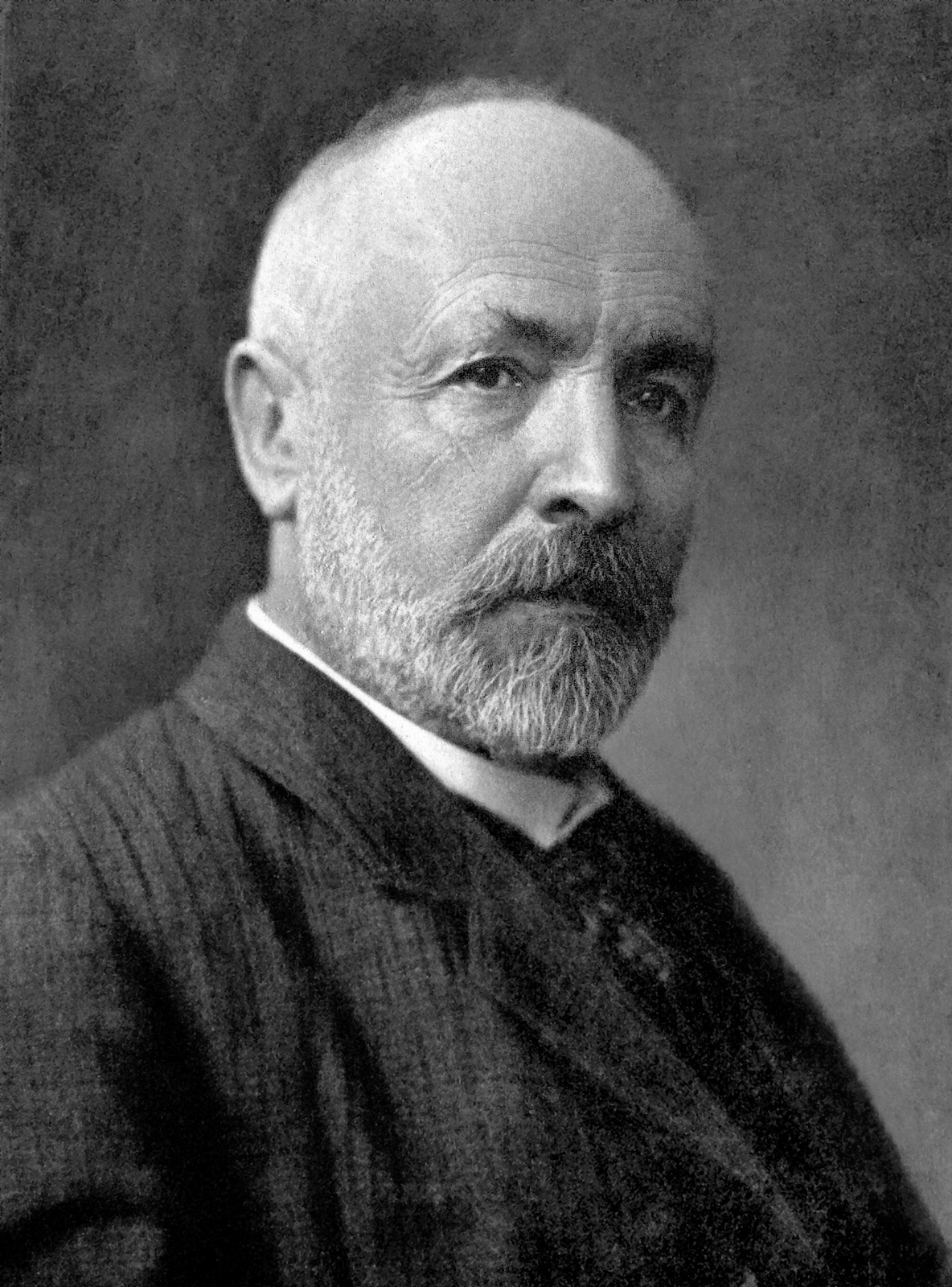
Behavioral Archetype
THE MAN WHO COUNTED PAST INFINITY — Subject proved a true result so counter-intuitive that the establishment treated it as a deliberate provocation. Cantor did not set out to troll anyone. He set out to do mathematics, rigorously, and arrived at a conclusion the field had assumed was impossible for two thousand years: that infinity comes in different sizes. The provocation was structural, not intentional. A correct proof that contradicts a settled intuition is indistinguishable, to the people holding that intuition, from an attack. The discipline responded to the attack rather than to the proof, and the proof was right.
Essence Indicators
- Proved in 1874 that the real numbers cannot be put in one-to-one correspondence with the natural numbers — two infinities, one strictly larger than the other
- Refined the result in 1891 into the diagonal argument, now taught to every undergraduate mathematician alive
- Founded set theory, the framework underneath topology, real analysis, and most of modern mathematics
- Was not engaging in rhetoric. The “provocation” was a theorem. It could not be refuted, only resented
- Suffered recurrent depressive episodes beginning in 1884; took repeated leaves and spent extended periods in sanatoria
- Died in 1918 in the sanatorium at Halle, in straitened circumstances, during the privations of the war’s final year
- Lived to see set theory begin its acceptance; did not live to see it become the foundation it now is
Social Persona / Impression Management
Immediate impression: An earnest, devout, professionally peripheral academic. Cantor spent his entire career at the University of Halle, a minor institution, and never obtained the chair at Berlin he wanted. He was not a political operator and had none of the institutional armor that protected a Newton or a Kronecker. He published his results and expected them to be judged on their merits, which turned out to be a naive theory of how disciplines work.
Energy: Sincere, combative under attack, increasingly fragile. Cantor did not absorb hostility with detachment. He resented Kronecker’s opposition openly and at length, and the conflict took a measurable toll. Where Fermat wrote a provocation and felt nothing, Cantor produced a proof and was wounded by the reaction to it.
Impression management strategy: NONE, EFFECTIVELY. This is the distinguishing feature of the case. Cantor had no strategy for managing the establishment because he did not believe one should be necessary. He assumed a correct proof would win on its own. It eventually did — long after the machinery available to defend it during his lifetime had failed him completely.
Forensic Archetype Comparison
| Pattern | Match Level | Evidence |
|---|---|---|
| The Inadvertent Provocateur | MAXIMUM | The provocation was a theorem, not a taunt. Cantor proved a true thing; the field experienced the true thing as an insult to its intuitions. The trolling, such as it was, lived entirely in the audience. |
| The Persecuted Heretic | HIGH | Kronecker treated a mathematical result as a doctrinal offense and moved against the man rather than the math — blocking appointments, delaying publication, disparaging the work. The structure is the heresy trial, conducted in journals. |
| The Margin Annotator | LOW-MODERATE | Shares Fermat’s pattern of an extraordinary claim about the structure of number that the establishment could not immediately absorb — but Cantor supplied the proof, in full, and was attacked anyway. The opposite failure mode: not withholding, but being disbelieved despite showing all the work. |
| The Narcissistic Operator | NONE | No flex, no withholding, no manipulation. Cantor wanted the result accepted because it was true, not because it was his. |
Psychometric Assessment
Big Five (OCEAN):
| Trait | Score | Evidence |
|---|---|---|
| Openness | 95/100 | Conceived of completed infinities as objects that could be counted, ordered, and compared — a category of thought the discipline had ruled out since Aristotle. The diagonal argument is one of the most genuinely original ideas in mathematics. |
| Conscientiousness | 80/100 | Rigorous and thorough in the work itself. Produced a sustained body of foundational papers through the 1870s and 1880s, sustained against active institutional opposition. |
| Extraversion | 30/100 | Low. An academic at a provincial university who worked largely in isolation and corresponded to defend his results rather than to build a faction. |
| Agreeableness | 45/100 | Cordial by default but combative when his work was attacked; the feud with Kronecker was prosecuted with real bitterness on both sides. |
| Neuroticism | 80/100 | High and consequential. Recurrent depressive episodes from 1884 onward, repeated sanatorium stays. The hostility magnified the suffering even where it did not cause it. |
Dark Triad:
| Trait | Score | Notes |
|---|---|---|
| Narcissism | 30/100 | Wanted recognition for a true result — ordinary scholarly ambition, not grandiosity. |
| Machiavellianism | 10/100 | Near absent. He had no strategy against Kronecker beyond being right, which is the opposite of a strategy. |
| Psychopathy | 5/100 | Negligible. A devout, sensitive man who was damaged by professional cruelty rather than indifferent to it. |
MBTI: INTP (“The Logician”) — dominant introverted thinking, auxiliary extraverted intuition. Cantor followed the logic of his ideas to wherever it led, including places the field insisted did not exist, and expected the logic alone to carry the argument. It did, eventually, with no help from him.
Why This Profile Matters
Cantor is the control case for the mathematics chapter of The Fires of History. Pierre de Fermat may have been bluffing; the open question of whether he had a proof is what keeps his margin note alive. Kurt Godel aimed his incompleteness theorems squarely at the ambitions of formal mathematics and knew exactly what they would do. Cantor did neither. He had the proof, he showed the proof, and the proof was not a weapon — and the establishment called him a charlatan and a corrupter of youth anyway. He demonstrates the chapter’s hardest point: the provocation does not have to be intended, or even present, for the field to respond as though trolled. Sometimes the only “provocation” is a correct result delivered to people who would rather it were false. The charge leveled against him — corrupter of youth — is the identical charge the Athenians brought against Socrates. The establishment has one move, and it is twenty-four centuries old.
Threat Assessment
| Category | Level | Notes |
|---|---|---|
| Physical threat | NONE | A professor at Halle. The danger ran entirely the other way. |
| Institutional threat | MODERATE | Did not seek to overturn institutions, but his result overturned a two-thousand-year-old consensus about infinity, which the institutions correctly perceived as a threat to their settled ground. |
| Scholarly threat | MAXIMUM | Set theory is now the foundation of modern mathematics. The diagonal argument is permanent. Kronecker is remembered chiefly as the man who was wrong about Cantor — the rare case where the establishment’s verdict was reversed so completely that the prosecutor became the cautionary tale. |
| Posthumous threat | RESOLVED IN HIS FAVOR | The field that broke him is built on his results. Hilbert’s “no one shall expel us from the paradise Cantor has created” is the establishment’s eventual surrender, issued too late to do the man any good. |
Flame Warrior Classification
Primary: Philosopher (the rigorous kind — the result, not the rhetoric) Secondary: Target (the establishment ran its standard persecution play against a man who had simply been correct) Notes: ATK 9 — the diagonal argument permanently rewrote what infinity means and seeded an entire foundational discipline; reach is total and ongoing. DEF 3 — almost none. Cantor had no institutional protection, no strategic armor, and no detachment; Kronecker reached him, blocked him, and hurt him with little resistance. HP 1 — the lowest band on the card. The system did not give him a Westminster Abbey burial or a presidency of anything. It gave him blocked appointments, a provincial post, recurrent breakdowns, and a death in the sanatorium. The mathematics survived intact. The mathematician did not. The gap between ATK 9 and HP 1 is the whole point of the case.
Sources: MacTutor History of Mathematics — Georg Cantor; Britannica — Georg Cantor; Stanford Encyclopedia of Philosophy — The Early Development of Set Theory; Georg Cantor (Wikipedia).
Cross-Referenced Dossiers

Prefer RSS? Subscribe here.