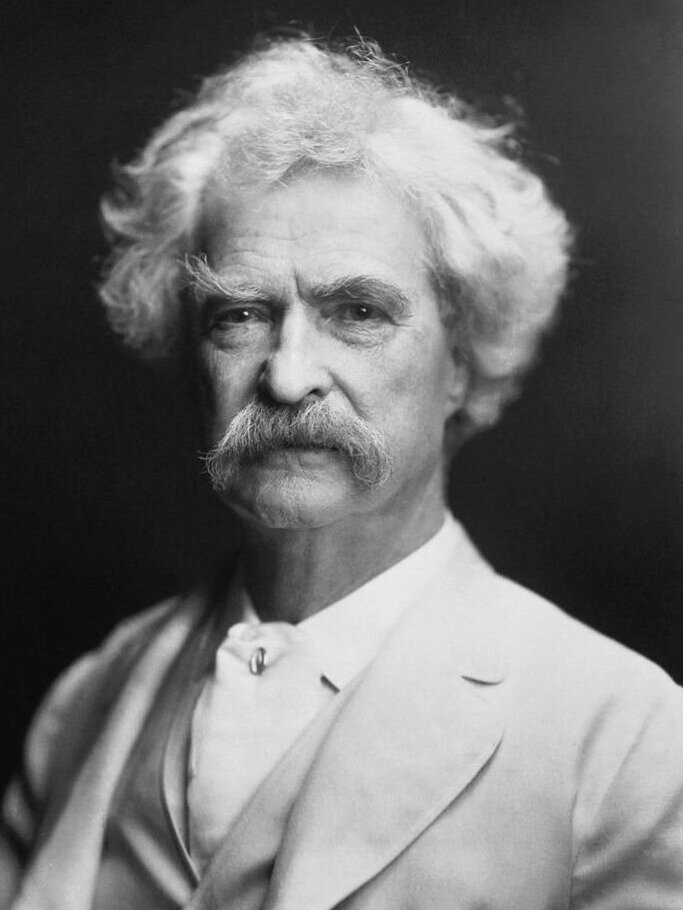
Behavioral Archetype
THE STRAIGHT-FACED PROVOCATEUR — Subject delivers the provocation without breaking expression and lets the audience supply the reaction. Where Swift hid the deadpan inside a printed pamphlet and never appeared, Twain performed it in person, in front of the people being mocked, and waited. The technique is the same — say the indefensible thing in the register of the defensible — but the delivery vehicle is the public platform: the after-dinner speech, the lecture circuit, the signed essay. The straight face is the weapon. The moment the audience realizes they were the target is the payload.
Essence Indicators
- Projects the affable native humorist while delivering the indictment underneath — the persona is the anesthetic, the argument is the incision
- Demonstrates the literary hoax as native vocabulary (the jumping-frog tale, the petrified-man newspaper hoax of his Nevada reporting years)
- Operates from inside the establishment that funds him — the most popular author in America biting the hand that applauds
- Shows the rarest variant of the deadpan: performed live, to the faces of the targets, with no anonymity and no retreat
- Converts the late-career anti-imperialist rage into signed, attributable attack (“To the Person Sitting in Darkness,” “King Leopold’s Soliloquy”) — the famous man spending his fame on the unpopular position
Social Persona / Impression Management
Immediate impression: America’s favorite uncle. White suit, drawl, cigar, an inexhaustible supply of stories — the most recognizable and best-liked writer in the country. The geniality is real, which is exactly what makes it usable. An audience that has decided in advance to be charmed will follow the speaker further than one on its guard.
Energy: Slow, patient, unhurried. The deadpan runs on timing — the held pause, the flat delivery, the refusal to signal the joke. The famous “report of my death was an exaggeration” works because it is delivered in the same tone as a weather report. (Barbara Schmidt, TwainQuotes.com, “Death” (quotation directory with dated sources)) The energy is that of a man who has decided exactly how long to wait before the listener understands what was said to them.
Impression management strategy: LIKABILITY AS DELIVERY SYSTEM. Twain’s popularity was the access. The establishment invited him to the podium because he was the establishment’s favorite entertainer; the invitation was the breach. At the 1877 Whittier birthday dinner he stood before Boston’s literary aristocracy — Emerson, Longfellow, Holmes seated in the room — and told a deadpan tall tale casting the three of them as a trio of drunken card-sharps imposing on a frontier miner. (Mark Twain in His Times (University of Virginia), “The Whittier Dinner Speech”) The room went to “a sort of black frost.” (Mark Twain in His Times (University of Virginia), “The Whittier Dinner Speech” (Twain’s own 1906 account, “The Story of a Speech”)) That is the strategy in one scene: be invited in as the charming guest, then make the hosts the joke before they realize the joke has started. The dinner was given by the publishers of The Atlantic Monthly at the Hotel Brunswick, Boston, on December 17, 1877, for Whittier’s seventieth birthday; the Cincinnati Commercial’s verdict that Twain lacked “the instincts of a gentleman” was reprinted by the Boston Globe on December 26. (Mark Twain in His Times (University of Virginia), “The Whittier Dinner Speech”)
Forensic Archetype Comparison
| Pattern | Match Level | Evidence |
|---|---|---|
| The Calculated Predator | HIGH | The late anti-imperialist essays are methodical and patient. Subject waited until he was the most famous author alive, then spent that capital attacking the Philippine war, King Leopold, and missionary imperialism — maximum reach, maximum cost, deliberately chosen. |
| The Serial Deceiver | MODERATE | The hoax is a recurring instrument (petrified man, jumping frog, the staged “death” line), but the deceptions resolve into a point. The fabrication is the setup; the recognition is the work. |
| The Chameleon | MODERATE | “Mark Twain” is itself a constructed persona worn over Samuel Clemens. The affable humorist was a managed public character, deployed to carry arguments the private man held in earnest. |
| The Grievance Collector | MODERATE | Subject nursed real and escalating grievances — against imperialism, organized religion’s complicity, and the cruelty of “civilization.” Late work (The War Prayer, the dark fables) is the grievance, fully collected and turned outward. |
Psychometric Assessment
Big Five (OCEAN):
| Trait | Score | Evidence |
|---|---|---|
| Openness | 88/100 | High. Travel writing, novels, hoaxes, polemic, science fiction (A Connecticut Yankee), unpublished dark allegory. The range is wide and the late work gets stranger and angrier, not safer. |
| Conscientiousness | 60/100 | Moderate. Disciplined as a craftsman — the deadpan is exact, every word load-bearing — but chaotic as a businessman, bankrupted by the Paige typesetter investment and forced into a global lecture tour to pay creditors. |
| Extraversion | 80/100 | High. Unlike Swift, Twain required the live room. The lecture circuit, the after-dinner speech, the persona built for an audience — the comedy was performed, not merely printed. |
| Agreeableness | 38/100 | Low-moderate. Charming in surface and savage underneath. The War Prayer prays aloud for the enemy’s children to be torn to bloody shreds, in church, to expose what the congregation is actually asking for. The warmth is genuine; so is the contempt. |
| Neuroticism | 66/100 | Elevated. The late years were marked by bankruptcy, the deaths of his wife and two daughters, and a darkening worldview that produced his bleakest, mostly-suppressed work. The geniality outlived the optimism. |
Dark Triad:
| Trait | Score | Notes |
|---|---|---|
| Narcissism | 58/100 | Moderate-high. Subject cultivated a global personal brand — the name, the suit, the recognizability — and enjoyed being the most famous author alive. The vanity is real and feeds the platform, but it is not the point of the work. |
| Machiavellianism | 72/100 | High. The deadpan is engineered manipulation: the audience is led to laugh, then to recognize what they were laughing at. The Whittier speech and The War Prayer are both precision-built to spring late. |
| Psychopathy | 18/100 | Low. The late work is saturated with grief and moral fury — over slavery, over empire, over the deaths in his own family. The flat delivery is a technique, not an absence of feeling; the feeling is the engine. |
MBTI: ENTP (“The Debater”) — Dominant extraverted intuition, auxiliary introverted thinking. Subject generates provocations endlessly and tests them on a live audience, the contrarian who argues the indefensible position precisely to expose what makes it indefensible. The extraversion is the lecture hall; the thinking is the cold architecture under the warm delivery.
Threat Assessment
| Category | Level | Notes |
|---|---|---|
| Physical threat | NONE | A humorist in a white suit. |
| Institutional threat | HIGH | As vice-president of the American Anti-Imperialist League (from 1901 to his death), Twain turned the country’s most beloved literary voice against the Philippine war and European colonialism — “To the Person Sitting in Darkness” (1901) and “King Leopold’s Soliloquy” (1905) named the policy and the men behind it. |
| Memetic threat | EXTREME | The quotes are permanent and frequently misattributed back to him because they sound like him — the “report of my death” line, the deadpan aphorisms, the persona itself. The War Prayer is still read aloud at antiwar gatherings 120 years on. The straight-faced-provocation technique is standard equipment in modern satire. |
| Posthumous threat | ONGOING | The War Prayer was rejected by Harper’s Bazaar in 1905 as “not quite suited to a woman’s magazine” and held back; Twain reportedly said he would not publish it because “only dead men can tell the truth in this world.” It appeared posthumously in 1916. The most dangerous attack he ever wrote, he could only fire from the grave. |
Deception Analysis
Primary deception modality: PERFORMED DEADPAN. Subject states the monstrous or the absurd in the calm register of the reasonable and declines to signal the irony, forcing the audience to locate the boundary themselves. The same mechanism as Swift, relocated from the anonymous page to the lit stage — and therefore riskier, because the proposer is named, present, and watching the room turn.
Authenticity assessment: INVERTED, LIKE SWIFT — but visible. The surface is false (the genial entertainer telling a harmless story). The depth is true (a man enraged by empire, slavery’s legacy, and sanctified cruelty). What separates Twain from Swift is exposure: Swift attacked from behind a pseudonym and a printed pamphlet; Twain attacked in his own name, with his own face, often in the same room as the target. The Whittier dinner is the proof — the deadpan landed, the room froze, and Twain spent years convinced he had humiliated himself, which is the cost of running the deadpan live instead of in print.
Flame Warrior Classification
Primary: Philosopher / Evil Clown Secondary: Performance Artist (the deadpan delivered live, to the faces of the targets — the provocation staged as entertainment until the audience locates itself inside the joke) Notes: ATK 9, DEF 6, HP 6. ATK 9 because the technique is devastating and the reach was unmatched — the most popular author in America turning the deadpan on empire and on his own admirers — one notch below Swift’s 10 only because A Modest Proposal remains the sharper single instrument and several of Twain’s hardest strikes (The War Prayer, the dark late fables) were suppressed in his lifetime. DEF 6 because the fame that was his platform was also his exposure: no anonymity, no pseudonymous cover at the podium, and the Whittier speech drew real public censure (“lacked the instincts of a gentleman,” wrote one paper). (Mark Twain in His Times (University of Virginia), “The Whittier Dinner Speech”) HP 6 reflects a long life and an enormous body of work, discounted by bankruptcy, repeated family bereavement, and a final decade in which the comedian could no longer afford to be funny.
Twain belongs to the literary-troll lineage this archive traces from Jonathan Swift — whose performed-on-the-page deadpan Twain moved onto the live stage — through the wit lineage of Oscar Wilde, his near-contemporary on the other side of the Atlantic, who weaponized the epigram where Twain weaponized the drawl.
Sources: Wikipedia; Encyclopaedia Britannica; The Whittier Birthday Dinner Speech (Mark Twain in His Times, University of Virginia); “The War Prayer” — full text (American Literature); Twain’s note to Frank Marshall White, London, 31 May 1897, in Shelley Fisher Fishkin, Lighting Out for the Territory (Oxford, 1996), p. 134 (“the report of my death was an exaggeration”).
Cross-Referenced Dossiers

Prefer RSS? Subscribe here.