Related research: The Hermetic Order of the Golden Dawn: Comprehensive Research.
Behavioral Archetype
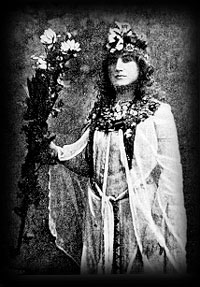
THE SET DESIGNER – Subject built the part of the Golden Dawn that audiences actually saw. MacGregor Mathers wrote the rituals and claimed the Secret Chiefs; Florence Farr ran the London temple; Moina painted the gods. The temple banners, the elemental tablets, the god-form regalia, the diagrams that turned a stack of cipher-manuscript correspondences into a room you could be initiated inside – those were hers. She was the order’s first initiate and its principal artist, and she was the clairvoyant whose visions her husband translated into doctrine. The archetype is not the founder or the operator. It is the maker whose work is the medium through which everyone else’s claims become experiences – and who, for that reason, gets filed under “the founder’s wife” in nearly every popular history.
Essence Indicators
- Born Mina Bergson, 28 February 1865, Geneva; sister of the philosopher Henri Bergson (Nobel Prize in Literature, 1927); Anglicized her name to “Moina” on marrying Mathers in 1890
- Enrolled at the Slade School of Fine Art at fifteen (1880), won a scholarship and four merit certificates for drawing, and kept a London studio – a trained professional artist, not a hobbyist (Lila Moore, “Moina Bergson Mathers”, World Religions and Spirituality Project (2019))
- The first person initiated into the Hermetic Order of the Golden Dawn (Isis-Urania Temple, March 1888); magical motto Vestigia Nulla Retrorsum (“no traces behind, never a backward step”). Howe, from the membership roll: “The first to be initiated in the Isis-Urania Temple were Miss Mina Bergson (‘Vestigia Nulla Retrorsum’), later Mrs MacGregor Mathers, and Miss Theresa Jane O’Connell”; by the end of March 1888 the order “totalled nine” (Ellic Howe, The Magicians of the Golden Dawn)
- Brought the patron with her. Annie Horniman’s own recollection: “Early in October 1882 at the Slade School, University College, Gower Street, I made the acquaintance of Mina Bergson. In the beginning of 1888 she introduced Mr. Mathers to me as an interesting man whom she did not want to marry.” Horniman then persuaded her father “to employ the indigent Mathers in his private museum and thus made it possible for him to marry Mina Bergson.” Their letters ran under Slade nicknames: “Dearest Tabbie,” signed “Bergie” (Howe)
- Designed and painted the order’s visual apparatus – temple furnishings, the elemental and Enochian tablets, ritual diagrams, ceremonial regalia and god-forms – the material that made the system immersive rather than textual
- Served as Praemonstratrix in initiations and as the order’s primary clairvoyant/skryer, supplying the visions that Mathers worked up into ritual and curriculum (Lila Moore, “Moina Bergson Mathers”, World Religions and Spirituality Project (2019))
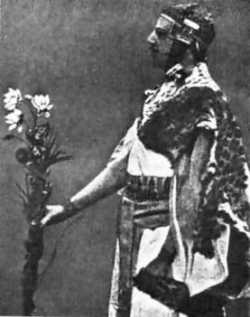
- Co-staged the public Rites of Isis in Paris from 1899 with Mathers, performing Egyptian liturgy on a Parisian stage – esoteric ceremony played as theater for paying audiences
- After Mathers died in 1918, led the Rosicrucian Order of Alpha et Omega as Imperatrix for the rest of her life, the senior surviving authority in the original Mathers lineage (Lila Moore, “Moina Bergson Mathers”, World Religions and Spirituality Project (2019))
- Expelled the young Dion Fortune from Alpha et Omega; Fortune then publicly accused her of a sustained psychic attack – real and “etheric” cats, blocked astral projection – in the 1930 book Psychic Self-Defence
- Died 25 July 1928 at St Mary Abbots Hospital, London, aged 63, after declining health
Social Persona / Impression Management
Immediate impression: A quiet, ascetic, strikingly beautiful artist standing slightly behind a domineering husband – which is how the contemporary accounts, and most of the histories since, chose to read her. The reality on the temple floor was a working professional whose hands had made everything in the room.
Energy: Reserved, devoted, severe in matters of the order. Where Farr was brisk and theatrical and Mathers was imperious, Moina reads as the disciplined craftsman who let the work speak and let her husband do the talking – until, after his death, she had to do the talking herself and turned out to have a sharp edge under the deference.
Impression management strategy: AUTHORITY THROUGH THE ARTIFACT. Moina did not run on the Secret-Chiefs gambit her husband used, nor on Farr’s demonstrable administrative competence. Her authority was embedded in the objects: every initiate’s most intense experience – the painted vault, the elemental tablets, the god-forms looming in candlelight – was something Moina had made. The maker of the medium is harder to displace than the author of the text, because the medium is what the membership remembers. The cost of that strategy is the one she paid in the record: the artist who builds the experience is credited as a fixture of it, not an author of it. She supplied the conviction that let Victorians believe; she was written up as scenery.
Forensic Archetype Comparison
| Pattern | Match Level | Evidence |
|---|---|---|
| The Maker / Artificer | HIGH | The order’s entire visual and ceremonial apparatus was her work; without it the Golden Dawn was, in the book’s phrase, a stack of papers. The defining pattern: the person who built the medium everyone else operated through. |
| The Loyal Lieutenant | HIGH | Subordinated her own career and credit to her husband’s project for nearly thirty years, channeled the visions he turned into doctrine, and defended his lineage as Imperatrix after his death. Devotion as an organizing principle. |
| The Faction Leader | MODERATE | Ran Alpha et Omega for a decade and exercised real power within it – including the expulsion of Dion Fortune and the alleged magical war that followed – but inherited the faction rather than building it, and led to preserve the Mathers line, not to seize a new throne. |
| The Authority Seeker | LOW | Held genuine rank and used it, but invented no nobility, claimed no unaccountable Chiefs of her own, and built her standing on what she had actually made and seen rather than on a fabricated mandate. |
Psychometric Assessment
Big Five (OCEAN):
| Trait | Score | Evidence |
|---|---|---|
| Openness | 90/100 | Fine art, Egyptology, Kabbalah, Enochian, clairvoyant skrying, public ritual-theater, and the synthesis of all of it into one designed visual system. The imaginative range that built the order’s iconography was wide and genuine. |
| Conscientiousness | 80/100 | Trained and credentialed at the Slade, executed an enormous body of meticulous ceremonial work, and administered a successor order for a decade. A finisher who could carry a long, exacting project. |
| Extraversion | 40/100 | Reserved and self-effacing by temperament; performed publicly in the Rites of Isis and presided over a temple, but the recorded energy is the introverted maker’s, not the performer’s or the commander’s. |
| Agreeableness | 50/100 | Devoted and cooperative within her marriage and circle for most of her life, but capable of cold institutional severity as Imperatrix – the Fortune expulsion and the reported magical campaign show a hard edge under the deference. |
| Neuroticism | 52/100 | Moderate. Sustained great strain – poverty in Paris, her husband’s authoritarian decline, his death, and the burden of leading the remnant alone – with the discipline of her craft, but the later feuds and her declining final years suggest real cost. |
Dark Triad:
| Trait | Score | Notes |
|---|---|---|
| Narcissism | 28/100 | Low. The self-presentation is the opposite of grandiose – she ceded the spotlight to Mathers for decades and let her work go uncredited. The ego that drove the order belonged to her husband. |
| Machiavellianism | 36/100 | Low-moderate. Exercised real political power inside Alpha et Omega and removed a rival who threatened to subsume the order, but in defense of an inherited lineage rather than for personal expansion. |
| Psychopathy | 18/100 | Low. The alleged psychic attack on Fortune is the one cold note in the file, and it is an accusation by the other party, not an established act; the dominant pattern is devotion and craft, not predation. |
MBTI: INFJ (“The Advocate”) – Dominant introverted intuition feeds the clairvoyant visions and the unified symbolic system she rendered; auxiliary extraverted feeling supplies the decades of devotion to her husband’s project and the order’s people. Where Mathers’s ENTJ commanded the system and Farr’s ENTJ ran it, Moina’s INFJ saw it and made it visible – the quiet intuitive whose private images became the order’s public face.
Why This Profile Matters
The Golden Dawn is remembered as immersive theater, and Moina built the set. The cipher manuscripts gave the order five skeletal rituals and a list of correspondences; Mathers fleshed out the scripts; but the thing an initiate actually walked into – the painted vault, the elemental tablets, the god-forms, the regalia – was Moina’s design and Moina’s hand. The Hidden Fire’s argument that the occult worked by producing genuine experience out of admittedly invented material runs straight through her studio: she is the one who turned the invention into something a body could stand inside.
She is also the cleanest case in the book’s gender thread. The most influential magical order in modern history performed its founding act of initiation on a woman, and that woman went on to make its entire visual language and, eventually, to lead its principal successor. In 1888 she could not vote and was a legal subordinate to the husband whose name buried hers; inside the temple she was the first initiate, the principal artist, the Praemonstratrix, and finally the Imperatrix. The occult granted her a standing the state and the academy did not – and then the popular histories handed even that to “the founder’s wife.” The recovery of Moina Mathers, like that of Farr, is the correction of a record that filed the makers as furniture.
Threat Assessment
| Category | Level | Notes |
|---|---|---|
| Physical threat | NONE | An artist and ceremonialist. The one violent episode in the file is a psychic attack – alleged by Dion Fortune, manifesting as cats – which photographs poorly. |
| Institutional threat | MODERATE | Led a successor order for a decade and exercised hard authority within it, including a rival’s expulsion; a real institutional actor, but a custodian of an inherited lineage rather than a builder or a wrecker. |
| Memetic threat | HIGH | Her visual system – the tablets, banners, diagrams, and god-forms – is the iconography by which the Golden Dawn is recognized and reproduced to this day; the look of modern Western ceremonial magic is substantially her design, propagated far beyond the order that commissioned it. |
| Posthumous threat | ONGOING | Long filed under “Mathers’s wife,” she has been steadily restored by historians of occultism and of women – Mary Greer’s Women of the Golden Dawn foremost – as the first initiate, principal artist, and leader she actually was. The reputation rises as the framing recedes. |
Flame Warrior Classification
Primary: Philosopher (the genuine artistic and visionary contribution – she built the order’s symbolic medium) Secondary: Big Cat (real, if inherited, organizational authority as Imperatrix of Alpha et Omega – and, per Fortune, the literal cats) Notes: ATK 5 – her impact is real and durable but indirect and under-credited: she shaped how the order looked and felt and stands as a load-bearing case for women’s standing in the tradition, rather than authoring the system or detonating it. DEF 6 – decent armor: her authority sat in objects she had made and a visionary role no one else could occupy, not in a fabricated doctrine that could be exposed, though the long subordination to Mathers and the poverty in Paris left her more exposed than the self-sufficient Farr. HP 5 – a full working life across art, ritual, and leadership, but lived largely in her husband’s shadow and his debts, ending in declining health and a hospital death at 63; the work outlasted her, the credit took a century to catch up. She is the maker whose medium proved more durable than her name.
Cross-References
Moina is the artistic and domestic counterpart to her husband MacGregor Mathers: he wrote the rituals and ruled by decree and the Secret Chiefs, she painted the gods those rituals invoked and supplied the clairvoyant visions he turned into doctrine – and after his death in 1918 she carried his lineage forward as Imperatrix of Alpha et Omega, the role she held until her own death. She belongs with Florence Farr in the recovery of the Golden Dawn’s women: the two are the order’s maker and its operator, the first initiate and the working head of the London temple, both long mis-filed as ornaments of the men. Her sharpest documented conflict was with the next generation’s Dion Fortune, whom she initiated into Alpha et Omega and then expelled; Fortune’s published account of the resulting psychic war – the real and etheric cats of Psychic Self-Defence – is the most lurid single episode attached to Moina’s name, and a reminder that the artist-priestess had a hard edge when the lineage was threatened.
Sources: Moina Mathers — Wikipedia; Mathers, Moina (1865–1928) — Encyclopedia.com; Moina Bergson Mathers — World Religions and Spirituality Project (WRSP); Moina Mathers, The High Priestess and Mother of the Golden Dawn — The Old Craft; Ellic Howe, The Magicians of the Golden Dawn (1972; 1985 ed.), Internet Archive
Cross-Referenced Dossiers
Prefer RSS? Subscribe here.