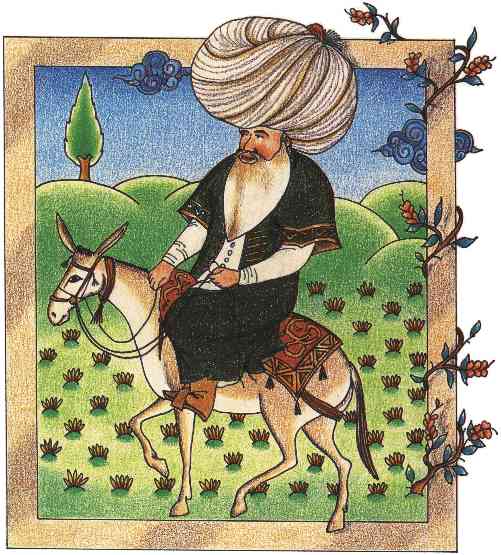
Related research: Nasreddin Hodja: Master Troll of the Islamic World.
Behavioral Archetype
THE BELOVED SURVIVOR — Subject deploys the full toolkit of high-effort trolling — feigned stupidity, reductio ad absurdum, deadpan absurdity, authority subversion, hypocrisy exposure, naive questioning — while occupying a position of religious and judicial authority (imam, teacher, qadi) inside the community he mocks. Where Socrates was executed and Diogenes died destitute, Subject was invited back, appointed judge, and is venerated across the entire Islamic world seven centuries later. The defining feature is not the technique — the technique is shared with every other figure in this file — but the outcome. Subject is the case study in a culture that metabolizes its troll instead of killing him.
Note on historicity: Subject is semi-legendary. The tomb at Aksehir keeps no original inscription; a later gravestone reads AH 386, read backwards as 683 AH, 1284-85 (Akşehir Belediyesi), and tradition places a real 13th-century Anatolian scholar at the center of the corpus. But the body of tales — thousands of them, told from Morocco to Xinjiang — vastly exceeds any single lifetime. He functions as a “story attractor”: a named figure to whom any sufficiently clever anecdote gets attached, the way the West attributes stray witticisms to Twain or Churchill. The profile assesses the figure the tradition built, attributing the legend as legend throughout.
Essence Indicators
- Trolls from inside the structure of authority — wears the turban, leads the prayers, sits as judge, then tells a story that makes the whole hierarchy look ridiculous. The institution cannot expel him because he is the institution.
- Accepts an absurd premise completely and extends its logic until it collapses (pays for the smell of food with the sound of coins; returns a “baby pot,” then reports the parent pot has died).
- Trolls up and down without discrimination — sultans, scholars, and judges, but also his wife, his neighbors, and himself. Equal-opportunity provocation.
- Every punchline carries a lesson. The trolling is pedagogical: it builds understanding while tearing down pretension, which is precisely why it was tolerated.
- Belongs to no one and to everyone. The corpus is folk property — anonymous, decentralized, endlessly remixed and re-attributed across at least seven cultures and 700-plus years. A proto-internet phenomenon.
Social Persona / Impression Management
Immediate impression: A genial, slightly bumbling village teacher on a donkey — frequently the donkey is facing the wrong way, or he is. Subject cultivates an appearance of harmless foolishness that disarms every target. The fool is the cover; the qadi underneath is real.
Energy: Warm, deadpan, unhurried. Subject never argues against a premise; he agrees with it, then follows it off a cliff while keeping a perfectly straight face. The comedy is the weapon and the affection is genuine, which is why nobody ever quite catches him being cruel — and therefore nobody can justify removing him.
Impression management strategy: Strategic foolishness as a teaching instrument — the Sufi wise-fool. Where Socrates’ cover was “I know nothing,” Subject’s is “I am a harmless idiot.” Both are load-bearing lies that let the operator dismantle a target’s certainty before the target registers an attack. The difference is the register: Socrates’ irony made men feel stupid; Subject’s foolishness makes men laugh first and feel implicated second. Laughter is a far safer delivery vector than humiliation. It is also why he kept his head.
Forensic Archetype Comparison
| Pattern | Match Level | Evidence |
|---|---|---|
| The Court Jester | HIGH | Licensed to mock power from within, protected by the comic frame. But the jester serves at the ruler’s pleasure; Subject answers to no patron and trolls the ruler (Tamerlane’s peppers) as readily as the peasant. |
| The Methodological Deconstructor | MODERATE-HIGH | Shares Socrates’ core move — strategic deployment of apparent ignorance to collapse a target’s position. Differs in medium: performance and one-liners rather than sustained dialectic. |
| The Con Artist | MODERATE | The pot-that-gave-birth story is a textbook long con, and the mark’s own greed springs the trap. But the “profit” is a demonstration, not the pot. |
| The Grievance Collector | LOW | No resentment, no score-settling, no enemies list. The trolling is affectionate and universal, aimed at human folly rather than any particular person. |
| The Chameleon | LOW | One persona — the wise fool — maintained with total consistency across the entire corpus. The only variation is which way the donkey faces. |
Psychometric Assessment
Assessment of the composite literary figure, not a clinical subject — he is semi-legendary.
Big Five (OCEAN):
| Trait | Score | Evidence |
|---|---|---|
| Openness | 90/100 | Reframes every situation — orientation, ownership, justice, smell — as negotiable. Will attempt to turn a lake into yogurt on the off chance “it takes.” |
| Conscientiousness | 60/100 | Functions as imam and judge; the tales require a man embedded in real institutional duties. But the performance runs on improvisation, not discipline. |
| Extraversion | 80/100 | Operates entirely in public — the marketplace, the courtroom, the banquet, the mosque. Trolling requires an audience and a target, and he always has both. |
| Agreeableness | 70/100 | Genuinely warm and beloved, unlike most of this file. The barbs land softly enough that the target laughs before he realizes he has been demolished. |
| Neuroticism | 8/100 | Eats Tamerlane’s hot peppers to the bottom of the basket “hoping the next one will be sweet,” weeping, unbothered. Composure under a conqueror’s gaze. |
Dark Triad:
| Trait | Score | Notes |
|---|---|---|
| Narcissism | 20/100 | Low. Routinely makes himself the butt of the joke — rides backwards, hooks the moon out of a well and congratulates himself. The self-deprecation is structural, not strategic. |
| Machiavellianism | 55/100 | Moderate. Each “foolish” act maps cleanly to a point about power, evidence, or hypocrisy. The donkey-bray lie (“who will you believe, me or a donkey?”) is a calibrated exposure of how authority expects to beat evidence. |
| Psychopathy | 8/100 | Very low. No callousness, no cruelty. The defining warmth of the figure is the inverse of the cold detachment that scores this trait. |
MBTI: ENFP (“The Campaigner”) — Dominant extraverted intuition, auxiliary introverted feeling. Improvisational, warm, allergic to rigid systems, forever finding the absurd reframe that dissolves a problem nobody else could touch. Where Socrates (ENTP) wins the argument and makes you feel it, Nasreddin wins the room and makes you love him for it.
Why This Profile Matters
This is the book’s exhibit for the thesis working as designed. The Fires of History argues that high-effort trolling is the immune system of civilization — the mechanism by which a culture tests its own assumptions and forces itself to evolve. Chapters 6 and 20 use Nasreddin as the proof that this is not a Western invention but a human universal: the same techniques the book traces through Socrates, Diogenes, Swift, and Voltaire are all present, fully formed, in a 13th-century Anatolian imam whose jokes spread from China to Hungary centuries before any of them.
But his deeper function in the argument is as the success-mode exemplar — the counterweight to Socrates. Both men ran the identical play: feign ignorance, deploy naive questions and absurd logic, expose the powerful as fools. Athens answered Socrates with hemlock. The Islamic world answered Nasreddin by making him a judge and then a saint. The contrast is the whole point. A healthy immune system does not destroy the irritant; it learns from it. The culture that metabolizes its troll — that absorbs the criticism, laughs, and keeps the critic inside the structure — is the culture that stays flexible enough not to shatter. The culture that executes its troll (Socrates, al-Hallaj, and the rest of the martyrs in this file) gets the idea anyway, but the hard way, and the executioners are remembered only as the people who killed him.
That he is beloved is therefore not incidental to his trolling — it is the measure of his civilization’s health. The locked gate on his tomb with no walls around it is the perfect coda: an imposing structure of authority that anyone can simply walk around, photographed reverently by tourists who still mistake the gate for the point. He is still trolling. He always was on the inside.
Threat Assessment
| Category | Level | Notes |
|---|---|---|
| Physical threat | NONE | A teacher on a donkey. The only casualty is the dignity of whoever started the conversation. |
| Institutional threat | NEUTRALIZED-BY-ABSORPTION | Demonstrates from inside the mosque and the courtroom that authority routinely mistakes itself for wisdom — the one thing every hierarchy needs unexamined. The institution’s defense was not to expel him but to claim him. |
| Memetic threat | EXTREME | The corpus has been self-replicating for 700-plus years across at least seven cultures and a dozen languages. The “streetlight effect” entered psychology and economics from his lost-key story. “Ya tutarsa?” (“but what if it takes?”) is proverbial Turkish. |
| Civilizational threat | INVERTED | Subject is not a threat to civilization but a load-bearing component of it — the trickster the mythology cannot remove without collapsing. Recognized as such: UNESCO declared 1996 International Nasreddin Hodja Year, and in 2022 inscribed the telling tradition on the Representative List of the Intangible Cultural Heritage of Humanity. |
Flame Warrior Classification
Primary: Jester (the licensed fool who mocks power from inside the court) Secondary: Philosopher / Kung-Fu Master (each absurdity resolves into a point sharp enough to draw blood, delivered so gently the target thanks him) Notes: ATK 9 — the reductio-ad-absurdum reach is genuinely Socratic, and the moves still land seven centuries later; he loses a point only because the comic register softens the blade by design. DEF 10 and HP 10 are the highest defensive profile in this file, and they are the entire reason he is here. You cannot destroy a troll the culture has decided to love. Socrates chose a low DEF; Nasreddin’s high DEF was granted by his audience — the community’s affection is his armor. HP 10 because he did not merely survive; he became a saint, a UNESCO heritage element, and a folk character shared by half the planet. The contrast with Socrates (DEF 3, HP 1) is the book’s single cleanest illustration of the difference between a civilization that kills its immune system and one that lets it do its job.
Sources: Britannica — Nasreddin Hoca; UNESCO Intangible Cultural Heritage — Telling tradition of Nasreddin Hodja / Molla Nesreddin / Molla Ependi / Apendi / Afendi Kozhanasyr Anecdotes (inscribed 2022); Encyclopaedia Iranica — Molla Nasreddin i. The Person; Nasreddin (Wikipedia).
Cross-Referenced Dossiers


Prefer RSS? Subscribe here.