Behavioral Archetype
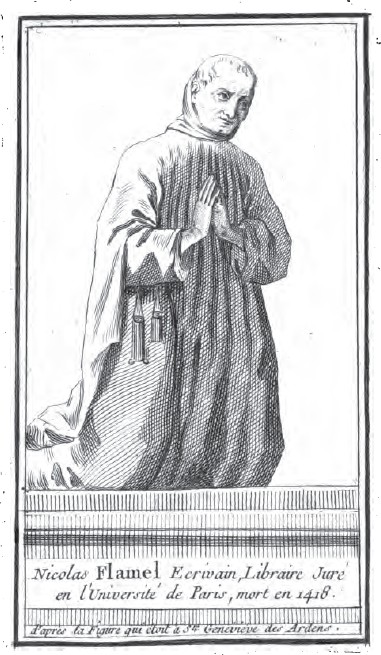
THE ACCIDENTAL LEGEND — The trolling in this file was not committed by the subject. It was committed on him, roughly two centuries after he died. The historical Nicolas Flamel was a prosperous, pious, well-documented Parisian scribe and manuscript-seller who left no trace of ever having practiced alchemy. The legendary Flamel — the man who cracked the Philosopher’s Stone and walked off into immortality — is a 17th-century literary construction bolted onto a real corpse. This profile grades that construction, not the man, and keeps the two cleanly separated throughout.
Essence Indicators
- The documented man (c. 1330–1418): a Paris écrivain — a scribe, copyist, and seller of manuscripts who ran shops near the church of Saint-Jacques-de-la-Boucherie
- Married Perenelle (also spelled Pernelle) before 1373; the couple grew wealthy, most plausibly through manuscript dealing and Paris real-estate speculation, not transmutation
- Genuinely generous and conspicuously devout: he and Perenelle endowed churches, chapels, and almshouses, and commissioned religious carvings — the philanthropy is real and on the record
- No historical evidence he ever practiced alchemy — none in his lifetime, none in the contemporary record
- The alchemical reputation appears only in the 17th century. The founding text, Livre des figures hiéroglyphiques (Paris, 1612; English ed. Exposition of the Hieroglyphicall Figures, London, 1624), is attributed to Flamel but is a pseudepigraph — edited and most likely authored by the Poitevin scholar Pierre Arnauld de la Chevallerie, almost 200 years after Flamel’s death
- The book frames Flamel deciphering a mysterious “Book of Abraham the Jew” bought for two florins in 1357 — a frame story, not a biography
- Posthumous afterlife: Isaac Newton owned and annotated Flamel material; a Paris street (rue Nicolas Flamel) crosses rue Pernelle; and the legend reached maximum saturation as a named character in Harry Potter and the Philosopher’s Stone
Social Persona / Impression Management
Immediate impression: Two different men wearing one name. The first is a careful, literate tradesman of medieval Paris — the kind of solid, churchgoing burgher whose biography is recoverable precisely because he was ordinary and left paperwork. The second is a glamorous immortal adept, all hieroglyphs and golden secrets, who exists entirely in print and entirely after 1612.
Energy: The historical Flamel reads as quiet, industrious, and risk-averse — a man who made money slowly and gave a great deal of it away. The legendary Flamel reads as the projection of everything his cataloguers wished a rich, generous, mysterious bookman must secretly have been. The gap between the two energies is the entire case.
Impression management strategy: None — and that is the point. The documented Flamel managed no occult image whatsoever; he managed a shop. The image was applied posthumously by people who needed his wealth and charity to have an exciting cause rather than a boring one. The “persona” here is an authorship attribution that the man never authorized and could not refuse.
Forensic Archetype Comparison
| Pattern | Match Level | Evidence |
|---|---|---|
| The Accidental Legend | MAXIMUM | The defining fact of the file: a reputation manufactured ~200 years after death, from real wealth and real charity supplied with fake causes. The subject is the canvas, not the painter. |
| The Forger’s Mark (as victim) | HIGH | The Livre des figures hiéroglyphiques is a pseudepigraph attributed to Flamel but authored by a later hand. Flamel is the brand the forgery wears, the way John Dee hired a documented forger as his medium — except here the forgery runs the other way and arrives after the funeral. |
| The Narcissistic Operator | NONE | The man cultivated no grandiose self-image; the record shows piety and donations, not self-mythologizing. The grandiosity is entirely his cataloguers'. |
| The Authority Seeker | LOW | The historical Flamel sought no occult authority. The legend supplies a posthumous claim to the highest alchemical authority — the Stone, immortality — which the man neither made nor needed. |
Psychometric Assessment
These scores read the documented man, since he is the only one who actually existed. The legend has no psychology — only its inventors do.
Big Five (OCEAN):
| Trait | Score | Evidence |
|---|---|---|
| Openness | 45/100 | A literate manuscript trader handled exotic books, but the record shows a conventional, devout tradesman, not an intellectual adventurer. The boundless curiosity is a feature of the legend, not the life. |
| Conscientiousness | 88/100 | Built durable wealth, ran an orderly business, endowed institutions, and arranged his and Perenelle’s affairs carefully enough that the donations and carvings survived him. The man was meticulous. |
| Extraversion | 45/100 | A shopkeeper and parishioner — socially embedded but not a public performer. No record of self-promotion. |
| Agreeableness | 75/100 | The philanthropy is documented and substantial: churches, chapels, almshouses, support for the poor. By the surviving record, a genuinely generous man. |
| Neuroticism | 35/100 | The picture is of a stable, steady operator who accumulated quietly over decades. Nothing in the record suggests volatility. |
Dark Triad:
| Trait | Score | Notes |
|---|---|---|
| Narcissism | 10/100 | The documented man left donations, not monuments to himself. The self-aggrandizement belongs to the 17th-century text, not to him. |
| Machiavellianism | 15/100 | Slow, lawful wealth-building and open charity — the opposite of a manipulator’s playbook. |
| Psychopathy | 5/100 | Documented generosity and piety; no record of harm. The “immortal who hoards the secret of life” is fiction. |
MBTI: ISTJ (“The Logistician”) — dominant introverted sensing, auxiliary extraverted thinking. A conventional, detail-driven, duty-bound tradesman who trusted concrete records and built steadily within established institutions. Precisely the temperament least likely to chase the Philosopher’s Stone — which is why the legend had to be added later by someone else.
Why This Profile Matters
Flamel anchors a different mechanism than the rest of the esoteric cohort in The Hidden Fire. Paracelsus and John Dee are men who built their own legends in life — the bombast and the angel-talking were self-authored. Flamel is the control case: a man whose legend was built for him, after death, by strangers who found the truth too dull to leave alone. He is the cleanest proof in the book that a reputation can be a forgery — that the “greatest alchemist in history” can turn out to have sold books, given to the poor, and never run a single experiment. The alchemical tradition’s habit of disguising real chemistry in mystical allegory is, in Flamel’s case, taken one step further: the biography itself becomes the allegory, and the allegory wins. That a tympanum-carving bookseller is now best known as a wizard in a children’s novel is the longest con in the file — and nobody alive ran it.
Threat Assessment
| Category | Level | Notes |
|---|---|---|
| Physical threat | NONE | A scribe and shopkeeper. The most dangerous thing in his shop was overdue parchment. |
| Memetic threat | EXTREME | Not from the man — from the legend attached to him. The Flamel-as-immortal-adept meme has propagated for four centuries, drew Newton’s annotations, named a Paris street, and reached saturation through Harry Potter. The fictional Flamel is vastly more famous than any real alchemist who ever lived. |
| Scholarly threat | MODERATE | The 1612 pseudepigraph polluted the alchemical record by passing a 17th-century invention as a 14th-century master’s testimony, sending later seekers chasing a fabricated lineage. |
| Civilizational threat | LOW | The legend is durable but benign — a story about wealth, charity, and secret knowledge that hurt no one and decorated a great deal of esoteric literature. |
Flame Warrior Classification
Primary: Innocent / Lurker — the subject lurked in the historical record as an ordinary tradesman and was conscripted into a flame war he never joined. Secondary: None for the man. The legend functions as an Issues (a position asserted in his name that he never held). Notes: ATK 6 — the reach of the attributed move is enormous (four centuries, Newton to Rowling), but it belongs to the forgers, not to Flamel; the man’s own offensive output is zero, so the score grades the legend’s blast radius. DEF 2 — a dead man cannot defend his name; the historical Flamel was defenseless against an attribution that arrived in 1612 and never stopped. HP 9 — near-maximal: the legend has survived two centuries longer than the man did, and the man himself reached roughly 88 in an age when that was extraordinary. He outlived his era; his myth outlived everything.
Sources: Britannica — Nicolas Flamel; McGill Office for Science and Society — “Cobbling Together the Legend of Nicolas Flamel”; Wikipedia — Nicolas Flamel; Science Museum Group Collection — Nicolas Flamel, 1330–1418.
Cross-Referenced Dossiers
Prefer RSS? Subscribe here.