Related research: Discordianism, Chaos Magick, SubGenius, and the Satanic Temple.
Behavioral Archetype
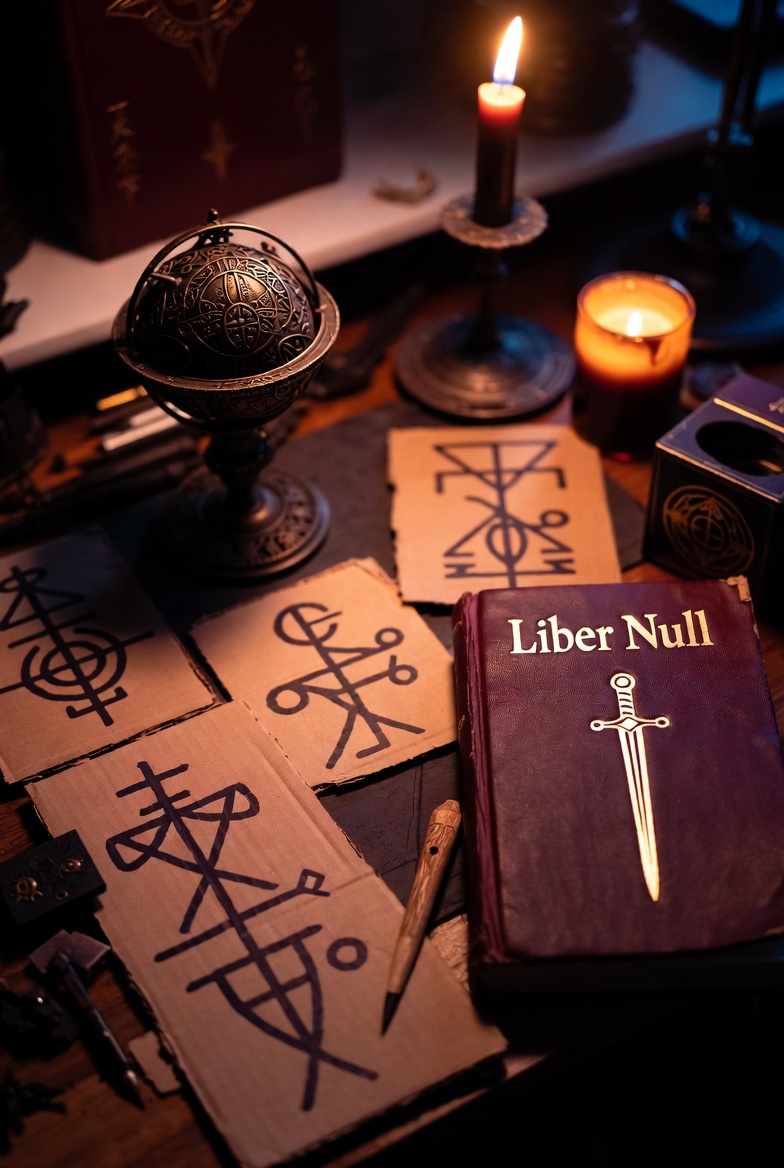
THE MANUAL WRITER – Where Carroll built the system and Spare supplied the technique, Hine wrote the instructions a beginner could actually follow. Condensed Chaos (expanded 1995 from an earlier pamphlet) did for chaos magick what a good O’Reilly book does for a programming language: it took an esoteric, intimidating, jargon-locked discipline and made it legible to anyone willing to read a paperback. Hine is not the provocateur of this lineage. He is the documentarian. The revolution had already happened by the time he showed up; his contribution was writing it down so clearly that the gatekeepers lost their last advantage – the claim that you needed them to explain it.
Essence Indicators
- Projects the register of a practitioner-explainer rather than a guru – deflationary, pragmatic, allergic to mystification
- Operationalizes the chaos-magick thesis (“belief is a tool, not a truth”) into step-by-step procedure: here is how you make a sigil, here is how you enter gnosis, here is what to do when it does not work
- Former initiate of the Illuminates of Thanateros (IOT), the order Carroll and Ray Sherwin co-founded in 1978; co-edited Pagan News with Rodney Orpheus and was active in the British occult press from roughly 1986 to 1996
- Wrote Prime Chaos (1993) on formalized ritual technique and The Pseudonomicon (1994; revised 2004) on Lovecraftian “Cthulhu Mythos” magic – treating a pulp horror writer’s invented gods as working tools, which is the chaos-magick move in its purest form
- Later pivoted from chaos-magick popularization to long-form scholarship on Tantra, gender, and “queer assemblies” in occulture, maintained for years at his site enfolding.org. The popularizer became a researcher.
Social Persona / Impression Management
Immediate impression: The competent, unglamorous one in the room. No Beast 666 theater, no rock-star charisma, no academic withdrawal. Hine presents as a working practitioner who happens to write unusually clear prose – the movement’s editor, not its prophet.
Energy: Patient, explanatory, faintly schoolteacherly. Where Morrison performs the magic and Carroll retreats from the audience, Hine runs the workshop. He facilitated seminars across America and Europe through the 1990s. The energy is that of someone who has done the thing many times and is happy to show you how, minus the mystique markup.
Impression management strategy: RADICAL LEGIBILITY. The strategy – whether deliberate or temperamental – is to remove every barrier to entry. No secret lineage, no graded initiation, no untranslated Latin. Burroughs called Condensed Chaos “the most concise statement of the logic of modern magic,” and concision is the whole brand. The clearer the manual, the more obsolete the priesthood. Hine democratized the toolkit by the simple expedient of explaining it well.
Forensic Archetype Comparison
| Pattern | Match Level | Evidence |
|---|---|---|
| The Technical Writer | EXTREME | Condensed Chaos is a how-to book. Its function is pedagogical: convert Carroll’s dense framework and Spare’s idiosyncratic technique into reproducible procedure. The contribution is documentation, not doctrine. |
| The Popularizer | HIGH | For a generation of readers, Hine – not Carroll – was the on-ramp to chaos magick. The accessible paperback, not the lab manual, is what most practitioners actually read first. |
| The Iconoclast | LOW-MODERATE | Hine inherited the iconoclasm rather than originating it. The “none of it is true, all of it works” provocation was already load-bearing before he wrote it down. He is the clarifier of a heresy, not its author. |
| The Scholar | MODERATE-HIGH | The post-1990s turn to sourced, citation-heavy work on Tantra and the history of occulture shows a genuine researcher’s temperament, not just a populariser’s. The enfolding.org material reads as scholarship. |
Psychometric Assessment
Big Five (OCEAN):
| Trait | Score | Evidence |
|---|---|---|
| Openness | 88/100 | High. Moved fluently from chaos magick to Lovecraftian practice to Tantra to gender studies in occulture. Treats every paradigm as worth investigating, which is the chaos-magick disposition applied to a whole career. |
| Conscientiousness | 82/100 | High. Sustained, structured output across decades; the books are organized, technically precise, and edited with a craftsman’s care. Clear prose is conscientiousness made visible. |
| Extraversion | 48/100 | Moderate. Ran public workshops and edited a magazine – more engaged than Carroll, less performative than Morrison. Sociable in service of the work, not for the spotlight. |
| Agreeableness | 58/100 | Moderate. The deflationary “use what works” register is collegial rather than combative. He explains rather than provokes; the tone invites the reader in. |
| Neuroticism | 35/100 | Low-moderate. Public conduct and writing suggest a stable, even-tempered practitioner. The voice is calm under material that drives other occultists to theatrics. |
Dark Triad:
| Trait | Score | Notes |
|---|---|---|
| Narcissism | 22/100 | Low. The popularizer’s posture is self-effacing by design – the point is the technique, not the author. No personality cult, no Beast persona. |
| Machiavellianism | 35/100 | Low-moderate. There is strategy in radical legibility – clarity is a weapon against gatekeepers – but it is transparent strategy, openly stated, not manipulation. |
| Psychopathy | 8/100 | Very low. No evidence of callousness or exploitation. The work is generous: it gives away what others charged for. |
MBTI: INTJ-leaning (“The Architect/Strategist”) – introverted intuition paired with structured judgment. Subject perceives the underlying pattern of a tradition (Ni) and then organizes it into transmissible form (Te). The output is the clean instruction manual: the insight made teachable.
Why This Profile Matters
Chaos magick’s central claim – that belief is a technology rather than a truth – only became a mass phenomenon because someone made it readable. The Hidden Fire traces a four-thousand-year arc in which secrecy was the source of power: the Eleusinians killed you for revealing the Mysteries; the Golden Dawn made you earn knowledge through graded initiation. Chaos magick inverted that entirely by publishing everything in paperback – and Hine is the man who wrote the most readable paperback. He matters because he completes the inversion: the final secret was that there was no secret, and Hine is the one who printed the instructions on the back cover. The same move now runs the consumer internet, where the manual is the product and the priesthood charges for the onboarding.
Threat Assessment
| Category | Level | Notes |
|---|---|---|
| Physical threat | NONE | Author and workshop facilitator. Not a combatant in any sense. |
| Institutional threat | MODERATE | Accessible documentation is corrosive to every order that sells access. A good how-to book is the natural enemy of a gatekeeping hierarchy – the IOT included. |
| Memetic threat | HIGH | Condensed Chaos is the gateway text for a large share of internet-era occultists. The deflationary “belief is a tool” framing it popularized is now the ambient default of online magical practice, frequently held by people who have never heard his name. |
| Posthumous threat | PENDING | Subject is active. The manual outlives the man: instructions, once printed, do not require their author. The framework is self-propagating. |
Flame Warrior Classification
Primary: Philosopher (in the practical, explainer register) Secondary: Tireless Rebutter (via clear documentation, not flame) Notes: ATK 4 – low, because Hine does not provoke; he explains. The disruptive force is in the clarity, not in any attack, and clarity works slowly. DEF 7 – high. There is little to flame in a man whose public posture is “here is how it works, try it yourself.” The deflationary, undefensive tone gives an attacker no purchase. HP 7 – decades of sustained output across two distinct phases (chaos-magick popularization, then Tantra/occulture scholarship), influence that long outran the period of his greatest activity, and a reputation that survived the British occult scene’s habit of eating its own.
Sources: Phil Hine (Wikipedia); Phil Hine’s site, enfolding.org; Condensed Chaos: An Introduction to Chaos Magic (Original Falcon Press); Chaos and Beyond: An Interview with Phil Hine (Dreamflesh).
Cross-Referenced Dossiers


Prefer RSS? Subscribe here.