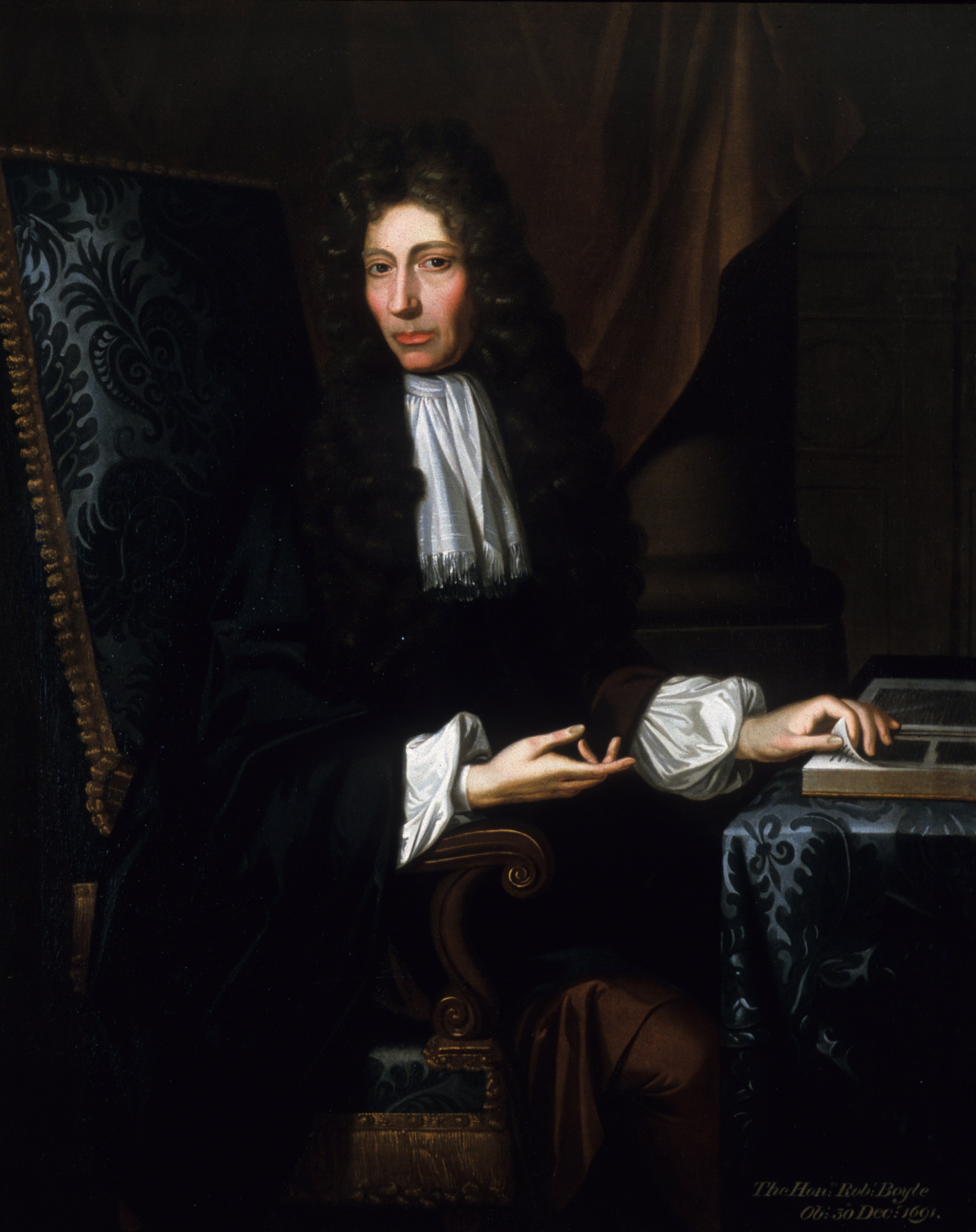
Behavioral Archetype
THE ESTABLISHMENT INSIDER – Subject is the founding myth of modern chemistry and one of its most successful concealments. The public Boyle wrote The Sceptical Chymist, formulated the gas law that bears his name, and helped found the Royal Society as a temple of open, repeatable experiment. The private Boyle hunted the Philosopher’s Stone for his entire life, believed he had witnessed transmutation, and lobbied Parliament to legalize the manufacture of gold. He is the man who kept one foot in the laboratory and one foot in the occult, and persuaded the Enlightenment he only had the one foot. Like Isaac Newton, he ran the two pursuits as a single project; unlike Newton, he did some of his hiding in plain sight.
Essence Indicators
- Anglo-Irish, born 1627 at Lismore Castle, the fourteenth child of the Earl of Cork; one of the founding fellows of the Royal Society and the author of Boyle’s Law (1662)
- The Sceptical Chymist (1661) is read as the document that separated chemistry from alchemy – a reading the historian Lawrence Principe overturned by showing it attacks sloppy pharmacists and textbook-writers, not transmutation, which Boyle pursued his whole life
- Lobbied successfully for the 1689 repeal of the 1404 statute of Henry IV against “multiplying” gold and silver – the law that made alchemical gold-making a felony – on the grounds that it obstructed legitimate research
- Published “An Historical Account of a Degradation of Gold Made by an Anti-Elixir” (London, 1678), anonymously, as a stand-alone pamphlet: a serious report of transmutation in reverse, put into print by a founding fellow of the most prestigious scientific body in the world
- Believed the Philosopher’s Stone could not merely transmute metals but attract angels – alchemy as both a source of knowledge and a defense against the atheism that genuinely frightened him
- Encrypted his alchemical work in ciphers and pseudonyms; half a century after his death the editors of his papers, Henry Miles and Thomas Birch, destroyed much of his alchemical work to protect the reputation (IEP)
- Declined the presidency of the Royal Society in 1680 and endowed the Boyle Lectures in defense of Christianity – the establishment man funding the establishment’s apologetics while keeping the heretical work behind a cipher
Social Persona / Impression Management
Immediate impression: The model of the gentleman natural philosopher – pious, courteous, independently wealthy, and constitutionally moderate. Where Paracelsus burned the textbooks and Newton waged private wars, Boyle was the man everyone in the room trusted. That trust was the instrument.
Energy: Cool, methodical, devout, valetudinarian. Boyle was a chronic invalid who turned ill health into a justification for the long solitary hours that experimental – and alchemical – work required. The register was never volcanic. It was reasonable. Reasonableness was the cover.
Impression management strategy: RESPECTABILITY AS CAMOUFLAGE. Boyle did not hide the alchemy by retreating from public life; he hid it by being the most publicly credible scientist of his age. The corpuscular philosophy, the air-pump demonstrations, the Royal Society fellowship, the Christian endowments – all of it built a reputation so unimpeachable that the transmutation work could be conducted under its shelter. The ciphers handled the rest. He hid the occult inside the institution he helped build.
Forensic Archetype Comparison
| Pattern | Match Level | Evidence |
|---|---|---|
| The Hidden Practitioner | DEFINING | Lifelong alchemical quest concealed behind the founding reputation of modern chemistry. The concealment outlived him: his 1740s editors discarded much of the alchemical material, and historians ignored what survived until Principe reconstructed the quest in the 1990s. |
| The Establishment Insider | MAXIMUM | Founding fellow of the Royal Society, declined its presidency, endowed lectures defending the faith. Boyle did not fight the institution – he was the institution, which is precisely why the heresy beneath it went unseen. |
| The Legitimizer | HIGH | Lobbied Parliament to repeal the 1404 anti-alchemy statute and published, anonymously, a report of transmutation in reverse. He used institutional authority to make the forbidden respectable, then declined to advertise how far he had taken it personally. |
| The Devout Heretic | MODERATE-HIGH | His alchemy was not irreligion but its opposite – a hedge against atheism, a search for spiritual agents in matter. The orthodoxy was sincere; so was the occult. The tension never resolved because to Boyle there was no tension. |
Psychometric Assessment
Big Five (OCEAN):
| Trait | Score | Evidence |
|---|---|---|
| Openness | 92/100 | Chemistry, pneumatics, theology, medicine, scriptural languages, and alchemy pursued as a unified inquiry into a single created order. No domain treated as beneath investigation; the crucible and the air-pump sat on the same bench. |
| Conscientiousness | 95/100 | Voluminous, meticulous, methodical across decades despite chronic illness. The experimental record is exhaustive; the alchemical record is enciphered but equally disciplined. Boyle finished what he started, quietly. |
| Extraversion | 35/100 | Reserved and frequently ill, but networked. Worked the Royal Society, the Hartlib circle, and Parliament through correspondence and patronage rather than performance. Influence by quiet access, not by stage presence. |
| Agreeableness | 70/100 | Genuinely courteous, charitable, and conciliatory – the anti-Paracelsus. The agreeableness was real, and it was also the most effective camouflage in the set: nobody suspects the gentleman. |
| Neuroticism | 60/100 | Chronic ill-health, scrupulous religious anxiety, and a documented terror of atheism that he tried to answer with both lectures and alchemy. The piety was partly a man arguing himself out of dread. |
Dark Triad:
| Trait | Score | Notes |
|---|---|---|
| Narcissism | 30/100 | Low. Declined the Royal Society presidency, published anonymously at times, framed himself as a servant of God and natural knowledge rather than a singular genius. The modesty was real and also load-bearing for the reputation. |
| Machiavellianism | 55/100 | Moderate. The respectability was a deliberately maintained instrument, the alchemy was enciphered against discovery, and the parliamentary lobbying was a calculated use of institutional standing to legalize the forbidden. Strategic, but in service of inquiry rather than conquest. |
| Psychopathy | 8/100 | Negligible. No cruelty, no exploitation, no indifference to others in the record. The deception was self-protective and tradition-protective, never predatory. |
MBTI: INTP (“The Logician”) – Dominant introverted thinking pursuing the underlying structure of matter for its own sake, with auxiliary extraverted intuition ranging freely across chemistry, scripture, and the occult. The inferior extraverted feeling shows in the social caution: he managed the reputation carefully because he could not afford to lose the institutional standing that protected the work.
Why This Profile Matters
Boyle is The Hidden Fire’s cleanest proof that the wall between science and the occult is a story told after the fact. The textbook says he is where chemistry begins – the moment the discipline grew up and left alchemy behind. The papers say he never left; he just stopped putting it in the papers other people were allowed to read. The same hands that built the repeatable, public, institutional method of modern science were also writing in cipher about the stone that turns lead to gold and summons angels. He belongs beside Isaac Newton, the other Royal Society man running physics and alchemy off the same desk, and downstream of Paracelsus, whose chemical medicine is the lineage Boyle inherited and laundered into respectability. The trick the chapter documents is not that Boyle was secretly a crank. It is that the Enlightenment needed the crucible and the equation to live in different rooms, and Boyle’s career is the evidence that they were always the same room.
Threat Assessment
| Category | Level | Notes |
|---|---|---|
| Physical threat | NONE | A sickly, charitable gentleman whose most aggressive act was a vacuum pump. |
| Institutional threat | HIGH | Helped found the Royal Society, set the template for the experimental method, and used parliamentary standing to repeal a 285-year-old law. He reshaped what counted as legitimate knowledge – and what counted as legal. |
| Memetic threat | CIVILIZATIONAL | “The father of modern chemistry” is one of the founding figures of the rationalist self-image. That the figure was a lifelong alchemist is a load-bearing crack in the story the Enlightenment tells about its own birth. |
| Posthumous threat | ONGOING | The editors’ clean-up worked for two and a half centuries. Principe’s reconstruction undid it. Every time the alchemical Boyle resurfaces, the tidy science-defeats-superstition narrative he supposedly headlines gets harder to hold. |
Deception Analysis
Primary deception modality: RESPECTABILITY + CIPHER. Boyle ran two layers. The outer layer was reputation: a public persona so credible that nobody looked for the heresy underneath it. The inner layer was literal encryption – the alchemical work written in codes and pseudonyms, much of it later discarded by his editors. He did not deny the alchemy; the 1678 anti-elixir paper and the 1689 lobbying were public. He simply never let the full extent of the private quest stand next to the public reputation where the two could be compared.
Authenticity assessment: DUAL AUTHENTIC. The chemistry was real and foundational; the alchemy was real and lifelong; the piety underwriting both was sincere. The inauthenticity was never in the work but in the partition – maintained by Boyle through cipher and decorum, and by his later editors through the bonfire. To Boyle there was one investigation of one created world. The separation into “science” and “occult” was imposed afterward, by people who needed him to have been only half of what he was.
Flame Warrior Classification
Primary: Philosopher / Gatekeeper (helped set the rules of what counts as legitimate science, and what counts as legal alchemy) Secondary: The Hidden Practitioner (occult quest concealed behind the institution he built) Notes: ATK 7 – the move was quieter than Newton’s but structurally larger in one respect: Boyle helped build the institution and then used it as cover, and got a 285-year-old felony statute repealed to clear room for the forbidden work. DEF 9 – respectability plus cipher plus a posthumous clean-up crew kept the full picture buried for three centuries; only modern scholarship cracked it. HP 1 – died wealthy, revered, and undisturbed, the reputation intact and the alchemy safely encrypted. The single point reflects what the world eventually took back: the secret, once Principe read the ciphers the editors missed.
Sources: Britannica – Robert Boyle; Science History Institute – Robert Boyle; Lawrence Principe, The Aspiring Adept: Robert Boyle and His Alchemical Quest (Princeton University Press); Wikipedia – Robert Boyle; IEP: “The early Boyle scholars Henry Miles and Thomas Birch actually destroyed much of Boyle’s work in alchemy, fearing it would tarnish his reputation as a scientist”; Boyle, Of a Degradation of Gold Made by an Anti-Elixir: A Strange Chymical Narrative (London: T.N. for H. Herringman, 1678), 17 pp. quarto, Wellcome Collection copy (Internet Archive).
Cross-Referenced Dossiers
Prefer RSS? Subscribe here.