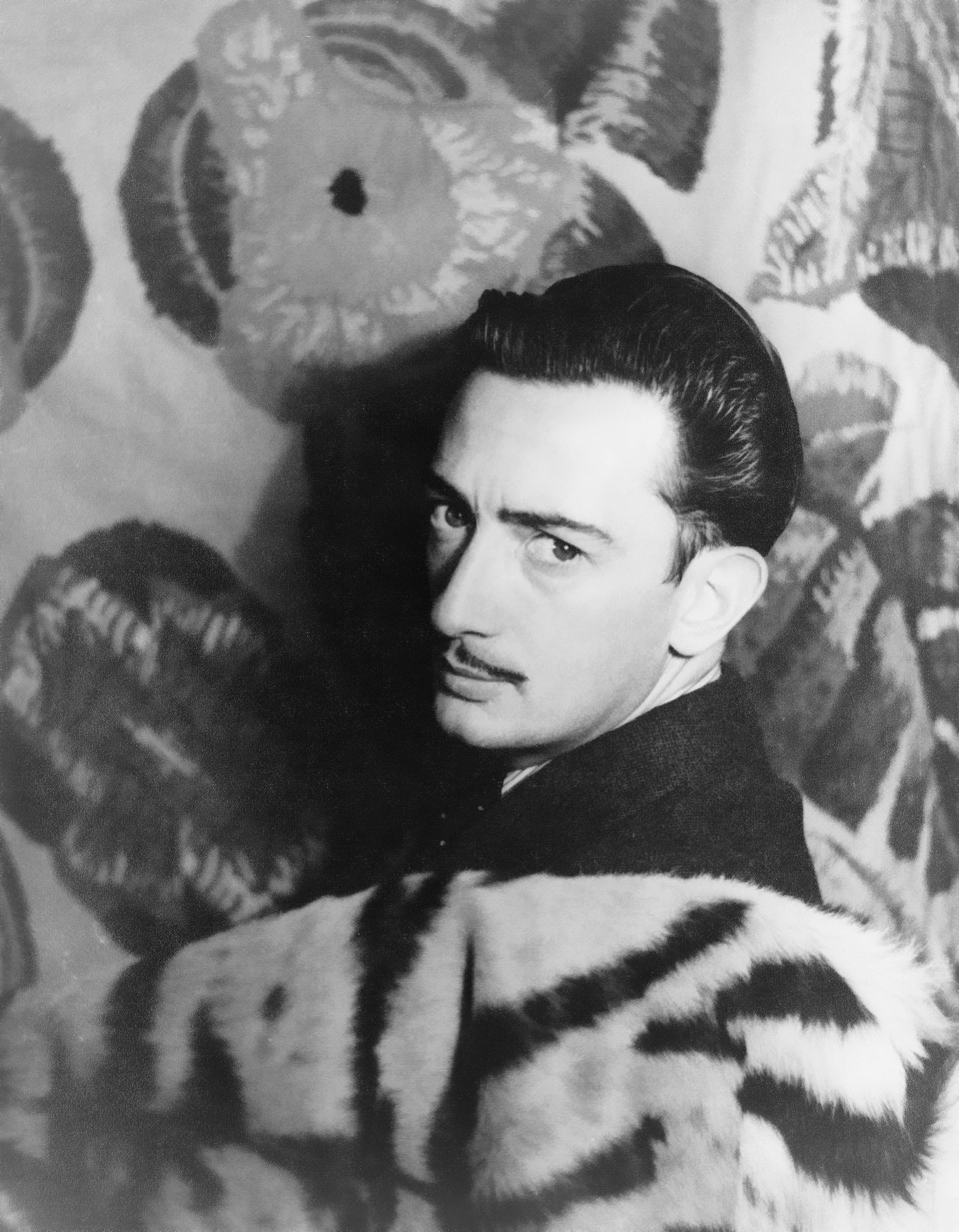
Behavioral Archetype
In 1969 Salvador Dali walked an anteater on a leash out of the Paris Metro for the cameras.
THE TROLL AS BRAND — Subject understood earlier and more completely than almost any artist of the twentieth century that in the age of mass media the artist’s persona is the primary artwork. The paintings were real and the talent was real, but Dali grasped that the canvas was only the pretext. The deliverable was “Dali” — the moustache, the cape, the wild-eyed pronouncements — broadcast through television, advertising, and the press until the brand outgrew the movement that produced it. When the Surrealists expelled him, he did not contest the verdict. He became more famous than Surrealism and annexed the name.
Essence Indicators
- Engineered a totalizing public persona — the upturned waxed moustache, the cape, the cane, the absolute-conviction pronouncements — and maintained it across every public appearance for five decades
- Treated mass media as the medium: appeared on game shows (What’s My Line?), filmed television commercials, and accepted commercial design work the avant-garde considered disqualifying
- Produced genuine landmark work — The Persistence of Memory (1931), the melting clocks — so the brand sat on real substance, not vapor
- Manufactured spectacle as a deliberate instrument: walked an anteater on a leash out of the Paris Metro (1969) for the cameras; built the Lobster Telephone (1938) and a sofa shaped like Mae West’s lips
- Responded to excommunication by absorbing the institution that expelled him — claimed to be Surrealism rather than merely belong to it
- Designed the Chupa Chups logo (1969), still in use, as a point of pride rather than embarrassment
- What he paid, ranked ahead of what he said. The Surrealists tried him: “Breton led and staged a trial of Dalí in January and February 1934 for praising Hitlerian fascism,” in the words of Cabañas and Murga, who add that Dalí had become “fascinated by the figure –yet not the ideas– of Hitler” (Cabañas Bravo and Murga Castro, Avant-garde Studies, Fall 2015, hosted by the Dalí Museum). The Dalí Museum’s timeline says he “was nearly expelled after a “trial” in 1934” and that “In 1939 Andre Breton definitively expelled Dalí from Surrealism” (Dalí Museum, timeline), and RTBF reports that “L’exclusion de Dalí n’est officiellement communiquée qu’en mai 1939” (RTBF). His own account of the politics, in the book he published in 1942: “I believed neither in the communist revolution nor in the national-socialist revolution, nor in any other kind of revolution,” and “I did not want to be called anything but Dali” (The Secret Life of Salvador Dalí, 1942, full text). He held that line through a trial and an expulsion
- The helmet, in his own account and in the magazine’s. At the International Surrealist Exhibition in London in the summer of 1936 he lectured from inside a diving suit (“at which I gave a lecture from inside a diving suit,” he writes). Apollo reports that, asked at the supplier’s how deep he planned to go, he replied “The depths of the subconscious!” (Apollo, Christopher Turner on Edward James, 1 May 2021); his own account gives that exchange to Lord Berners, on the telephone. Then the lecture: he “felt faint and on the point of suffocating,” and “The audience for the most part was convinced that all this was part of the show” (The Secret Life of Salvador Dalí). Apollo has the rescue: “his fellow artists tried to free him, unsuccessfully, with a spanner. The billiard cue was used to lever off the helmet instead.” His own verdict on the period, a few pages on: “Enough diving suits, lobster-telephones, jewel-clips, soft pianos, archbishops, and blazing pines thrown from windows, enough of publicity and cocktail parties.” He was asked about the helmet on air in 1958 and answered, “Because I think there is nothing like it. The audience understand Dali when penetrate in the bottom of the sea” (The Mike Wallace Interview, 19 April 1958, Harry Ransom Center)
- The thesis, to a national audience, in his own words. Wallace opens by calling him “a self-confessed genius with an ingenious flair for publicity.” Asked what he is a genius at besides painting: “The most important in my life, modern clown, modern painting, modern draftsmanship is my personality.” And: “My personality is more important than any of these little facets of my activities.” And, when Wallace restates it as expressing Dali and nothing else: “The painting, the clowning, the showmanship, the technique - everything is only one manner for express the total personality of Dali.” Asked which contemporary painters he admires: “First Dali, after Dali, Picasso, after this, no others.” Wallace closes the programme on a line he quotes him as saying, “I do not understand why, when I ask for grilled lobster in a restaurant, I’m never served a cooked telephone” (The Mike Wallace Interview, 19 April 1958, transcript and video, Harry Ransom Center)
- The method was in the 1942 book before it was a strategy. Of his childhood: “If you play at genius you become one!” Of the crossing to New York, with the reporters who would meet the ship and a loaf of bread two and a half metres long worked out in advance: “I love getting publicity, and if I am lucky enough to have the reporters know who I am, I will give them some of my own bread to eat,” and to his fellow passengers, “What do you think I can do to have my bread make the greatest impression on the reporters?” Of the Surrealist group he joined: “I was going to make a bid for power, and for this my influence had to remain occult, opportunistic” (The Secret Life of Salvador Dalí)
- The state honoured him, in its own gazette. Decree 1087/1964 of 1 April 1964, dated at Madrid and issued over Francisco Franco’s name, concedes Salvador Dalí the Grand Cross of the Order of Isabella the Catholic: “Vengo en concederle la Gran Cruz de la Orden de Isabel la Católica” (Boletín Oficial del Estado no. 102, 28 April 1964, p. 5391). Royal Decree 1676/1982 of 24 July 1982 grants him the title of Marqués de Dalí de Pubol “en atención a los méritos y circunstancias que concurren en el extraordinario pintor don Salvador Dalí Domenech, cuya obra constituye una de las más relevantes creaciones artísticas de nuestro tiempo” (BOE, 26 July 1982, p. 20173), and Royal Decree 1377/1983 of 20 April 1983 converts it into a life title (BOE-A-1983-15159)
- He built the monument himself. The Foundation’s page says the site in Figueres was “converted into the Theatre-Museum according to Salvador Dalí’s own criteria and design” and “Inaugurated in 1974, the Dalí Theatre-Museum is home to the world’s most extensive collection of the artist’s work” (Fundació Gala-Salvador Dalí, Dalí Theatre-Museum)
On the record, by date:
- The Franco state: Grand Cross of the Order of Isabella the Catholic by Decree 1087/1964, over Franco’s name; “the Francoist regime had turned him into a big star” after his return in 1948 (1948; 1964) (BOE, 28 April 1964; Cabañas and Murga)
- The Crown: the marquisate of Dalí de Pubol by Royal Decree 1676/1982, converted to a life title by Royal Decree 1377/1983 (1982) (BOE, 26 July 1982; BOE-A-1983-15159)
- The Surrealist group under André Breton: admitted in 1930, tried in January and February 1934, nicknamed “Avida Dollars” in 1935, still contributing to Minotaure in 1936, definitively expelled in 1939 (1930) (Cabañas and Murga; Dalí Museum)
- Luis Bunuel: the film “on which I had collaborated with Bunuel” (1931) (The Secret Life of Salvador Dalí)
- Edward James: patron and, in Dali’s words, one who “ordered aphrodisiac lobster-telephones, bought the best Dalis”; accompanied him to the 1936 London lecture and translated it (1936) (The Secret Life of Salvador Dalí; Apollo)
- The Dalí Theatre-Museum, Figueres, built to his design, inaugurated 1974; the Fundació Gala-Salvador Dalí now speaks for the estate (its lawyers appeared in the 2017 suit) (Fundació Gala-Salvador Dalí; Fundació Gala-Salvador Dalí)
- Gala, his wife: per a 1987 review, “signing contracts on his behalf in 1980” (1980) (review of Rogerson, 1987)
- The print-fraud prosecutions: Center Art Galleries-Hawaii and its executives convicted in 1990, a Chicago dealer pursued by the FTC and then criminally; Dali is not a party to either (1990) (Honolulu Star-Bulletin; The Art Newspaper)
- The 2017 paternity suit: a Madrid court ordered his exhumation for DNA comparison; the Foundation, through its lawyers, opposed the order and appealed; the forensic result excluded him as the claimant’s father. He was the subject, not a party, having died in 1989 (2017) (NBC News; Fundació Gala-Salvador Dalí)
- Bonwit-Teller, New York: “I accepted an offer to dress one of the windows of Bonwit-Teller’s shop with a surrealist display” (The Secret Life of Salvador Dalí)
- None entered. No foreign-government service, registration or diaspora-organisation role appears in any source cited on this page; the Dalí Museum records that he and Gala “spent the better part of the 1940s in America after fleeing WWII,” which is a residence, not a tie (Dalí Museum)
- None entered. No tie to SPLC, ADL, CCDH, GDI, NewsGuard, ISD, Graphika or SIO appears in any source cited on this page
- The overlap is the finding, and it sits across the Movement and Agency axes in sequence and on the Corporate axis throughout: the man the Surrealists expelled in 1939 was back in Spain nine years later, was decorated by Franco in 1964 and made a marquis by the King in 1982, and through all of it the Corporate ties kept running: patrons, a department-store window, a film, a museum. In 1958, ten years after the return and six years before the Grand Cross, he told an American audience that “Prince Juan Carlos and Franco agree on its restoration,” and when Wallace asked why he feared a death he had called beautiful he answered “because Dali is contradictory and paradoxical man” (Harry Ransom Center). No Ratchet or Diaspora tie appears. Both Legal entries are posthumous or about sellers, not about him.
Social Persona / Impression Management
Immediate impression: Theatrical, grandiose, relentlessly on. Where Duchamp projected cool detachment, Dali projected maximum wattage — a man performing genius at full volume and daring you to decide whether it was real. The conviction never broke character, which is precisely why nobody could tell where the act ended.
Energy: Loud, ornate, indefatigable. The energy of a showman who has correctly calculated that no press is bad press and that the spectacle sells the canvas, not the reverse. Television amplified it; he used the medium more ruthlessly than any fine artist of his generation.
Impression management strategy: TOTAL BRAND SATURATION. Dali did not manage impressions selectively — he flooded every available channel with a single, exaggerated, instantly recognizable signal until “Dali” became shorthand for the entire idea of the eccentric genius. The moustache alone is a logo. The strategy’s masterstroke was reframing commercialization, the very charge his enemies leveled, as evidence of his triumph. They said he sold out. He pointed out that everyone knew his name.
Forensic Archetype Comparison
| Pattern | Match Level | Evidence |
|---|---|---|
| The Self-Promoter | MAXIMUM | The persona was the product. Every appearance, stunt, and commercial deal fed a single brand that Dali built with the deliberation of an ad agency, decades before “personal branding” had a name. Exhibit: “everything is only one manner for express the total personality of Dali” (Harry Ransom Center). |
| The Chameleon | LOW | Unlike Kaufman, Dali ran ONE character relentlessly. The power came from saturation and consistency, not multiplicity. There was only ever one “Dali,” everywhere, all the time. Exhibit: his answer to Wallace on the childhood ambitions that preceded it, “A little one like it becoming Dali. And now is every day more Dali” (Harry Ransom Center). |
| The Authority Usurper | HIGH | Expelled by Breton, the self-appointed pope of Surrealism, Dali responded by out-branding the office. “I am Surrealism” is a claim to the title itself — the excommunicant declaring himself the church. Exhibit: RTBF gives the sentence as “Le surréalisme, c’est moi !” (RTBF). |
| The Calculated Provocateur | HIGH | The anteater, the lobster phone, the pronouncements — none of it accidental, all of it staged for the cameras. The provocation was instrumented for coverage, not impulse. Exhibit: Wallace puts to him his own line, “I like to be a clown, a buffoon, I like to spread complete confusion” (Harry Ransom Center). |
Psychometric Assessment
Big Five (OCEAN):
| Trait | Score | Evidence |
|---|---|---|
| Openness | 94/100 | Worked across painting, sculpture, film (collaborated with Bunuel and Hitchcock), jewelry, fashion, advertising, and object-art. Invented the “paranoiac-critical method” and applied it to a career, not just a canvas. Exhibit: his own account of the film, “on which I had collaborated with Bunuel,” and of the method he named, “Dali paint the atomic age and the Freudian age nuclear things and psychologic things” (The Secret Life of Salvador Dalí; Harry Ransom Center). |
| Conscientiousness | 80/100 | High where it counted. The technical precision of the paintings is meticulous, and the brand was maintained with unbroken discipline for fifty years. The chaos was curated. Exhibit: the preparation, “What do you think I can do to have my bread make the greatest impression on the reporters?” (The Secret Life of Salvador Dalí). |
| Extraversion | 95/100 | Operated almost entirely in public, required an audience, and sought the camera. The spotlight was the workspace. Exhibit: “The painting, the clowning, the showmanship, the technique” (Harry Ransom Center). |
| Agreeableness | 30/100 | Antagonized the Surrealist establishment, refused to play by movement rules, and cheerfully monetized the things his peers considered sacred. Charm deployed tactically, not warmly. Exhibit: his own sorting of people, “Very rich people have always impressed me; very poor people, like the fishermen of Port Lligat, have likewise impressed me; average people, not at all,” and “Everybody love Dali very much,” which he followed with “But they pick on him” (The Secret Life of Salvador Dalí; Harry Ransom Center). |
| Neuroticism | 55/100 | Moderate-to-high. Documented anxieties and obsessions ran beneath the performance; the relationship with his wife and manager Gala was a load-bearing dependency. The serenity was not the genuine register. Exhibit: “I suddenly felt myself in the grip of a depression which I was unable to define,” written of the period straight after the diving-suit lecture, and, asked by Wallace whether he feared death, “Yes” (The Secret Life of Salvador Dalí; Harry Ransom Center). |
Dark Triad:
| Trait | Score | Notes |
|---|---|---|
| Narcissism | 90/100 | Among the highest in this file. “I am Surrealism” is not a metaphor; it is a self-assessment. The persona was an act of sustained self-aggrandizement that happened to be commercially correct. Exhibit: “My personality is more important than any of these little facets of my activities,” and “my admiration for Dali is becoming tremendous” (Harry Ransom Center). |
| Machiavellianism | 78/100 | High. Reframing the “sold out” accusation into a badge, annexing a movement’s name after being expelled from it, and using television to make the brand outlast the establishment all required cold strategic sense. Exhibit: “I was going to make a bid for power, and for this my influence had to remain occult, opportunistic,” and his phrase for his own temperament in the same passage, “the half-conscious Machiavellism in my scepticism” (The Secret Life of Salvador Dalí). |
| Psychopathy | 25/100 | Low-moderate. The provocations targeted institutions, rivals, and audiences — not victims. No pattern of personal cruelty for its own sake; the ruthlessness was promotional. Exhibit: Wallace read him the memoir’s record, “As a child you kicked people - you threw a friend off a rocky ledge. As an adult you confessed that you once kicked a legless beggar along the street,” and he answered, “Exactly. But this is my adolescence period. Now becoming much more quiet in these kind of sadistic things” (Harry Ransom Center). |
MBTI: ENTP (“The Debater”) — extraverted intuition generating an endless stream of provocations and connections, with auxiliary introverted thinking organizing them into a coherent, self-justifying brand logic. The type that argues itself into being the movement it was thrown out of.
Why This Profile Matters
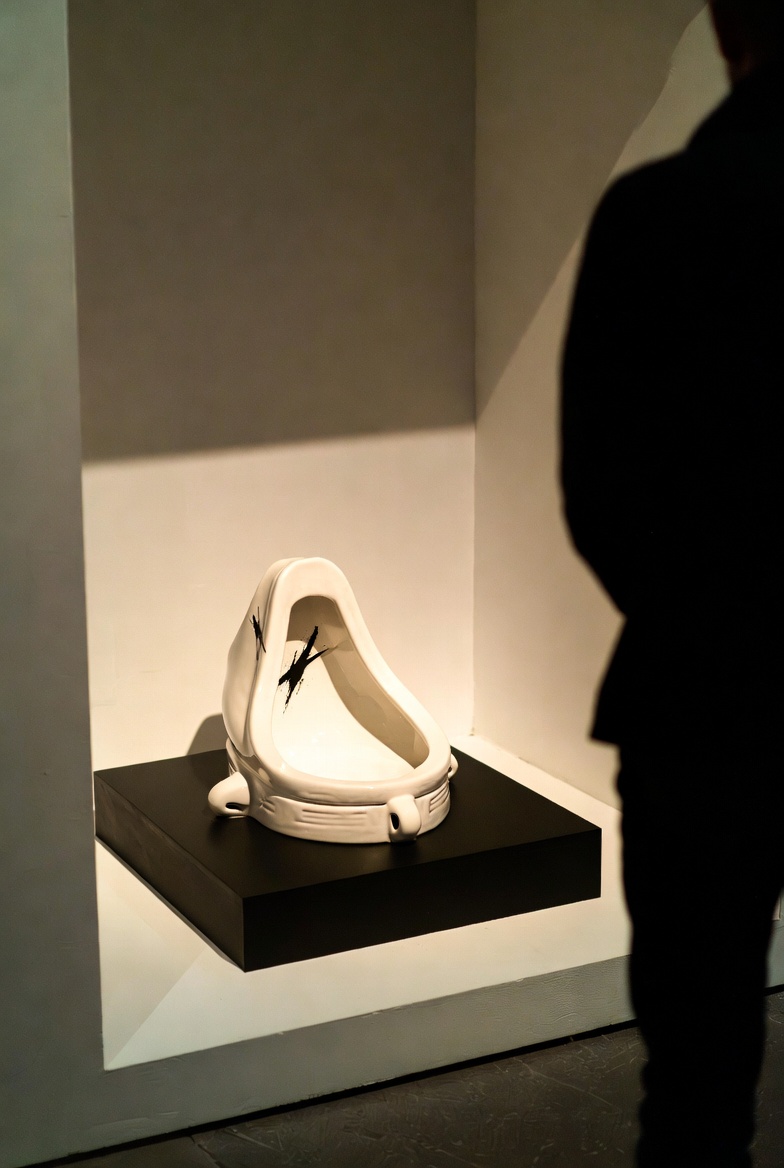
Dali sits in The Fires of History (Chapter 9, “Art as Trolling”) alongside Duchamp and Wilde as proof that art-world provocation is a trolling lineage, not a series of isolated scandals. Duchamp attacked the definition of art; Dali attacked the economy of fame around it, demonstrating that in a mass-media age the artist’s self is the most valuable thing the artist makes. His response to excommunication — out-branding the institution until the public forgets the institution ever existed — is the same maneuver Luther ran on the Church and the same one Crowley ran on respectable society: turn the expulsion into the platform. Every figure who has since converted notoriety into a personal brand, from the publicity-stunt artist to the engagement-farming poster, is working a template Dali pressure-tested with an anteater and a lollipop logo.
Threat Assessment
| Category | Level | Notes |
|---|---|---|
| Physical threat | NONE | A painter with a moustache and a leashed anteater. |
| Institutional threat | HIGH | Demonstrated that an individual brand can outgrow and outlive the movement that credentialed it. Breton expelled him; the public made Dali the face of Surrealism anyway. |
| Memetic threat | EXTREME | The moustache, the melting clocks, and “Avida Dollars” are durable memes. Ask a stranger to name a Surrealist and they say Dali — the brand is still running the table a century on. |
| Civilizational threat | MODERATE | Helped normalize the now-total fusion of fine art and self-promotion. The “artist as brand” assumption that saturates contemporary culture is, in part, a Dali bequest. |
Flame Warrior Classification
Primary: Ego Secondary: Evil Clown Also reads as: Primary: Self-Promoter / Showman Secondary: Enfant Provocateur (the staged stunts) Notes: ATK 9 — the brand strategy landed so hard that “Salvador Dali” beat “Surrealism” in the public memory; that is a top-tier offensive result. DEF 8 — nearly unassailable, because the standard attack (“commercial sellout”) was the exact charge Dali had already converted into a selling point; Breton’s “Avida Dollars” anagram curdled into a grudging admission. HP 9 — the persona has outlived the man by decades and shows no decay; the moustache is a working logo and the clocks are still melting in every dorm room. Subdued only by Duchamp on pure conceptual ATK, and never on reach.
The receipts behind each number. ATK 9: asked by Wallace why a dedicated painter behaves as he does, he answered that “My personality is more important than any of these little facets of my activities,” and that “everything is only one manner for express the total personality of Dali” (Harry Ransom Center); the Franco state then decorated him over Franco’s name in 1964 and the Crown made him a marquis in 1982, “cuya obra constituye una de las más relevantes creaciones artísticas de nuestro tiempo” (BOE, 28 April 1964; BOE, 26 July 1982). It is not 10 because the movement whose name he annexed could and did expel him, and because the attack he made on the economy of fame reset no definition the way the urinal did. DEF 8: Cabañas and Murga record the 1934 trial, the 1935 nickname, Breton still taking his contributions to Minotaure in 1936, and a regime that “had turned him into a big star” after 1948 (Cabañas and Murga); the Dalí Museum dates the definitive expulsion to 1939 (Dalí Museum). It is not 9 because the one body with the standing to expel him did, and it is not lower because the expulsion did not cost him the audience: in his own 1958 account, “Everybody love Dali very much. But they pick on him” (Harry Ransom Center). HP 9: the Theatre-Museum he designed, inaugurated in 1974 (Fundació Gala-Salvador Dalí), is a building with a ticket office, and in 2025 NPR was still asking why his work is forged so often and answering “there is a huge global demand” (The Art Newspaper, 2 Oct 2025 (Parma seizure of 21 suspected Dali forgeries); NPR). An institution and a market are the artifacts that outlast a persona.
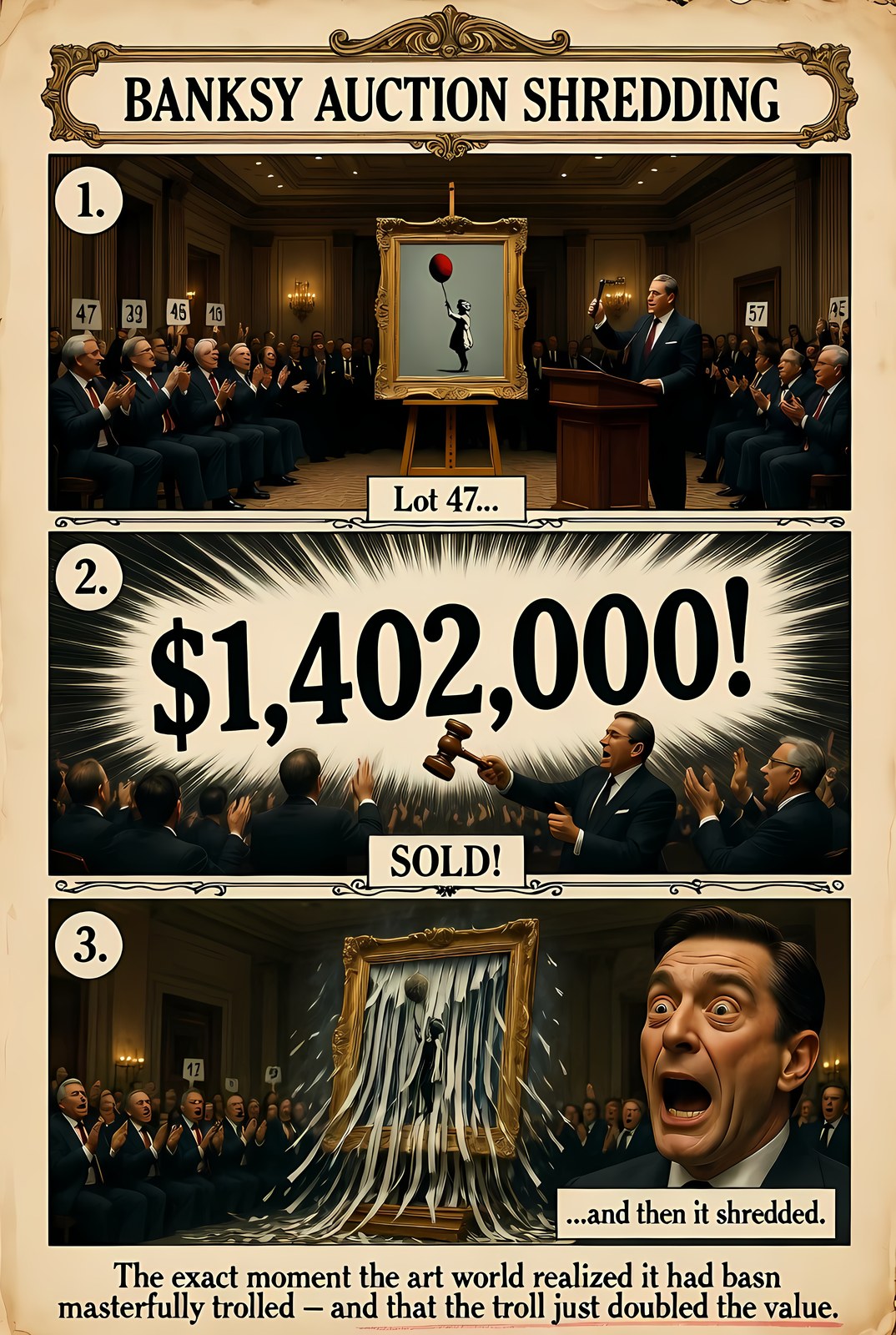
Against peers on the same values: Duchamp holds 10 / 8 / 9 at 80.7, a point above on ATK and level on DEF and HP, because the urinal reset a definition where the persona annexed a name, and the 1.3-point gap between them is the one ATK point. Banksy holds 9 / 9 / 9 at 84.0, level on ATK and HP and a point above on DEF, because the Banksy persona is, on that page’s record, shielded by an authentication company the High Court names, where Dali’s shield was a persona that the Surrealists could still expel and a market that forged him.
Further sources: The Mike Wallace Interview: Salvador Dalí, 19 April 1958 (Harry Ransom Center) · Dalí, The Secret Life of Salvador Dalí (1942), full text · Cabañas Bravo and Murga Castro, “Paris, New York and Madrid: Picasso and Dalí before Great International Exhibitions” (2015) · Dalí Museum, timeline · Apollo, 1 May 2021 · RTBF, “Le saviez-vous ? Salvador Dali avait été rejeté par les surréalistes” · BOE no. 102, 28 April 1964, p. 5391 · BOE, 26 July 1982, p. 20173 · BOE-A-1983-15159 · Fundació Gala-Salvador Dalí, Dalí Theatre-Museum · Fundació Gala-Salvador Dalí, statement of 6 September 2017 · NBC News, 2017 · NPR, 2 October 2025 · Honolulu Star-Bulletin, 15 March 2000 · The Art Newspaper · review of Rogerson on the Dalí forgeries, 1987
Attested and Attributed
| Claim | Status | Source |
|---|---|---|
| His personality was the work, in his own words | Attested: “My personality is more important than any of these little facets of my activities” and “everything is only one manner for express the total personality of Dali,” on The Mike Wallace Interview, 19 April 1958 | Harry Ransom Center |
| He lectured in a diving suit at the 1936 London International Surrealist Exhibition and nearly suffocated | Attested in his own account (“at which I gave a lecture from inside a diving suit”) and in Apollo’s account (the spanner, the billiard cue); Wallace put the same incident to him in 1958 (“you almost suffocated”) and he did not dispute it | The Secret Life of Salvador Dalí; Apollo; Harry Ransom Center |
| The Surrealists put him on trial in 1934 | Attested by Cabañas and Murga, who date it January and February 1934 and give the charge as “praising Hitlerian fascism”; the Dalí Museum says he “was nearly expelled after a ‘trial’ in 1934.” The two accounts differ on whether 1934 ended in expulsion, and this page enters the question as open | Cabañas and Murga; Dalí Museum |
| Breton expelled him definitively in 1939 | Attested: “In 1939 Andre Breton definitively expelled Dalí from Surrealism”; RTBF, “L’exclusion de Dalí n’est officiellement communiquée qu’en mai 1939” | Dalí Museum; RTBF |
| Breton called him “Avida Dollars” | Attributed: Cabañas and Murga give the nickname as Breton’s, in 1935, and say Breton was still receiving his contributions to Minotaure in 1936; RTBF reports Dalí’s 1967 comment on it, “C’est une anagramme qui était magique et qui m’a apporté une chance extraordinaire” | Cabañas and Murga; RTBF |
| He said “Le surréalisme, c’est moi” | Attributed: RTBF gives the sentence as his (“Le surréalisme, c’est moi !”); no dated recording or text of it is cited here | RTBF |
| He refused both revolutions | Attested in his own words: “I believed neither in the communist revolution nor in the national-socialist revolution, nor in any other kind of revolution”; he adds, “I did not want to be called anything but Dali” | The Secret Life of Salvador Dalí |
| Franco’s state decorated him | Attested in the gazette: Decree 1087/1964 of 1 April 1964 grants Salvador Dalí the Grand Cross of the Order of Isabella the Catholic, dated at Madrid and issued over Franco’s name | BOE no. 102, 28 April 1964 |
| He returned to Spain in 1948 and the regime made him a star | Attributed to Cabañas and Murga: “returned to Spain in 1948 and the Francoist regime had turned him into a big star” | Cabañas and Murga |
| On air in 1958 he forecast the monarchy’s return | Attested: “Prince Juan Carlos and Franco agree on its restoration,” in his answer to Wallace on Spain | Harry Ransom Center |
| The Crown made him a marquis in 1982 | Attested: Royal Decree 1676/1982 of 24 July 1982, “el extraordinario pintor don Salvador Dalí Domenech”; Royal Decree 1377/1983 of 20 April 1983 is published under the title that converts it into a life title (“vitalicio”) | BOE, 26 July 1982; BOE-A-1983-15159 |
| The Theatre-Museum in Figueres opened in 1974 to his design | Attested by the Foundation: “Inaugurated in 1974” and “conceived and designed by the artist himself” | Fundació Gala-Salvador Dalí |
| He signed thousands of blank sheets for publishers | Attributed and disputed: NPR’s interview with an art-fraud investigator says “he was reportedly signing thousands of blank sheets of paper for publishers to use in later limited-edition prints” and that “Some may have been signed under questionable circumstances when his health was declining”; a 1987 review of Rogerson’s book on the forgeries gives his former secretary Peter Moore as the source of the story (“signing at the rate of one every two or three seconds”) and reports that Dalí “has publicly stated that he stopped signing blank sheets in December 1980”; no document of the signing is cited here | NPR, 2 October 2025; review of Rogerson, 1987 |
| Dealers, not Dalí, were convicted for selling fake Dalí prints | Attested: Center Art Galleries-Hawaii, William Mett and Marvin Wiseman were “convicted in 1990 of various fraud charges for selling poster-quality reproductions as original artworks,” and prosecutors “accused the two of selling copies at inflated prices by claiming that they were original prints by well known artists such as Salvador Dali”; of a separate Chicago dealer prosecution, “An FTC expert who examined 490 prints did not find a single authentic original.” Dalí was not a defendant in either | Honolulu Star-Bulletin, 15 March 2000; The Art Newspaper |
| A Madrid court ordered his exhumation in 2017 and the DNA excluded him as a father | Attested: NBC, “The court ruled that the DNA tests were necessary to make a genetic comparison with Dalí”; the Foundation reports the National Institute of Toxicology and Forensic Sciences result as one that “permits the exclusion of Salvador Dalí as the biological father of María Pilar Abel Martínez,” notified through Madrid Court of First Instance no. 11, and had called the exhumation order “totally inadequate and disproportionate” | NBC News; Fundació Gala-Salvador Dalí |
Sources: Encyclopaedia Britannica; MoMA — The Persistence of Memory; Tate — Lobster Telephone; Gala-Salvador Dali Foundation; Salvador Dali — Wikipedia.
LULZ Index
Best act 9 of 15 2 acts scored
9of 15
Dali lectures in a diving suit at the London Surrealist Exhibition
C+ T++ F++ H+++ A+
at which I gave a lecture from inside a diving suit
archive.org first-hand7of 15
Dali walks an anteater out of the Paris Metro
C+ T- F++ H+++ A+
walked an anteater on a leash out of the Paris Metro
thedali.org press
C craft T target F funny H harmless A anonymous One plus a point, three at most. The number rates the act, not the person. How the code reads The whole index
Cross-Referenced Dossiers
The scores on this file are computed by a published rule from sourced records, the same rule for every troll. Nobody types a number: a score moves only when a record does. How the scoring works
Prefer RSS? Subscribe here.