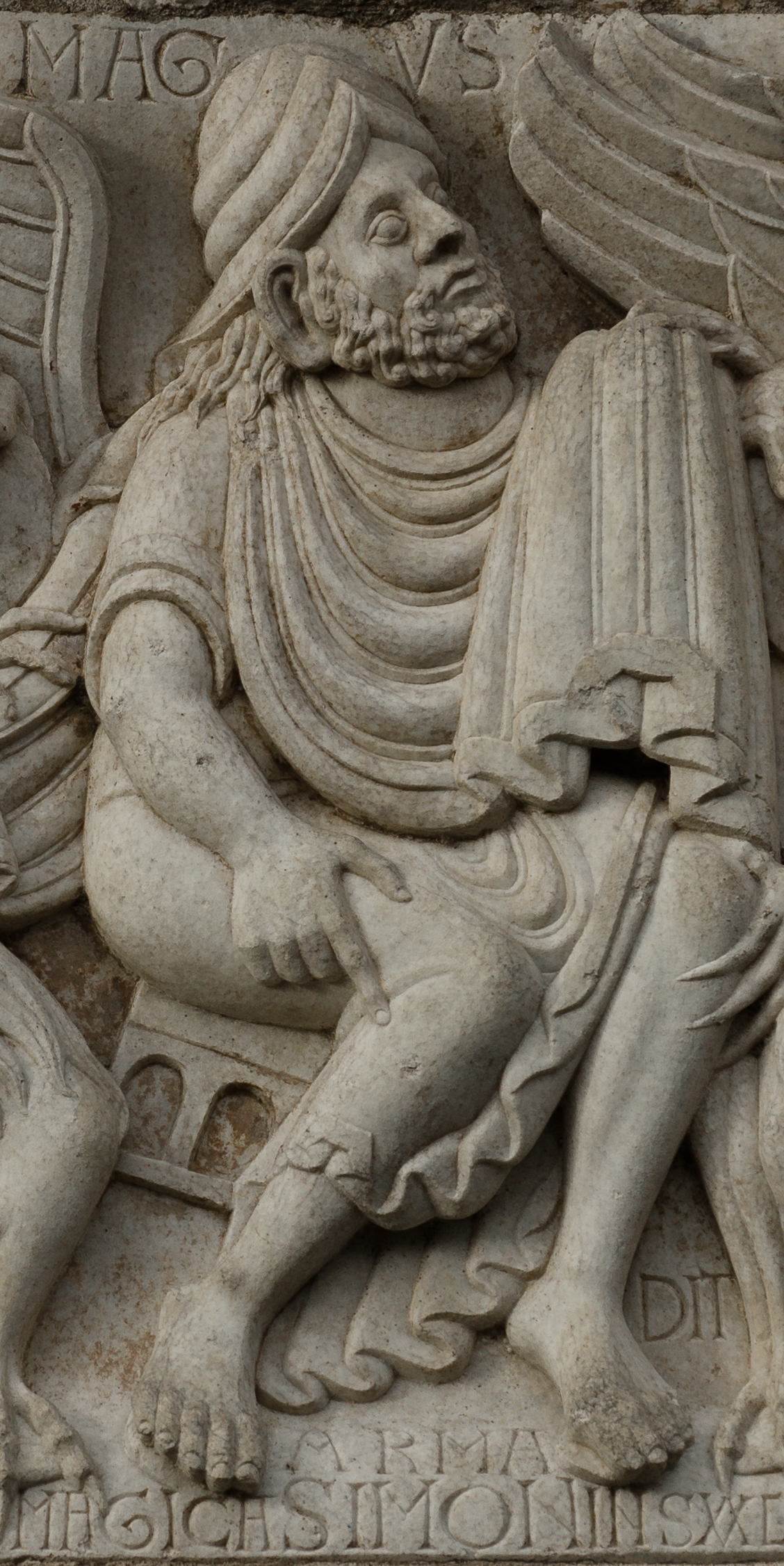
Related research: Simon Magus: Comprehensive Research Document.
Behavioral Archetype
THE FIRST HERETIC – A Samaritan magician who appears in the New Testament for sixteen verses (Acts 8:9-24), claims to be “someone great,” is baptized, and then tries to buy the apostles’ power to confer the Holy Spirit. Peter curses him. He asks for prayer and exits the narrative. That is the entire historical record. Everything else – the Gnostic cosmology, the rescued prostitute who was once Helen of Troy, the fatal flying duel with Peter over Rome – was assembled by the Church Fathers across the following three centuries, who needed an origin point for every heresy that came after and elected Simon to the role. He is the rare subject whose file is mostly written by his prosecutors.
Essence Indicators
- Claimed elevated status in a Samaritan context: the crowds called him “the power of God that is called Great” (Acts 8:10)
- Treated spiritual authority as a purchasable commodity – offered cash for the apostolic gift (Acts 8:18-19), the act that gave the word simony to canon law forever
- Believed-and-was-baptized, then immediately tried to acquire the franchise: the conversion reads as acquisition, not surrender
- Became, in patristic hands, “Simon of Samaria, from whom all sorts of heresies derive their origin” (Irenaeus, c. 180 AD) – the designated father of Gnosticism
- The legend accreted in layers: Justin (c. 150) reports Roman Simon-worship; Irenaeus (c. 180) supplies the Helena/Ennoia myth; the apocryphal Acts of Peter (c. 180-190) stages the flying death
- Attribution caution: the canonical text says nothing of Helena, nothing of cosmology, nothing of flight. Treat the heresiarch and the flying duel as legend, not biography.
Social Persona / Impression Management
Immediate impression: A provincial wonder-worker who had already “amazed the people of Samaria” before Christianity arrived (Acts 8:9-11). A man with a following, a reputation for power, and a title the crowd gave him. Not a fringe figure locally – the text says “all of them, from the least to the greatest, listened to him eagerly.”
Energy (per the hostile sources): Acquisitive and status-seeking. Where al-Hallaj gave everything away for a claim, Simon’s defining gesture is reaching for his purse. The single most quoted thing about him is that he tried to buy what could not be bought.
Impression management strategy: STATUS ARBITRAGE. Simon’s move is to recognize a more powerful operation and attempt to acquire its capability rather than submit to it. Peter reads this instantly – “your heart is not right before God” – and the rebuke is not a refusal but a curse. The legend later inverts the register entirely: the flying Simon of Rome is pure spectacle, a public demonstration of divinity that ends with a fall into the Sacred Way and a leg broken in three places. The historical man bargained; the legendary man performed.
Forensic Archetype Comparison
| Pattern | Match Level | Evidence |
|---|---|---|
| The Status Buyer | HIGH | The one undisputed act: offering money for spiritual power (Acts 8:18-19). The behavior is so definitional it became a legal category. |
| The Cult Leader | MODERATE | Justin and Epiphanius report a Simonian sect that worshipped him, persisting into the late 4th century. Origen, c. 248, counted barely thirty Simonians left in the world (Contra Celsum I.57; VI.11). The developed cult may postdate the man by generations. |
| The Narcissistic Operator | MODERATE-HIGH | “Said that he was someone great” (Acts 8:9); in Irenaeus he claims to be “the loftiest of all powers.” How much is Simon and how much is heresiology is unrecoverable. |
| The Designated Villain | DEFINING | Simon is the load-bearing antagonist of the Pseudo-Clementine novels and the Acts of Peter – a literary device for “everything orthodoxy is not,” likely overbuilt far past the historical figure. |
Psychometric Assessment
Scoring caveat: the only behavioral data with any claim to history is sixteen verses. Everything below the canonical line is scored against the constructed Simon – the heresiarch the Fathers built – and is flagged as such.
Big Five (OCEAN):
| Trait | Score | Evidence |
|---|---|---|
| Openness | 80/100 | The cosmology attributed to him (fire as primal principle, paired emanations, the Ennoia myth) is wildly inventive – but it is attributed, possibly retrofitted by later Simonians or by Hippolytus. Scored on the construct. |
| Conscientiousness | 35/100 | The defining act is an impulsive grab for power immediately after baptism. No discipline, no patience, no submission to process. |
| Extraversion | 70/100 | A public performer who “amazed the people” and gathered a crowd. The legendary Simon stages a flight over the Roman Forum. Whatever else he was, he was not private. |
| Agreeableness | 25/100 | Tried to purchase the apostles’ charism rather than receive it; in the heresiological tradition, a relentless debater and rival. |
| Neuroticism | 50/100 | Ambiguous. After Peter’s curse he asks for prayer “that nothing of what you have said may happen to me” (Acts 8:24) – which reads as either genuine fear or instant capitulation. |
Dark Triad:
| Trait | Score | Notes |
|---|---|---|
| Narcissism | 70/100 | “Someone great”; “the Great Power of God”; in legend, a man who claims to be God and flies to prove it. High on the construct, uncertain on the man. |
| Machiavellianism | 60/100 | The purchase attempt is a transaction – treat the gift as an asset, acquire the asset. The Pseudo-Clementine Simon is a manipulator and scripture-twister, though that is fiction. |
| Psychopathy | 30/100 | Low-moderate. The canonical Simon shows fear, not callousness. The legendary deceiver is a literary villain, not a clinical profile. |
MBTI: ENTP (“The Debater”) – on the constructed figure. Extraverted intuition generating systems and spectacle, paired with extraverted thinking that treats power as something to be acquired and operated. The heresiologists’ Simon is the archetypal contrarian system-builder; the historical Simon is too thinly attested to type honestly, and this classification is offered for the legend, not the man.
Why This Profile Matters
Simon is the template. He is the first person the institutional Church designated a heretic, and in designating him it discovered the technique it would use for two thousand years: locate the deviation, name a single founder, trace every subsequent error back to him, and let the genealogy do the condemning. Irenaeus does not merely call Simon wrong – he makes Simon the root, “from whom all sorts of heresies derive their origin,” so that every later Gnostic is retroactively Simon’s heir. The heretic, like the troll, is partly a real actor and partly a role the establishment needs filled. Simon is the proof that the second part can swallow the first: a man known for sixteen verses became fifteen centuries of cathedral art, a Faust-legend ancestor (via the Pseudo-Clementine shape-shifting subplot), and a permanent entry in canon law – all built on top of a record that supports almost none of it.
Threat Assessment
| Category | Level | Notes |
|---|---|---|
| Physical threat | NONE | A first-century magician. The only violence in the file is his own legendary fall. |
| Institutional threat | HIGH (as constructed) | Not from the historical man but from the category he became. “Simon” gave the Church its model for heresy-by-genealogy and its founding case of buying sacred office. |
| Memetic threat | EXTREME | The word simony is still live in canon law. Dante puts simoniac popes head-down in the Eighth Circle of Hell, feet on fire (Inferno XIX). The irony is total: the Church named the sin after a man who tried it once, then practiced it systematically for a millennium. |
| Posthumous threat | PERMANENT | The Helena/Ennoia myth became the prototype for the Gnostic Sophia. The flying-duel death became one of the most-painted scenes in medieval art. He is more influential dead and legendary than he ever was alive and historical. |
Flame Warrior Classification
Primary: Provocateur / Target Secondary: Grenade (invoke “Simon Magus” in any discussion of heresy, Gnosticism, or church corruption and the entire genealogy of Christian deviance detonates) Notes: ATK 6 – the historical man landed one move (the purchase attempt) that became a permanent legal category, and the construct built on him seeded Gnostic mythology; substantial reach, but most of it is posthumous and not his own doing. DEF 3 – the canonical Simon makes no real defense: cursed by Peter, he asks for prayer and vanishes, and every later text uses him as a punching bag he cannot answer. HP 2 – the legend kills him by dropping him out of the sky onto the Sacra Via with his leg broken in three places. Compare John Dee, the occultist whose system outlived him intact; Simon’s “system” outlived him only as something his enemies wrote down.
Sources:
- Acts 8:9-24 (NRSVUE) — Bible Gateway — the entire historical record: the magician, the purchase attempt, Peter’s curse.
- Irenaeus, Against Heresies I.23 — New Advent — the patristic source that makes Simon the root “from whom all sorts of heresies derive their origin” (and, in the Book III preface, “the father of all heretics”) and supplies the Helena/Ennoia myth (legend, c. 180 AD).
- Simon Magus — Encyclopaedia Britannica — scholarly overview distinguishing the Acts figure from the later legendary heresiarch.
- Simony — Wikipedia — the word, the canon-law category, and the institutional irony.
- Acts of Peter 32, M. R. James translation — Early Christian Writings — “And he fell from the height and brake his leg in three places.”
- Simon Magus — Catholic Encyclopedia (New Advent) — the flying-death legend and the Semo Sancus inscription error.
Cross-Referenced Dossiers
Prefer RSS? Subscribe here.