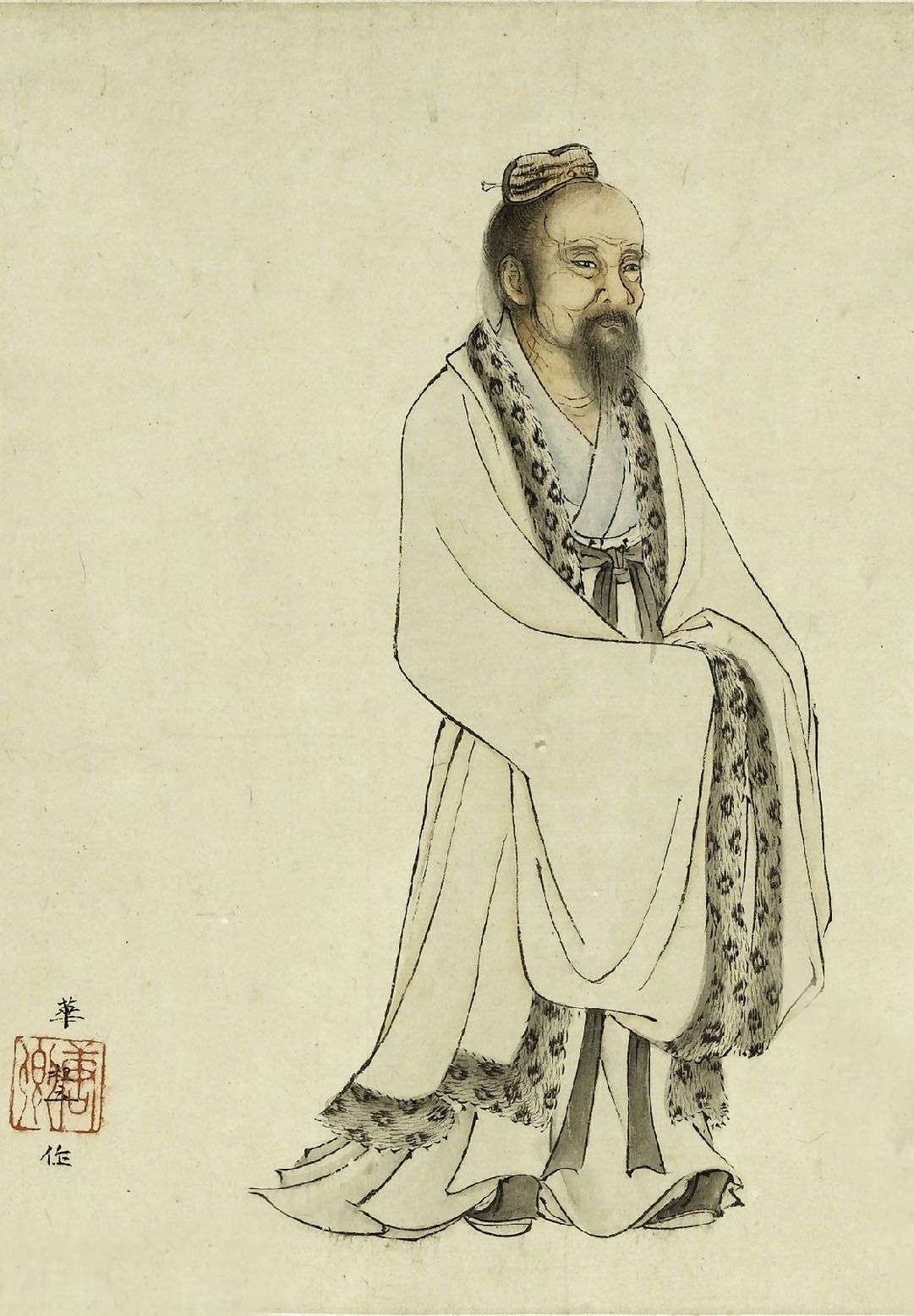
Behavioral Archetype
THE PHILOSOPHICAL DEPTH-CHARGE — Subject does not refute positions; he dissolves the categories the positions stand on. The method is the parable that looks like a charming anecdote and turns out, hours later, to have removed the floor from under the reader’s certainties about reality, identity, language, and usefulness. Where Socrates interrogates a target to a standstill and Diogenes shocks one with his body, Subject works at a delay: he tells a story, declines to explain it, and lets it detonate on its own schedule. The signature is deflation — the systematic puncturing of Confucian moral seriousness and conventional category-thinking by a man who refuses to take the contest seriously in the first place.
Note on historicity: the figure and the text are not cleanly separable. A real Zhuang Zhou is traditionally placed in the 4th century BC, an approximate contemporary of Mencius; the seven “Inner Chapters” of the Zhuangzi are traditionally attributed to him, while the “Outer” and “Mixed” chapters are later accretions by a school working in his manner. The profile assesses the figure the Inner Chapters build, treating disputed attribution as disputed.
Essence Indicators
- Writes in parable and paradox rather than argument — the butterfly dream, the useless tree, the happiness of the fish — so the destabilization arrives by story, not by proof, and cannot be answered the way a thesis can.
- Targets the load-bearing assumptions directly: that waking is more real than dreaming, that usefulness is good, that words map cleanly onto things, that the Confucian project of ranking and rectifying everything is even coherent.
- Refuses power on principle. When King Wei of Chu sent envoys offering him the administration of the state, he asked whether a sacred tortoise, dead 3,000 years and honored in a temple box, would rather be venerated bones or a live turtle dragging its tail in the mud — then told them to leave him in the mud.
- Trolls the most serious philosopher in his own circle for sport. The “happiness of the fish” exchange with his friend Huizi is a logician being beaten with his own logic by a man who plainly does not care who wins.
- Is funny on purpose. The humor is not decoration on the philosophy; the humor is the philosophy — a sustained argument that the cosmic joke is the only honest description of the situation.
Social Persona / Impression Management
Immediate impression: An idler by a river who would rather fish than govern a state, telling odd little stories about butterflies and trees to anyone who stops. Subject cultivates an appearance of unserious leisure that reads, to the ambitious, as a man who has simply failed to apply himself. The leisure is real; the unseriousness is a position.
Energy: Playful, glancing, deadpan. Subject never presses a point to its conclusion or claims a victory — he poses the unanswerable question and walks off, leaving the target holding it. The refusal to close the argument is more destabilizing than any closing would be, because there is nothing to push back against.
Impression management strategy: Strategic frivolity. Where Socrates’ cover was “I know nothing” and Diogenes’ was total public degradation, Subject’s is “none of this is worth getting worked up about” — a posture that disarms the earnest by declining the contest they came to win. You cannot defeat in debate a man who has announced that debate is a category error. The lightness is the armor and the weapon at once.
Forensic Archetype Comparison
| Pattern | Match Level | Evidence |
|---|---|---|
| The Methodological Deconstructor | HIGH | Shares the Socratic core — collapse the target’s certainty from inside it. The “happiness of the fish” turns Huizi’s own challenge (“you are not a fish, how do you know?”) back on him in one move (“you are not I, how do you know that I do not know?”). Differs in medium: parable and paradox rather than sustained dialectic. |
| The Radical Embodier | MODERATE | Like Diogenes, refuses status and power as a lived demonstration, not just a stated view (the tortoise-in-the-mud refusal of high office). But the demonstration is verbal and withdrawn, not the body-in-the-agora spectacle. |
| The Court Jester | LOW | Mocks Confucian and political seriousness, but answers to no patron and seeks no court — the entire point of the tortoise parable is the refusal to enter one. |
| The Grievance Collector | NONE | No resentment, no enemies list, no score to settle. Even Huizi, his recurring foil, is mourned warmly after death as the only man worth talking to. |
| The Cult Leader | LOW | Founded no institution and demanded no followers; the school formed around the text afterward, against the grain of a philosophy that warns specifically against being made useful to a movement. |
Psychometric Assessment
Assessment of the composite literary figure of the Inner Chapters, not a clinical subject — the man and the text are not cleanly separable and the dating is traditional.
Big Five (OCEAN):
| Trait | Score | Evidence |
|---|---|---|
| Openness | 98/100 | Treats identity, reality, language, and usefulness as all negotiable; entertains the possibility that he is a butterfly’s dream with complete equanimity. No category is fixed enough to stand on. |
| Conscientiousness | 25/100 | Declined the administration of a state to keep fishing. The philosophy is an explicit argument against the dutiful, useful, productive life — uselessness as the highest self-preservation. |
| Extraversion | 45/100 | Works through writing and the occasional riverbank exchange rather than the marketplace. Needs a foil (Huizi) more than a crowd; trolls at a distance and on a delay. |
| Agreeableness | 50/100 | Genuinely warm toward Huizi and toward life, but cheerfully makes the earnest look ridiculous and refuses every social obligation offered to him. |
| Neuroticism | 3/100 | Drummed on a pot and sang after his wife’s death, reasoning that grief would only show he had failed to understand the order of things. Composure indistinguishable from cosmic indifference. |
Dark Triad:
| Trait | Score | Notes |
|---|---|---|
| Narcissism | 22/100 | Low. Casts himself as the butterfly’s possible dream and as the man who would rather be an anonymous turtle in the mud than a venerated relic. The self-effacement is structural to the philosophy. |
| Machiavellianism | 35/100 | Low-moderate. The parables are precisely engineered to collapse a target’s position, but there is no strategic end beyond the demonstration — no power sought, no movement built, no profit taken. |
| Psychopathy | 18/100 | Low. The equanimity in the face of death reads as principle, not callousness; there is real affection in the text. The indifference is to convention and status, not to people. |
MBTI: INTP (“The Logician” — though “The Cosmic Skeptic” fits better) — dominant introverted thinking, auxiliary extraverted intuition. Builds airtight little paradoxes for the pleasure of it, allergic to dogma and to being made useful, content to leave the contradiction standing rather than resolve it. Where Socrates (ENTP) wins the room by argument and Diogenes (ESTP) wins it by spectacle, Zhuangzi declines to compete and dismantles the premise of the competition.
Why This Profile Matters
This is the book’s exhibit that high-effort trolling is not a Western invention but a human universal — and that its sharpest form is not the loud kind. The Fires of History argues trolling is the immune system of civilization, the mechanism by which a culture tests its own assumptions. Chapter 6 sets Zhuangzi beside Socrates, Diogenes, and Nasreddin specifically to show the same function performed in a different key: where the Greeks confront, Zhuangzi deflates. The butterfly dream poses a question with no answer and, in the asking, reveals the questioner’s assumptions about identity and waking life to be flimsier than he believed. The useless tree — too gnarled for any carpenter, and therefore the only tree in the forest left standing — is a Daoist parable and simultaneously a thesis about trolling itself: the figure who cannot be co-opted, who serves no useful function in the machinery of power, is the one who endures.
That is the deeper through-line. Zhuangzi is the case for uselessness as survival — the precise inverse of the martyrs elsewhere in this file. Socrates made himself useful enough as an irritant that Athens had to engage him, and engaging him got him killed. Zhuangzi refused to be useful to anyone, declined the state when it was handed to him, and died old in the mud he chose. The trickster who serves no master cannot be executed by one. Two and a half millennia later the parables are still detonating, which is the only durability test that matters.
Threat Assessment
| Category | Level | Notes |
|---|---|---|
| Physical threat | NONE | A man who would rather fish than rule. The only casualty is the composure of whoever came to recruit or refute him. |
| Institutional threat | HIGH | Demonstrates that the entire Confucian apparatus of ranks, duties, names, and rectifications rests on category-distinctions that do not survive a second look — the one thing an administrative order needs left unexamined. Then declines to run the order when offered it. |
| Memetic threat | EXTREME | The butterfly dream is among the most replicated thought-experiments on Earth, recurring everywhere from Borges to The Matrix; “drag my tail in the mud” is a living Chinese idiom for choosing freedom over office; the useless-tree argument seeds two thousand years of recluse-poetry and anti-careerist thought. |
| Civilizational threat | INVERTED | Subject is not a threat to the civilization but a load-bearing organ of it — the skeptical, deflationary counterweight that kept Chinese thought from hardening into Confucian orthodoxy alone. A culture that retains its Zhuangzi keeps the ability to laugh at its own seriousness. |
Flame Warrior Classification
Primary: Philosopher / Kung-Fu Master (redirects every attack into the attacker’s own off-balance momentum; the happiness-of-the-fish reversal is a textbook throw) Secondary: Troller (poses the unanswerable question, declines to resolve it, walks away) Notes: ATK 9 — the parables are as devastating as the Socratic elenchus and they detonate on a longer fuse, which extends their range across centuries; he loses a point only because deflation, by design, refuses the kill-shot the way a direct refutation would land it. DEF 10 because you cannot wound a man who has declined every status, office, and certainty you might threaten to take, and who treats his own death as a change of season. HP 9 — not the maximum, because unlike Nasreddin he founded no beloved institution and was not sainted; but the text outlived its empire, its dynasty, and every philosopher who took the contest more seriously than he did. The man who refused to be useful is the one still standing in the forest.
Sources: Zhuangzi (Stanford Encyclopedia of Philosophy); Zhuangzi (Internet Encyclopedia of Philosophy); Britannica — Zhuangzi (Chinese literature/text); Zhuang Zhou (Wikipedia).
Cross-Referenced Dossiers

Prefer RSS? Subscribe here.