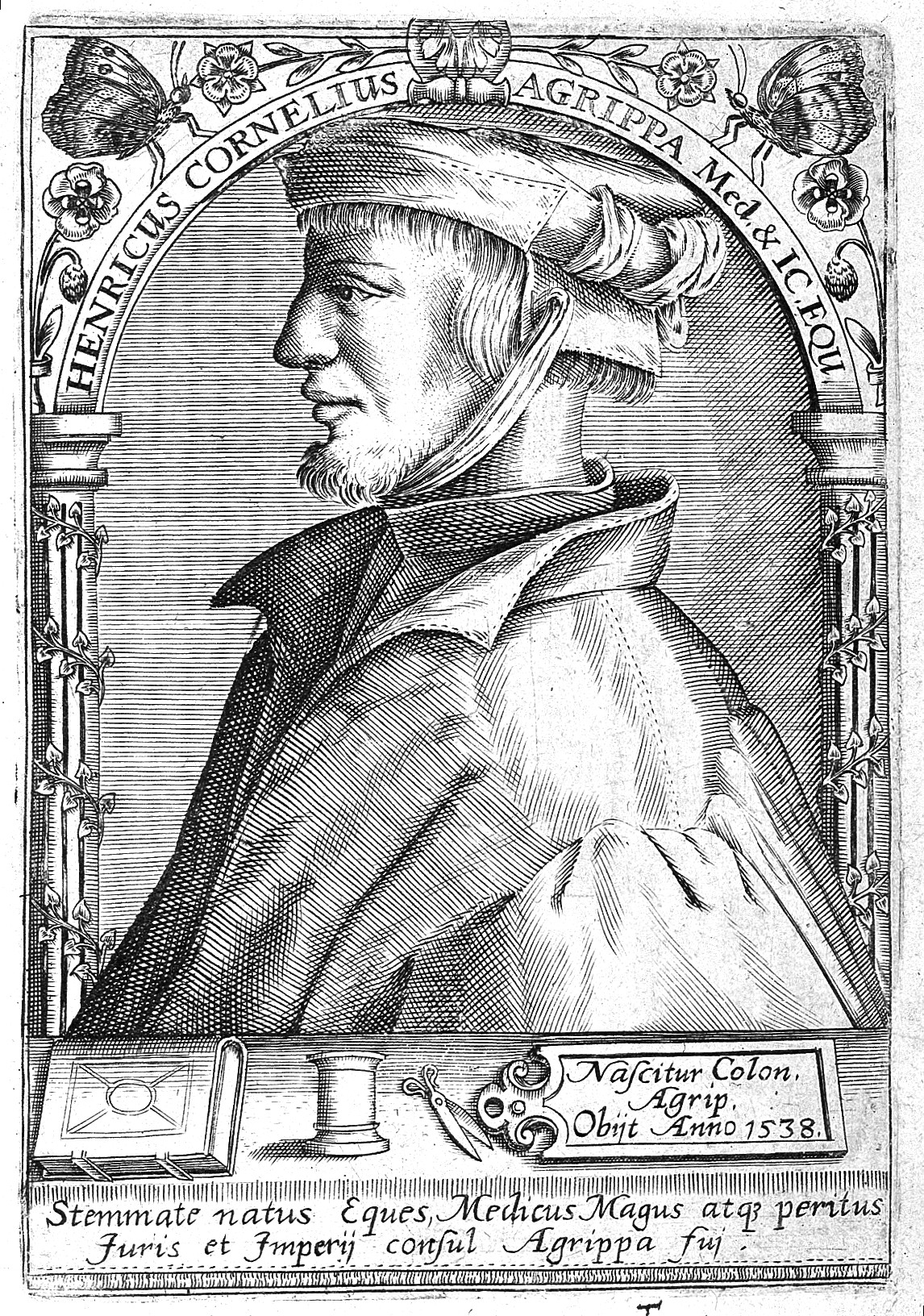
Behavioral Archetype
THE PRE-EMPTIVE RECANTER – Subject wrote the foundational compendium of Renaissance magic and, three years before publishing it, wrote a book demolishing all human learning, including magic. The magician who debunked magic. The standard reading is intellectual crisis. The coherent reading is operational: publish the recantation first, establish skepticism as a matter of public record, then publish the dangerous material under the cover of having already denounced it. When the Inquisition arrives, point to the recantation. The hedge was not confusion. It was survival.
Essence Indicators
- Born Heinrich Cornelius Agrippa von Nettesheim at Cologne, 14 September 1486; matriculated at the University of Cologne in 1499
- Authored De Occulta Philosophia Libri Tres (drafted 1510, dedicated to his teacher Trithemius; published in full 1533) – the single most comprehensive Renaissance synthesis of natural, celestial, and ceremonial magic
- Authored De Incertitudine et Vanitate Scientiarum et Artium (1530) – a sweeping skeptical attack on every field of human learning, his own occult work explicitly included
- Learned the three-tier magical architecture from Johannes Trithemius, Abbot of Sponheim – the same teacher whose Steganographia disguised cryptography as angel-summoning
- As town advocate at Metz (appointed 1518), defended a woman accused of witchcraft; secured her acquittal by attacking the inquisitor’s procedure and the hereditary-guilt logic of the charge – then was driven from the city for it
- Served as physician, soldier, legal advocate, theologian, and court secretary across the Low Countries, Italy, France, and the German lands, rarely holding any post for long
Social Persona / Impression Management
Immediate impression: The scholar who hands you the complete manual of forbidden knowledge with one hand and a signed disavowal of all knowledge with the other. Agrippa cultivated the posture of the encyclopedic systematizer while keeping a documented escape hatch in print. The contradiction was the point.
Energy: Restless, combative, perpetually in transit. Contemporary records show a man who could not stay employed – arrested briefly under Francis I for disparaging the queen-mother, exiled from Metz for winning the wrong case, chronically short of patronage. The intelligence that organized all of magic into a clean three-tier hierarchy was the same intelligence that could not organize a stable career.
Impression management strategy: STRATEGIC AMBIGUITY. Agrippa did not choose between the magus persona and the skeptic persona. He maintained both, in print, simultaneously, and let the audience – or the censor – pick the one that suited the moment. The De Vanitate recantation is the load-bearing element: a public, citable record of skepticism that made the magic book deniable. Where Paracelsus burned his bridges on arrival, Agrippa built a fireproof one before he needed it.
Forensic Archetype Comparison
| Pattern | Match Level | Evidence |
|---|---|---|
| The Hedger | EXTREME | Two contradictory books, three years apart, by design. The recantation is not a change of mind – it is insurance filed in advance. The defining move of the file. |
| The Systematizer | HIGH | De Occulta Philosophia organizes the entire Western magical inheritance into natural / celestial / ceremonial tiers. The Golden Dawn’s graded degrees three centuries later are this skeleton, reformatted. |
| The Contrarian Advocate | MODERATE-HIGH | Defended an accused witch against an inquisitor and won, then defended the dignity of women in print (De Nobilitate Feminei Sexus). Took the unpopular side and made the cost personal. |
| The Narcissistic Operator | LOW-MODERATE | The grandiosity is real – a single book claiming to contain all of magic – but it is subordinated to the survival instinct. Agrippa wanted to live more than he wanted to be right loudly. |
Psychometric Assessment
Big Five (OCEAN):
| Trait | Score | Evidence |
|---|---|---|
| Openness | 96/100 | Magic, medicine, law, theology, military service, and skeptical philosophy, pursued across half of Europe. Synthesized Hermeticism, Kabbalah, Neoplatonism, and astrology into one architecture. |
| Conscientiousness | 55/100 | Split. The magical synthesis is meticulous and internally consistent. The career is a sequence of abandoned and lost posts. Discipline in the work, chaos in the life. |
| Extraversion | 60/100 | Moderate-high. Advocate, soldier, court secretary, public disputant. Operated in courts and cities, not in monastic seclusion. |
| Agreeableness | 35/100 | Low-moderate. Picked fights with inquisitors, mocked the learned establishment in De Vanitate, and disparaged a queen-mother into a brief arrest. Combative by default. |
| Neuroticism | 55/100 | Moderate. The constant relocations and patronage failures suggest genuine instability; the late arrest and the lifelong proximity to a heresy charge supplied real and continuous threat. |
Dark Triad:
| Trait | Score | Notes |
|---|---|---|
| Narcissism | 50/100 | Moderate. Claiming to compile the totality of occult knowledge is grandiose, but the work serves transmission, not self-monument. |
| Machiavellianism | 72/100 | High – and this is the distinguishing score. The pre-emptive recantation is a genuinely strategic act, executed with foresight no other figure in this immediate cohort matched. Where Dee trusted and was exposed, Agrippa hedged and survived (mostly). |
| Psychopathy | 15/100 | Low. Documented moral commitment – the witch defense was costly and principled, not self-serving. Emotional engagement with his work and dependents is on record. |
MBTI: INTP (“The Logician”) – Dominant introverted thinking, auxiliary extraverted intuition. Builds comprehensive theoretical systems (the three-tier magic) while reserving the right to dismantle any of them under pressure (De Vanitate). The skepticism and the system-building are the same faculty pointed in opposite directions, which is exactly how a man writes both books and means both.
Why This Profile Matters
Agrippa is the cleanest historical specimen of a move that recurs through the entire occult tradition and well beyond it: encode the dangerous payload inside a frame the authorities can tolerate. His teacher Trithemius disguised cryptography as angel-summoning. The alchemists disguised chemistry as coded recipe. Agrippa’s innovation was to disguise the magic as already-debunked magic – to ship the recantation as the wrapper. It is the survival strategy of every heretic who wanted both to publish and to live, formalized into a two-book sequence. The technique outlived him: the manuscript chain runs Trithemius to Agrippa to Dee to Eliphas Levi to the Golden Dawn, and the hedge-and-publish pattern runs straight into the modern footnote that says “documenting, not endorsing.”
Threat Assessment
| Category | Level | Notes |
|---|---|---|
| Physical threat | NONE | Scholar, advocate, occasional soldier. The danger ran toward him, not from him. |
| Institutional threat | MODERATE | The witch defense embarrassed an inquisitor and won; De Vanitate indicted the entire edifice of learned authority. Both punctured institutional self-regard, neither toppled it. |
| Memetic threat | EXTREME | De Occulta Philosophia is the master-table from which four centuries of Western ceremonial magic is filled in. The three-tier hierarchy is the Golden Dawn’s blueprint and, through it, the structure of most modern occult practice. |
| Posthumous threat | ONGOING | Reprinted, denounced, and absorbed for five hundred years. The recantation strategy he pioneered is now the default rhetorical posture of anyone publishing dangerous material under a disavowal. |
Deception Analysis
Primary deception modality: STRATEGIC SELF-CONTRADICTION. Agrippa did not lie about magic; he published the magic in full. The deception operates one level up – on the relationship between his two books. The recantation invites the reader (and the censor) to believe the author has renounced what he is about to hand them. He has not. He is staging a renunciation as cover. The lie is not in either text. It is in the juxtaposition.
Authenticity assessment: DELIBERATELY UNRESOLVABLE. Modern scholarship (Nauert) reads De Vanitate as strategy rather than crisis, and the chronology supports it: you do not demolish all learning and then publish your magnum opus on magic three years later unless the demolition was always meant to be survivable. But Agrippa engineered the ambiguity so thoroughly that it cannot be closed from the outside, which is the whole point. A hedge that can be proven to be a hedge is a failed hedge. His worked.
Flame Warrior Classification
Primary: Philosopher / Tireless Secondary: Lurker (the pre-emptive recantation is the original deniability play – say it loudly, then do it quietly) Notes: ATK 8 – the magical synthesis reshaped an entire tradition, and the hedge-and-publish technique is reused to this day. DEF 5 – the highest defensive rating in the immediate Renaissance-magus cohort, earned by the recantation that kept the heresy charge at arm’s length; where Dee (DEF 4) was exposed and Paracelsus (DEF 1) was expelled on contact, Agrippa maintained a documented escape route and was never burned. HP 3 – dead at 48 after a life of brief arrests, lost posts, and perpetual relocation. The hedge protected the work and the neck. It did not buy a comfortable life.
Sources: Britannica – Heinrich Cornelius Agrippa von Nettesheim; Stanford Encyclopedia of Philosophy – Heinrich Cornelius Agrippa von Nettesheim; Nauert, Charles G. Agrippa and the Crisis of Renaissance Thought. University of Illinois Press, 1965; Wikipedia – Heinrich Cornelius Agrippa.
Cross-Referenced Dossiers
Prefer RSS? Subscribe here.