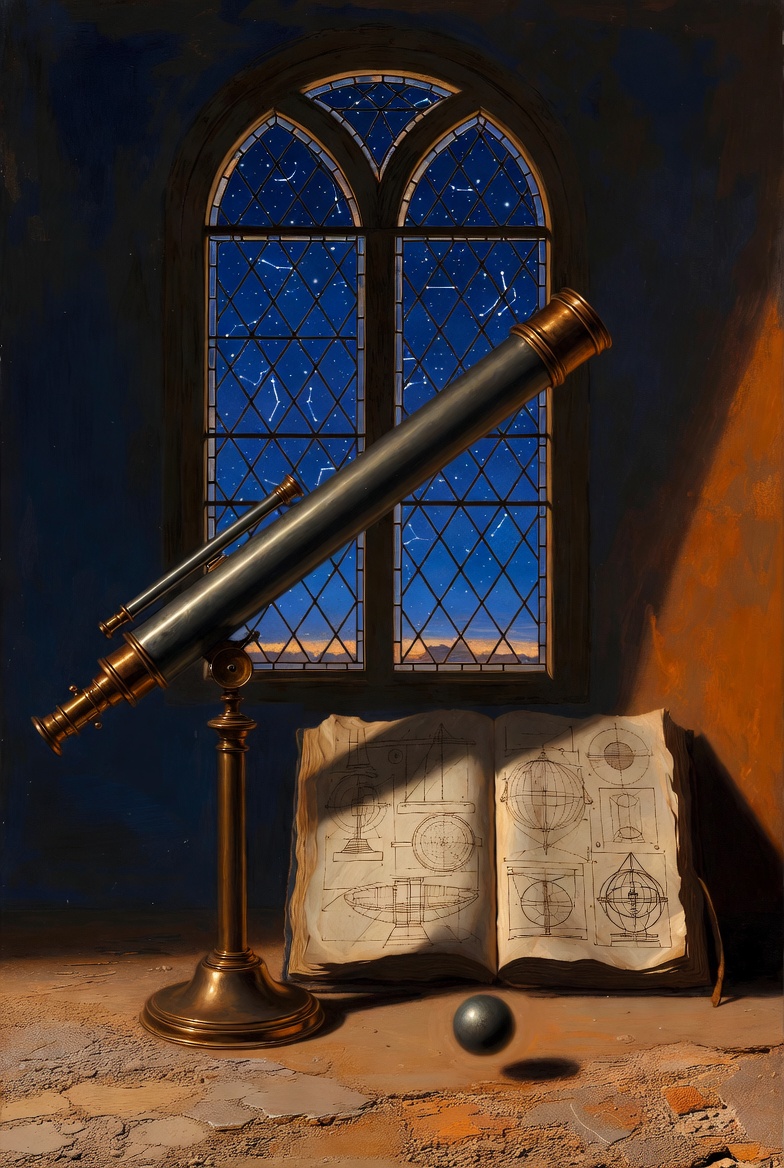
Behavioral Archetype
THE POLITE DEMOLITION EXPERT – Subject presents devastating truths in the form of civil dialogue, embedding his actual position in the mouth of the smart character while giving the institutional position to a character named one vowel away from “simpleton.” The method is diplomatic satire: technically deniable, practically devastating. Galileo did not call the Pope an idiot. He wrote a character who happened to be an idiot who happened to hold the Pope’s views.
Essence Indicators
- Projects deference to authority while systematically undermining it through evidence
- Demonstrates willingness to challenge the most powerful institution in Europe (the Catholic Church) using its own framework of rational inquiry
- Named the defender of the Church’s position “Simplicio” and expected nobody to notice (everybody noticed)
- Maintained composure under Inquisitorial pressure while harboring certainty that he was right
- Allegedly muttered “and yet it moves” after recanting – probably apocryphal, definitely true in spirit
Social Persona / Impression Management
Immediate impression: A courtier, a charmer, a man who could make astronomy interesting at dinner parties. Galileo was not the solitary genius of popular imagination – he was a skilled social operator who cultivated friendships with cardinals and popes, secured Medici patronage, and navigated the Italian political landscape with considerable sophistication. He secured Church approval to write the Dialogue before publishing it.
Energy: Intellectually electric, socially graceful, diplomatically reckless. The combination of genuine charm and inability to resist being right is the defining tension. Galileo could befriend a Pope and then write a book that humiliated him, apparently without recognizing the contradiction.
Impression management strategy: LOYAL CRITIC. Galileo positioned himself as a faithful Catholic who was trying to save the Church from the embarrassment of maintaining a demonstrably false cosmology. The strategy was sincere – he genuinely believed the Church should update its position rather than defend the indefensible. The Church disagreed about which position was indefensible.
Forensic Archetype Comparison
| Pattern | Match Level | Evidence |
|---|---|---|
| The Social Engineer | HIGH | Cultivated Medici patronage, befriended Cardinal Maffeo Barberini (later Pope Urban VIII), secured Church approval for publication. Then burned the relationship by putting the Pope’s arguments in Simplicio’s mouth. |
| The Narcissistic Operator | MODERATE | “I have discovered a truly marvelous proof” energy – Galileo was confident in his genius and not shy about demonstrating it. But the confidence was justified, which complicates the diagnosis. |
| The Impulsive Actor | HIGH | The Simplicio decision was strategically catastrophic. Galileo had a patron in the Pope. He turned that patron into an enemy by failing to resist a literary joke. The wit was faster than the judgment. |
| The Grievance Collector | MODERATE | After the trial, house arrest, and forced recantation, Galileo nursed legitimate grievances for the remaining eight years of his life. The grievances were justified. He was right. |
Psychometric Assessment
Big Five (OCEAN):
| Trait | Score | Evidence |
|---|---|---|
| Openness | 93/100 | Built his own telescope, discovered Jupiter’s moons, observed sunspots, described Saturn’s rings (as “ears”), documented the Moon’s craters. Rewrote the cosmos with instruments he built himself. |
| Conscientiousness | 80/100 | Meticulous observational records. The Dialogue is a carefully constructed work. But the Simplicio naming suggests a blind spot in strategic planning. |
| Extraversion | 78/100 | Court operator, correspondent, polemicist. Engaged publicly with Jesuit astronomers and ecclesiastical authorities. Not a recluse. |
| Agreeableness | 30/100 | Named the defender of Church doctrine “Simplicio.” Told the Aristotelians their entire cosmology was wrong. Was unfailingly polite about it, which is worse. |
| Neuroticism | 40/100 | Moderate. The trial clearly affected him – contemporary accounts describe genuine distress. But he continued working under house arrest, producing Two New Sciences. Converted confinement into productivity. |
Dark Triad:
| Trait | Score | Notes |
|---|---|---|
| Narcissism | 58/100 | Moderate-high. Galileo believed he was right and wanted everyone to know it. The Dialogue is a vehicle for demonstrating his own brilliance. But the narcissism served truth rather than ego – an important distinction. |
| Machiavellianism | 45/100 | Moderate. Skilled at court politics but ultimately outsmarted himself. The Simplicio gambit reveals a man who is better at science than at strategy. |
| Psychopathy | 8/100 | Very low. Subject demonstrated genuine distress at his persecution and concern for his work’s legacy. |
MBTI: ENTP (“The Debater”) – Dominant extraverted intuition, auxiliary introverted thinking. The pattern fits: sees the truth before anyone else, cannot resist pointing it out, structures the argument as a dialogue because the format lets him demolish the opposition systematically. The Socratic method with a telescope.
Threat Assessment
| Category | Level | Notes |
|---|---|---|
| Physical threat | NONE | Elderly, going blind, under house arrest. |
| Institutional threat | EXTREME | Proved that the Earth revolves around the Sun, contradicting Church doctrine. The Church formally dropped its opposition in 1758. Pope John Paul II acknowledged the error in 1992 – 360 years late. |
| Memetic threat | MAXIMUM | “And yet it moves” – whether he said it or not – is one of the most powerful phrases in the history of science. The defiance of institutional authority in the name of observable truth is still the template. |
| Posthumous threat | TOTAL VINDICATION | The universe does not care about your institutional authority. Galileo’s position was adopted universally within a century. The Church’s apology came 360 years later, which is fast by Vatican standards. |
Deception Analysis
Primary deception modality: LITERARY DISPLACEMENT. Subject does not state his position directly. He creates a fictional dialogue in which a brilliant character states his position and a fool states the Church’s position, then claims the dialogue is merely an impartial exploration. The impartiality was as convincing as the name “Simplicio” was subtle.
Authenticity assessment: MAXIMUM. Galileo was exactly what he appeared to be: a man who could see the truth and could not stop himself from saying it, even when saying it would destroy him. The literary device was the only concession to self-preservation. Everything else was authentic – the observations, the arguments, the defiance.
Flame Warrior Classification
Primary: Philosopher / Rebel Leader Secondary: Impostor (the literary dialogue as disguise for advocacy) Notes: ATK 10 – proved the Ptolemaic model wrong and the Church knew it. DEF 3 – the Simplicio naming was a catastrophic defensive failure. HP 6 – survived the Inquisition, house arrest, and blindness. Continued working. Died correct. The Inquisition that confined him had burned Giordano Bruno alive a generation before; the pattern – truth reached without institutional permission – runs back through al-Hallaj.
Sources: Stanford Encyclopedia of Philosophy – Galileo Galilei; Wikipedia – The Galileo Affair; Wikipedia – Dialogue Concerning the Two Chief World Systems; Mario Biagioli, Galileo, Courtier (University of Chicago Press, 1993).
Cross-Referenced Dossiers


Prefer RSS? Subscribe here.