Behavioral Archetype
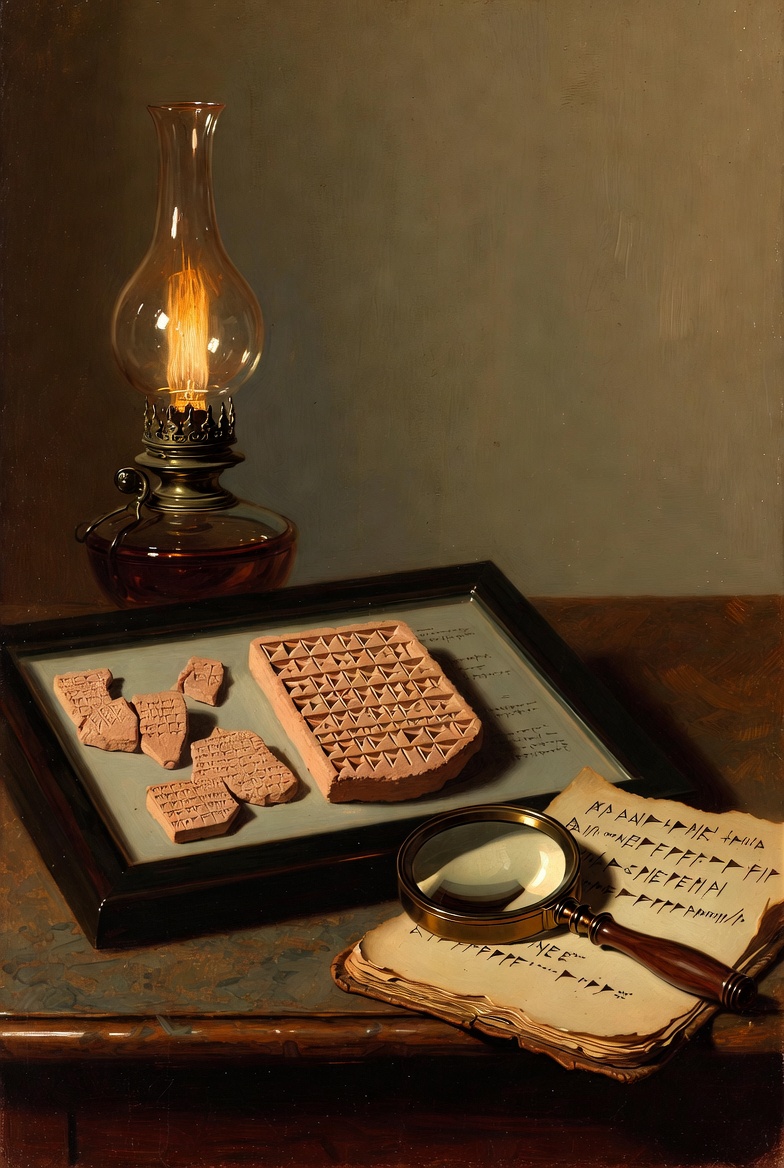
THE ACCIDENTAL REVOLUTIONARY — A working-class banknote engraver who taught himself to read cuneiform on his lunch breaks at the British Museum, was hired to sort the Nineveh fragments, and on 3 December 1872 read to the Society of Biblical Archaeology his translation of a clay tablet describing a great flood, an ark, and a bird sent out to find land. Prime Minister Gladstone was in the room. It was the eleventh tablet of the Epic of Gilgamesh, and it predated Genesis. The moment Western civilization learned its origin story was a copy.
Essence Indicators
- No formal academic training; learned Akkadian and Sumerian from museum publications during his lunch hour while apprenticed as an engraver
- Spotted by Samuel Birch and brought to the attention of Sir Henry Rawlinson; by 1861 was cleaning and sorting tablet fragments in the evenings
- Recognized the flood narrative’s significance on sight and grasped its theological weight immediately
- The Times funded his expedition to Nineveh to find the missing fragments — and he found more of them, which is statistically absurd and historically true
- Published The Chaldean Account of Genesis (1876) before dying in the field at 36; the flood account derives from the older Atrahasis/Gilgamesh tradition
Social Persona / Impression Management
Immediate impression: The shy, intense autodidact, out of place among the credentialed and visibly indifferent to that fact. The work spoke; he largely did not.
Energy: Quiet obsession. The opposite of performance — a man who would rather be reading a broken tablet than addressing a society, and who addressed the society only because the tablet demanded it.
Impression management strategy: None, which is the point. Smith made no claim his evidence did not carry. Where Hislop and Sitchin wore scholarship as costume, Smith was the scholarship and wore no costume at all. The credential he lacked on paper he possessed in full in the one place it could be tested: the clay.
Forensic Archetype Comparison
| Pattern | Match Level | Evidence |
|---|---|---|
| The Accidental Revolutionary | MAXIMUM | Sought a translation, found a civilization-rewriting fact, and reported it plainly. |
| The Genuine Scholar | MAXIMUM | Self-taught to the frontier of a field; the translations have stood for 150 years. |
| The Anti-Troll | HIGH | Not a provocateur. The clay did the provoking; he merely refused to soften it. |
| The Confident Fabricator | NONE | The exact inverse of Hislop/Sitchin — read the real cuneiform they only pretended to. |
| The Self-Promoter | NONE | Let the find carry the fame; died working, not touring. |
Psychometric Assessment
Big Five (OCEAN):
| Trait | Score | Evidence |
|---|---|---|
| Openness | 92/100 | Taught himself a dead language and an entire young science from scratch, for love of it. |
| Conscientiousness | 90/100 | Painstaking fragment-by-fragment reconstruction; the discipline of an engraver applied to clay. |
| Extraversion | 30/100 | LOW. Reluctantly public; the lecture was an interruption of the work, not its goal. |
| Agreeableness | 62/100 | MODERATE-HIGH. Generous with credit, unprotective of turf, focused on the find rather than the rivalry. |
| Neuroticism | 45/100 | MODERATE. Drove himself hard enough to die in the field at 36 chasing more tablets. |
Dark Triad:
| Trait | Score | Notes |
|---|---|---|
| Narcissism | 14/100 | VERY LOW. The discovery was the event; the man stayed behind it. |
| Machiavellianism | 10/100 | VERY LOW. No manipulation; the method is the simple, honest reading of the evidence. |
| Psychopathy | 8/100 | VERY LOW. Earnest to a fault. The opposite pole of this catalogue. |
MBTI: INTP (“The Logician”) — the self-directed pattern-solver who follows the evidence wherever it goes, including straight through his own culture’s founding story.
Why This Profile Matters (Book 2)
George Smith is the Book 2 thesis in one biography. A working-class engraver reads a clay tablet and discovers that the Bible’s flood story was borrowed from the civilization the Bible spent two millennia naming “Confusion.” Babylon — Bab-ilu, the Gate of God — gave Israel its flood, its cosmology, and the seedbed of its mystical tradition; in return it got demonized. Smith’s discovery should have ended the demonization. Instead the culture absorbed and forgot it while the conspiracy ecosystem (Hislop before him, Sitchin after) kept building on the demonized version. The scholarship exists. Almost nobody reads it. The myth persists. Everybody knows it.
Threat Assessment
| Category | Level | Notes |
|---|---|---|
| Physical threat | NONE | |
| Memetic threat | HIGH | The find itself is a permanent detonation under any claim of biblical originality — but it propagates slowly, through scholarship, against a louder myth. |
| Scholarly threat | NONE (to truth) / MAXIMUM (to the myth) | The translation is impeccable and unchallenged; the only thing it threatens is the demonized Babylon the fabricators sell. |
| Civilizational threat | NONE | The rare file in this catalogue whose hazard score is a tribute. The danger runs entirely against the liars, not the record. |
Flame Warrior Classification
Primary: Philosopher — genuine knowledge, genuine discovery. Secondary: Grenade — the Flood tablet detonates any conversation about biblical originality. Notes: ATK 10, DEF 8, HP 2. ATK 10 is the discovery itself: a single clay tablet that rewrote a civilization’s understanding of its own origin. DEF 8 because the scholarship is impeccable and has never been overturned. HP 2 because the man was mortal and died at 36 in the field. He was fragile; the discovery is indestructible — which is the whole moral of his file.
Sources: Wikipedia — George Smith (Assyriologist); Britannica — George Smith; Smithsonian Magazine — “Epic Hero”.
Cross-Referenced Dossiers
Prefer RSS? Subscribe here.