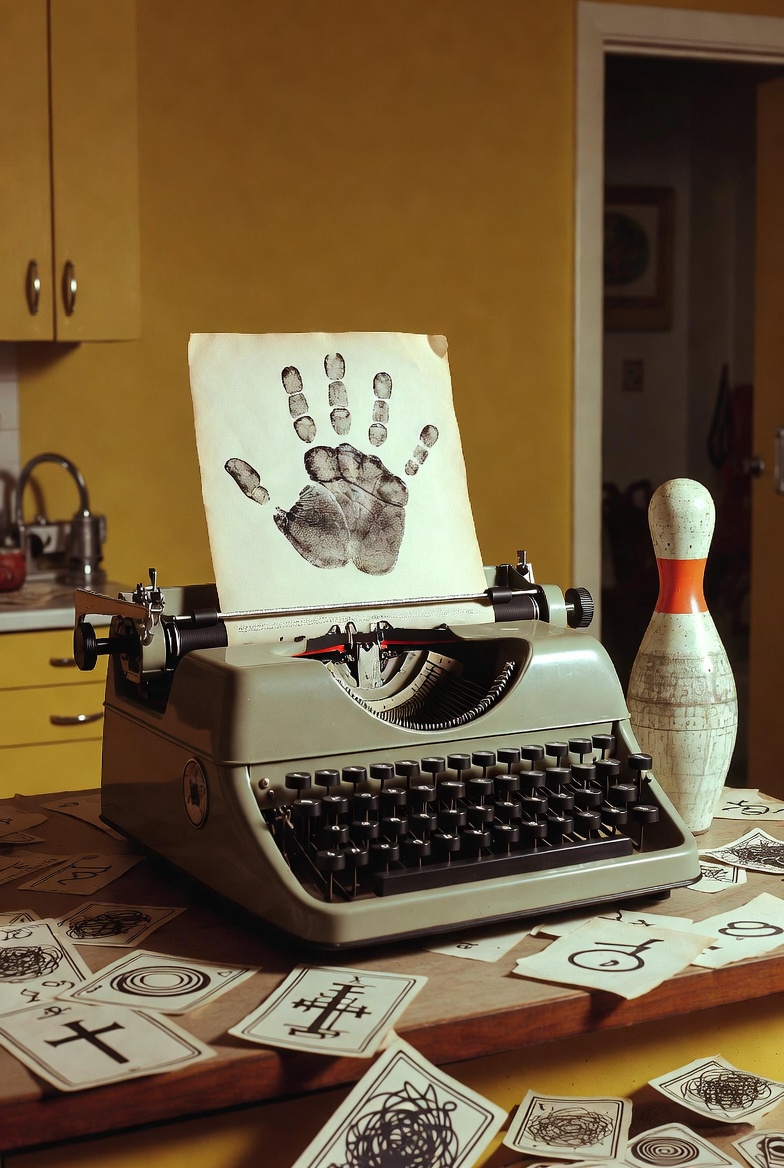
Related research: Discordianism, Chaos Magick, SubGenius, and the Satanic Temple.
Behavioral Archetype
THE JOKE THAT BECAME A RELIGION – In the late 1950s, Greg Hill (Malaclypse the Younger) and Kerry Thornley (Omar Khayyam Ravenhurst) founded Discordianism and wrote the Principia Discordia, a holy text devoted to Eris, the Greek goddess of discord and chaos. (Carole M. Cusack, “Discordianism”, World Religions and Spirituality Project (Virginia Commonwealth University), 2016) The religion was a joke. The joke was a religion. The distinction between these two statements is the entire point, and Hill spent the rest of his life refusing to resolve it. Discordianism is the proof-of-concept that a religion can be founded on the explicit admission that it is absurd, and that this admission does not make it less functional than religions that conceal their absurdity. The Principia Discordia is the only holy text that tells you, on the first page, that it might be lying. Every other holy text does the same thing without telling you.
Essence Indicators
- Projects comedic anarchism while operating one of the most sophisticated theological experiments of the twentieth century
- Demonstrates that parody and sincerity are not mutually exclusive – the Principia Discordia is simultaneously a joke, a philosophy, and a functional religious text
- Co-created the religion with Kerry Thornley at a bowling alley in 1958-1963 (accounts vary, which is on brand) (Carole M. Cusack, “Discordianism”, World Religions and Spirituality Project (Virginia Commonwealth University), 2016; KerryThornley.com, “Greg Hill aka Malaclypse the Younger” (biography page, sourced to Gorightly, The Prankster and the Conspiracy, and the Loompanics afterword))
- Published the Principia Discordia through increasingly unauthorized channels – Xerox machines, free distribution, deliberate abdication of copyright (“All Rites Reversed”) (Malaclypse the Younger (Greg Hill), Principia Discordia, 4th ed., POEE Head Temple, San Francisco, 1970 (hypertext edition, discordia.ch), colophon; G. H. Hill, “Special Afterword to the Loompanics Edition of Principia Discordia” (interview with Norton Cabal by Gypsie Skripto), San Francisco, 1979)
- Operated under the pseudonym Malaclypse the Younger, a name that combines Greek misfortune with a claim to succession from an earlier Malaclypse, who does not exist. (Malaclypse the Younger (Greg Hill), Principia Discordia, 4th ed., POEE Head Temple, San Francisco, 1970 (hypertext edition, discordia.ch), “The Five Apostles of Eris”) The pseudonym is its own joke.
- The book’s own colophon gives the edition history: five copies of “Principia Discordia or How the West Was Lost” in New Orleans in 1965, “which were mostly lost”; a second edition of 100 copies in Los Angeles in 1969; a third of 500 “whomped together in Tampa 1969”; and the fourth edition of March 1970 from POEE Head Temple, San Francisco, of which Hill later said 1,000 were printed. (Malaclypse the Younger (Greg Hill), Principia Discordia, 4th ed., POEE Head Temple, San Francisco, 1970 (hypertext edition, discordia.ch), colophon; print run of the 4th edition from Hill’s 1979 Loompanics afterword)
Social Persona / Impression Management
Immediate impression: Depends on when you met him. 1960s: Californian countercultural prankster passing out Xeroxed copies of a fake holy book. 1970s-80s: Increasingly private, amused observer of the religion he accidentally created. 1990s: Quiet, unwell, watching the internet discover Discordianism and carry it further than he ever imagined. The trajectory is from active prankster to bemused patriarch of a movement that does not acknowledge patriarchs. Born in California on 21 May 1941, Hill worked as a Western Union teletype operator in Whittier (the source of the blank telegram forms pasted into the Principia), spent most of his career as a computer programmer for Bank of America in the San Francisco Bay Area, and died of esophageal cancer in Pleasant Hill, California, on 20 July 2000, still working at his computer on a final project titled A History of Everything. (Adam Gorightly, “The Last Days of Malaclypse the Younger: This Day In Discordian History: July 20th, 2000”, Historia Discordia, 2015; birth, Western Union and Bank of America per KerryThornley.com, “Greg Hill aka Malaclypse the Younger” (biography page, sourced to Gorightly, The Prankster and the Conspiracy, and the Loompanics afterword); the teletype detail is Hill’s own, in the 1979 afterword)
Energy: Playful, elusive, fundamentally unserious about seriousness and fundamentally serious about unseriousness. Contemporary accounts describe Hill as warm, funny, and constitutionally unable to maintain a straight face during conversations about the meaning of his own work. The energy of a man who threw a stone into a pond and has spent forty years watching the ripples with genuine delight.
Impression management strategy: STRATEGIC INCOHERENCE. The Principia Discordia contradicts itself deliberately. Discordian doctrine includes both “All affirmations are true in some sense, false in some sense, meaningless in some sense, true and false in some sense, true and meaningless in some sense, false and meaningless in some sense, and true and false and meaningless in some sense” (Malaclypse the Younger (Greg Hill), Principia Discordia, 4th ed., POEE Head Temple, San Francisco, 1970 (hypertext edition, discordia.ch), “Sri Syadasti”) and “A Discordian is prohibited from believing what he reads.” (Malaclypse the Younger (Greg Hill), Principia Discordia, 4th ed., POEE Head Temple, San Francisco, 1970 (hypertext edition, discordia.ch), “The Pentabarf”, V) The strategy makes the religion impossible to pin down, which makes it impossible to attack. You cannot refute a position that has already refuted itself.
Forensic Archetype Comparison
| Pattern | Match Level | Evidence |
|---|---|---|
| The Sacred Comedian | EXTREME | Founded a religion as a joke. The joke became a religion. The religion’s central doctrine is that the joke and the religion are indistinguishable. This is either the purest comedy or the purest theology. Hill maintained that the answer was yes. |
| The Ontological Anarchist | HIGH | Discordianism’s core claim – that chaos is the fundamental state of reality and order is the imposed illusion – is anarchist metaphysics. Hill did not merely challenge political authority; he challenged the authority of coherent reality itself. |
| The Accidental Prophet | EXTREME | Hill did not intend to found a lasting religious movement. The Principia Discordia was a prank, a philosophical game, a Xeroxed artifact of 1960s California. That it became a genuine influence on chaos magick, internet culture, the Church of the SubGenius, and the Anonymous movement was not the plan. (Carole M. Cusack, “Discordianism”, World Religions and Spirituality Project (Virginia Commonwealth University), 2016) There was no plan. That is the point. |
| The Copyright Abolisher | HIGH | “All Rites Reversed” – the Principia Discordia was released into the wild with explicit permission to copy, modify, and distribute. Hill invented copyleft before copyleft existed, for religious texts. |
Psychometric Assessment
Big Five (OCEAN):
| Trait | Score | Evidence |
|---|---|---|
| Openness | 94/100 | Founded a religion based on the worship of chaos, contradiction, and hot dog buns. (Malaclypse the Younger (Greg Hill), Principia Discordia, 4th ed., POEE Head Temple, San Francisco, 1970 (hypertext edition, discordia.ch), “The Pentabarf”, IV) Incorporated Zen, surrealism, anarchism, and Greek mythology into a single incoherent-by-design theological system. The openness is structural – the religion’s architecture requires it. |
| Conscientiousness | 35/100 | Low. The Principia Discordia was produced on a Xerox machine and distributed for free. There is no organizational structure, no membership rolls, no hierarchy (the religion makes everyone a pope). (Malaclypse the Younger (Greg Hill), Principia Discordia, 4th ed., POEE Head Temple, San Francisco, 1970 (hypertext edition, discordia.ch), Pope card) Hill ran Discordianism the way you’d run a joke – casually, generously, and without a business plan. |
| Extraversion | 55/100 | Moderate. Active in countercultural circles in the 1960s-70s, social enough to distribute the Principia through personal networks. But Hill became increasingly private in later decades and did not seek publicity for himself or the movement. |
| Agreeableness | 65/100 | Moderate-high. Hill was by most accounts warm, approachable, and generous. The disagreeableness of Discordianism is directed at rigid systems, not at people. Hill liked people. He just thought their belief systems were hilarious. |
| Neuroticism | 30/100 | Low. The man who founded a religion on chaos and contradiction appears to have been remarkably stable. The theology is neurotic; the theologian was not. |
Dark Triad:
| Trait | Score | Notes |
|---|---|---|
| Narcissism | 10/100 | Negligible. Hill did not seek credit, fame, or authority. Made everyone a pope. Released the text into the wild. Used a pseudonym. The anti-narcissism is so thorough it might itself be a form of narcissism, but probably isn’t. |
| Machiavellianism | 20/100 | Low. There is no evidence of strategic manipulation. The Principia Discordia was not designed to achieve a specific outcome – it was designed to be funny and possibly true. The absence of strategy is the strategy, but Hill did not plan for that either. |
| Psychopathy | 3/100 | Effectively zero. Hill was generous, warm, and amused. The chaos worship is philosophical, not behavioral. |
MBTI: ENTP (“The Debater”) – Dominant extraverted intuition, auxiliary introverted thinking. Subject generates novel connections and contradictions at extraordinary speed (Ne) and structures them into internally consistent (if externally absurd) logical frameworks (Ti). The Principia Discordia is pure Ne-Ti: a system for systematically undermining systems, a structure for celebrating the absence of structure.
Threat Assessment
| Category | Level | Notes |
|---|---|---|
| Physical threat | NONE | Countercultural humorist with a Xerox machine. The most dangerous object Hill ever wielded was a stapler. |
| Institutional threat | MODERATE | Discordianism challenges the legitimacy of all organized religion by demonstrating that a religion founded as an explicit joke can be as functional and meaningful as one founded in earnest. This is a structural threat to religious authority, but it is delivered so gently that most institutions have never noticed. |
| Memetic threat | EXTREME | The Principia Discordia is one of the most influential underground texts of the twentieth century. Its influence runs through Robert Anton Wilson’s Illuminatus! trilogy, chaos magick (Carroll cites Discordianism) (Carole M. Cusack, “Discordianism”, World Religions and Spirituality Project (Virginia Commonwealth University), 2016 (the Principia’s own ‘On Occultism’ passage, p. 61, which chaos magick took up)), the Church of the SubGenius, Operation Mindfuck, the early internet’s culture of trolling and absurdist humor, Anonymous, and the broader principle that sacred and absurd are not opposites. Hill’s bowling-alley religion is the headwaters of internet chaos culture. |
| Posthumous threat | PERMANENT | Hill died in 2000, one year before the culture he helped create went fully online. The Principia Discordia is freely available, infinitely reproducible, and designed to propagate without institutional support. Every internet troll who posts “hail Eris” is citing Hill whether they know it or not. The joke is still telling itself. |
Deception Analysis
Primary deception modality: META-DECEPTION. The Principia Discordia tells you it is deceiving you. “A Discordian is prohibited from believing what he reads.” The deception is transparent, which makes it either the most honest deception or the most deceptive honesty. Hill’s method is to short-circuit the deception-detection apparatus by pre-emptively admitting the deception. You cannot catch a liar who has already confessed. You cannot debunk a religion that has already debunked itself.
Authenticity assessment: PARADOX. Was Hill sincere? The question is the doctrine. Discordianism’s position is that sincerity and insincerity are both faces of the same coin, and that the coin is fake, and that fake coins spend as well as real ones. Hill appears to have genuinely loved the project, genuinely found it funny, and genuinely believed that the funny parts were the true parts. (G. H. Hill, “Special Afterword to the Loompanics Edition of Principia Discordia” (interview with Norton Cabal by Gypsie Skripto), San Francisco, 1979) The authenticity is total, but it is an authenticity that includes its own negation. Hill meant every word, including the ones that contradict the other ones. Hill stated the experiment’s design himself in 1979: “So I set out to do what my society told me is impossible–make a real religion from a patently absurd deity. In the 50’s a female deity was blasphemy. In the 70’s a humorous deity is still considered impossible, ridiculous, and blasphemous. As far as I’m concerned, I have proven my point.” (G. H. Hill, “Special Afterword to the Loompanics Edition of Principia Discordia” (interview with Norton Cabal by Gypsie Skripto), San Francisco, 1979) To Margot Adler, for Drawing Down the Moon, Hill described the drift from parody to practice: “In the beginning I saw myself as a cosmic clown. I characterized myself as Malaclypse the Younger. But if you do this type of thing well enough, it starts to work. In due time the polarities between atheism and theism become absurd.” (Margot Adler, Drawing Down the Moon (Viking, 1979; 2nd ed. Beacon Press, 1986), p. 335, as quoted in Cusack, WRSP 2016; publisher page for the book)
Flame Warrior Classification
Primary: Evil Clown / Philosopher Secondary: Troll (the original, mythological kind – the creature under the bridge that asks riddles) Notes: ATK 6 – the Principia Discordia does not attack directly. It asks questions that make the target’s position untenable. The attack is Socratic – it forces you to defend propositions you never examined. DEF 9 – the highest defensive rating in this file. You cannot attack Discordianism because it has already attacked itself. Every criticism you level is a doctrine the religion already contains. “Discordianism is absurd.” Yes, that’s the point. “Discordianism is not a real religion.” Define real. “The Principia Discordia contradicts itself.” Thank you, we worked hard on that. The defense is perfect because the position is unfalsifiable by design. HP 0 – deceased, 2000. The pope is dead. Long live all the other popes. There are currently seven billion of them.
Sources: Wikipedia — Malaclypse the Younger (Gregory Hill); Wikipedia — Principia Discordia; Principia Discordia (full text); Carole M. Cusack, “Discordianism”, World Religions and Spirituality Project (Virginia Commonwealth University), 2016; KerryThornley.com, “Greg Hill aka Malaclypse the Younger” (biography page, sourced to Gorightly, The Prankster and the Conspiracy, and the Loompanics afterword); Malaclypse the Younger (Greg Hill), Principia Discordia, 4th ed., POEE Head Temple, San Francisco, 1970 (hypertext edition, discordia.ch), colophon; G. H. Hill, “Special Afterword to the Loompanics Edition of Principia Discordia” (interview with Norton Cabal by Gypsie Skripto), San Francisco, 1979; Adam Gorightly, “The Last Days of Malaclypse the Younger: This Day In Discordian History: July 20th, 2000”, Historia Discordia, 2015; publisher page for the book.
Cross-Referenced Dossiers

Prefer RSS? Subscribe here.