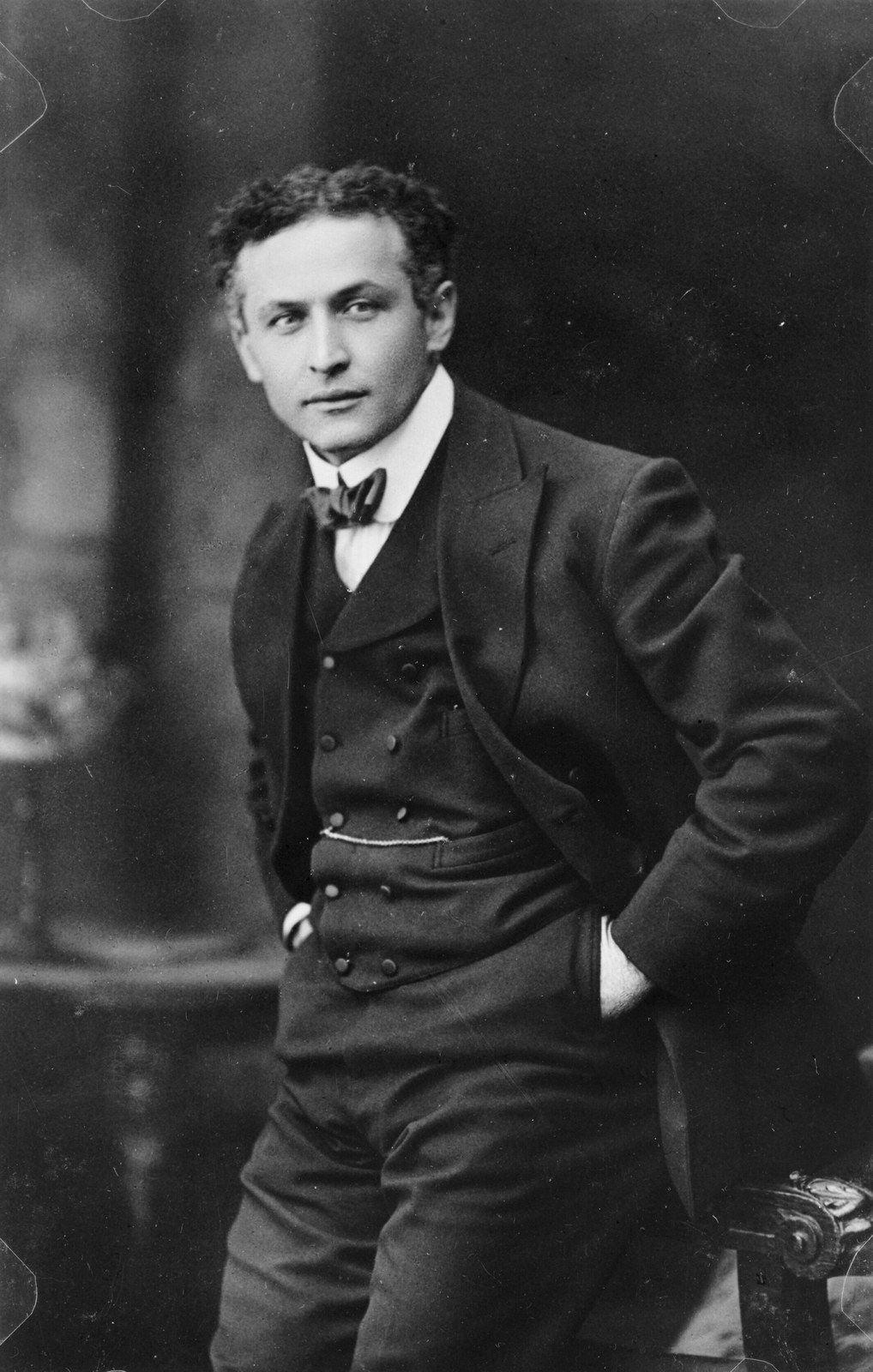
Behavioral Archetype
THE FOUNDING DEBUNKER – Houdini is the origin point of a lineage: the professional deceiver who turns the craft against professional deceivers who claim their tricks are real. For the last six years of his life he ran a public campaign against fraudulent spiritualist mediums, attending séances in disguise, replicating their “phenomena” by ordinary means on stage, and publishing the methods. His logic was the whole thesis in one line – because he knew deception professionally, he could catch it where scientists could not, and so an investigating committee needed a conjuror in the room. Everything James Randi later did – the box, the props, the controls, the receipt – was Houdini’s move, half a century early.
Essence Indicators
- Hungarian-American escape artist and stage magician (1874–1926), the era’s most famous performer, who spent roughly 1920–1926 crusading against fraudulent mediums and collected the campaign in A Magician Among the Spirits (1924).
- Sat on the Scientific American committee that offered US$2,500 to any medium who could produce a genuine manifestation under controlled test conditions. No one ever won it.
- Exposed Boston medium Mina “Margery” Crandon by building a wooden restraint cabinet – the “Margie box” – and demonstrating how her effects were produced by an unrestrained foot; published the takedown at his own expense as “Margery” the Medium Exposed (1924).
- Testified across four days before a House subcommittee in 1926 in support of a bill to ban fortune-telling for money in Washington, demonstrating mediums' tricks on the floor and daring any psychic present to read a sealed message.
- Feuded with Sir Arthur Conan Doyle – creator of the arch-rationalist Sherlock Holmes and, in life, a true-believing spiritualist – until the friendship collapsed over a séance purporting to channel Houdini’s dead mother.
Social Persona / Impression Management
Immediate impression: A showman in total command of a room – the same audience-control he used to sell an impossible escape, redeployed to run an investigation. He did not debate mediums; he staged them.
Energy: Relentless and combative. The crusade had the intensity of a vendetta and the discipline of a production, with disguises, planted observers, and prepared exposures.
Impression management strategy: THE HONEST LIAR, WEAPONIZED. Houdini announced that he was a professional deceiver and used that standing as authority: only a man who makes his living faking the impossible can reliably tell you when someone else is faking it. The pose was not deniability but credential – the fraud-catcher who is fluent in fraud.
Forensic Archetype Comparison
| Pattern | Match Level | Evidence |
|---|---|---|
| The Debunker | EXTREME | Built the entire method – replicate the effect, engineer the controls, publish the receipt – that defines the archetype. |
| The Public Shamer | HIGH | The Margery pamphlet and the congressional stunt were designed to humiliate frauds in front of the largest available audience. |
| The Culture Jammer | HIGH | Turned a spiritualism boom into a running national demonstration that a confident operator can make a room certify the impossible. |
| The Grievance Collector | MODERATE | The Doyle feud became personal and public; Houdini did not let the channeled-mother séance go. |
| The Cruel Troll | NONE | The target was the paying fraud, never the bereaved mark; he expressed open sympathy for the grieving. |
Psychometric Assessment
Big Five (OCEAN):
| Trait | Score | Evidence |
|---|---|---|
| Openness | 80/100 | Endlessly inventive across escape, illusion, and investigative method – the Margie box was engineered like an escape in reverse. |
| Conscientiousness | 85/100 | Meticulous staging, disguised reconnaissance, self-funded publication – the campaign was run like a career, because it was. |
| Extraversion | 88/100 | Built his whole life around commanding an audience and took the fraud fight to the most public venues available. |
| Agreeableness | 35/100 | Combative and unsparing toward frauds; burned a genuine friendship rather than concede the point to Doyle. |
| Neuroticism | 45/100 | Driven, thin-skinned about the paranormal, and increasingly consumed by the crusade in his final years. |
Dark Triad:
| Trait | Score | Notes |
|---|---|---|
| Narcissism | 60/100 | Elevated. A lifelong self-promoter who cast himself as the lone honest man exposing an industry of liars – a posture that was largely earned. |
| Machiavellianism | 65/100 | High-competence manipulation of attention and staging, aimed at exposure rather than gain; he understood exactly how belief is manufactured because he manufactured it professionally. |
| Psychopathy | 20/100 | Low. The care taken to spare the grieving and target the profiteer is the defining restraint. |
MBTI: ESTP (“The Entrepreneur”) – the pragmatic performer who learns by doing, reads a room in real time, and acts on the physical evidence in front of him. Where Joey Skaggs is the ENFP idealist staging the reveal as pedagogy, Houdini is the operator who builds the box, runs the test, and shows you the foot.
Why This Profile Matters
Houdini is the founder of the debunker-troll lineage the corpus traces – the professional deceiver who turns the craft against professional deceivers, and proves on a stage what the books otherwise argue on the page: that a confident operator can make a room of intelligent adults, scientists included, certify something false. His innovation was to answer that not with argument but with method – build the restraint, prepare the props, control the conditions, and let the fraud expose itself. That is the exact move James Randi would inherit and run for the next fifty years, from Project Alpha to the Popoff scanner. Every later magician-debunker is working in Houdini’s line. And unlike most of this file’s provocateurs, his target was chosen with a conscience: the paying fraud, never the grieving mark. He is trolling in the sense the books defend – deception aimed at the credulous and the con, in service of exposing a lie.
Threat Assessment
| Category | Level | Notes |
|---|---|---|
| Physical threat | NONE | The danger was entirely reputational – to frauds. |
| Institutional threat | HIGH | Made a scientific committee’s credulity a national story and dragged the spiritualism industry before Congress. |
| Individual threat | MODERATE | Aimed squarely at named, profiting mediums (Crandon) and a named believer (Doyle); private grievers were deliberately spared. |
| Memetic threat | HIGH | Established the template – “the professional deceiver is the profession’s best fraud-catcher” – that still governs how paranormal claims are tested a century on. |
Flame Warrior Classification
Primary: Philosopher (the high-effort operator who wins by method and demonstration, not by volume) Secondary: Evil Clown (the exposure staged as spectacle – the sealed telegram, the Margie box, the trick performed to shame its owner) Notes: ATK 8 – national reach; a single performer who put the séance industry on the front page and in the Congressional Record, though his weapon was demonstration rather than the reputation-rewriting broadcast of a Aristophanes. DEF 7 – well armored by his own authority (you cannot easily discredit the world’s most famous deceiver on the subject of deception) and by choosing frauds as targets, but not invulnerable: Doyle and the believers never conceded, and the fortune-telling bill died in committee. HP 8 – the crusade outlived the man by a century; he shaped how the paranormal is tested to this day, and the legend of Houdini endures far beyond the mediums he unmasked. The premature death (peritonitis, October 31, 1926) is the only reason it is not higher.
Sources: PBS American Experience – Houdini and Conan Doyle; PBS American Experience – The “Margery” pamphlet; Mina Crandon (Wikipedia); The Collector – Arthur Conan Doyle vs. Harry Houdini; Smithsonian Magazine – “For Harry Houdini, Séances and Spiritualism Were Just an Illusion”; Atlas Obscura – “In 1926, Houdini Spent 4 Days Shaming Congress for Being in Thrall to Fortune-Tellers”
Cross-Referenced Dossiers
Prefer RSS? Subscribe here.