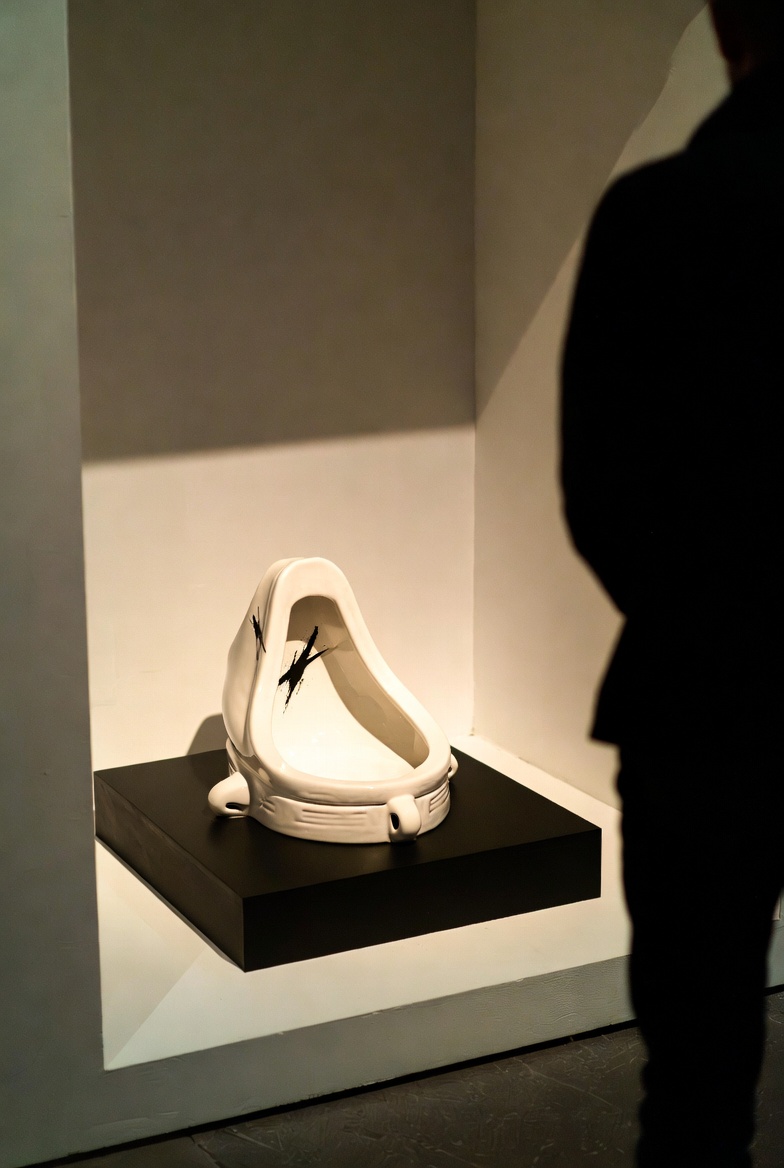
Behavioral Archetype
THE SYSTEMS HACKER — Subject does not attack individual targets but attacks the systems that define what counts as a valid target. Duchamp did not submit a urinal to an art show to insult the art show. He submitted it to demonstrate that the art show’s definition of art could not withstand a single contrary example. The target was not the exhibition; the target was the concept of “exhibition.”
Essence Indicators
- Projects amused detachment — the energy of someone who has already figured out the answer and is waiting for everyone else to catch up
- Demonstrates systematic interest in boundaries and their vulnerability (art/not-art, original/copy, finished/unfinished)
- Maintains remarkable patience — willing to wait decades for effects to manifest (Etant donnes, worked on secretly 1946-1966, revealed 1969)
- Shows unusual comfort with ambiguity and contradiction — did not defend or explain his work, allowing interpretation to become part of the art
- Operated with minimal output for maximum impact: a few dozen works reshaped a century of art
Social Persona / Impression Management
Immediate impression: Elegant, quiet, slightly amused. Contemporary accounts describe a man who was unfailingly polite, socially graceful, and appeared to find the entire art world gently hilarious. The impression is of someone who is in on a joke that nobody else has heard yet.
Energy: Cool, precise, economical. Where Kaufman creates chaos, Duchamp creates clarity — the terrible clarity of a question nobody can answer. The energy is that of a chess player (Duchamp was a serious competitive chess player) who sees twelve moves ahead and is politely waiting for you to make your next one.
Impression management strategy: ELEGANT WITHDRAWAL. Duchamp famously “stopped making art” in 1923 to focus on chess. This was itself an artistic act — the most influential artist of the twentieth century announcing he was bored and walking away. The withdrawal was the ultimate statement of dominance: I don’t need to keep making art because the questions I raised in 1917 still haven’t been answered. (Also, he was secretly working on Etant donnes for twenty years. The withdrawal was a lie. The lie was the art.)
Forensic Archetype Comparison
| Pattern | Match Level | Evidence |
|---|---|---|
| The Calculated Predator | HIGH | Fountain was not impulsive. Subject was on the board of the exhibition that rejected it. He knew the Society’s rules. He knew the submission would create a contradiction. The trap was set months in advance. |
| The Chameleon | MODERATE | Subject moved between art world (painter, sculptor, conceptualist), chess world (competitive tournament player), and social world (charming dinner guest) with apparent ease. |
| The Authority Seeker | LOW | Subject systematically refused authority. Declined to explain his work. Declined to make more work. Declined to play the role of Great Artist. The refusal was the assertion. |
| The Social Engineer | MODERATE-HIGH | The entire readymade project is social engineering — manipulating the art world’s classification systems by introducing objects that break the rules. |
Psychometric Assessment
Big Five (OCEAN):
| Trait | Score | Evidence |
|---|---|---|
| Openness | 96/100 | Produced work across painting, sculpture, readymades, kinetic art, optical illusions, installation, and chess. Invented an entire artistic category (the readymade) and then abandoned it. |
| Conscientiousness | 78/100 | High when engaged (the precision of the Large Glass, the 20-year secret work on Etant donnes). But the output volume is deliberately minimal — quality and conceptual impact over quantity. |
| Extraversion | 50/100 | Moderate. Comfortable in social settings but did not seek the spotlight. Preferred to let the work create the conversation rather than creating it himself. |
| Agreeableness | 55/100 | Surprisingly high for a provocateur. Duchamp was by all accounts personally charming and well-liked. The provocations were directed at systems, not people. He got along with everyone while undermining everything they believed about art. |
| Neuroticism | 12/100 | Extremely low. Subject appeared constitutionally incapable of anxiety. The serenity was either genuine or the most convincing performance in this file. Given the 20-year secret project, some capacity for concealment is documented. |
Dark Triad:
| Trait | Score | Notes |
|---|---|---|
| Narcissism | 40/100 | Moderate. Subject clearly believed his work was important but expressed this through restraint rather than display. The narcissism of walking away from art — “I’ve said everything I need to say” — is a quieter but potentially deeper form than Crowley’s or Voltaire’s. |
| Machiavellianism | 72/100 | High. The readymade strategy is pure Machiavellian calculation: identify the system’s weakness, exploit it with minimal effort, let the system’s own defenders amplify the damage through their response. |
| Psychopathy | 8/100 | Very low. Subject showed no callousness toward individuals. The provocations targeted institutions and concepts, not people. Personally warm and generous by all accounts. |
MBTI: INTP (“The Logician”) — Dominant introverted thinking, auxiliary extraverted intuition. Subject analyzes systems, identifies logical vulnerabilities, and constructs minimal interventions that expose them. The chess connection is structural — both chess and Duchamp’s art are about seeing the board that other people don’t see.
Threat Assessment
| Category | Level | Notes |
|---|---|---|
| Physical threat | NONE | Elegant Frenchman who played chess. |
| Institutional threat | MAXIMUM | Broke the definition of art in 1917. The definition has not been repaired. Every “But is it art?” argument since Fountain is evidence that the damage is permanent and ongoing. |
| Memetic threat | EXTREME | The readymade concept — that context determines meaning, that anything can be art if framed as art — is now the foundational assumption of contemporary art. The entire field operates inside Duchamp’s thought experiment. |
| Posthumous threat | STILL REVEALING | Etant donnes was revealed a year after his death. Subject was producing provocations from beyond the grave. The piece is still generating interpretive controversy 57 years later. |
Deception Analysis
Primary deception modality: STRATEGIC WITHDRAWAL. Subject’s most effective deception was not a positive act but an absence — the pretense of having “quit art” while secretly working on a major installation for twenty years. The art world mourned his departure. He was in his studio. The withdrawal was the longest-running deception in modern art history, and its revelation (posthumous) was the final artistic act: even death was a setup for the reveal.
Authenticity assessment: IRRELEVANT. Duchamp rendered the authenticity question moot as an artistic project. Is a signed urinal “authentic” art? Is abandoning art “authentic” retirement? Is a secret 20-year installation “authentic” withdrawal? The questions are the answers. Duchamp’s authentic self is the person who made authenticity undecidable.
Flame Warrior Classification
Primary: Enfant Provocateur / Philosopher Secondary: None needed. Notes: ATK 10 — the highest possible, because the question “But is it art?” has been running for 108 years and every time someone asks it, Duchamp wins again. DEF 8 — high, because the personal charm deflected attacks that would have destroyed a less likable operator. HP 9 — the secret 20-year project means the HP was still regenerating when everyone thought the character was retired.
Sources: Encyclopaedia Britannica; Tate; MoMA; Wikipedia.
Cross-Referenced Dossiers
Prefer RSS? Subscribe here.